
Greece recorded a primary surplus of 4.9% of GDP in 2025, the highest in the EU. According to an analysis by the Institute for Alternative Policies ONE, improvement is mainly due to inflation that increased tax revenues by 1.5 units of GDP, while primary expenditure increased only 0.4 units. Civil servants' wages and social benefits decreased as a percentage of GDP, as nominal increases fall short of inflation. Despite the financial aid measures announced by Minister Kyriakos Pierrakakis, the shock of accuracy continues to burden economically weaker households disproportionately.
Analyticalally:
The primary surplus for 2025 was announced in celebrations. «Climb» 4.9%The government seized the opportunity by announcing «a package of economic aid measures for society» But they are judged below circumstances to face the shock of the accuracy that still remains «He's choking.» households.
Inflation has a decisive impact on the relationship between public revenue and expenditure, operating in a way that, while burdening citizens, significantly strengthens public funds and improves financial indicators
«This surplus is of particular importance because it is not a coincidence. It does not come from overtaxation of citizens, nor from any temporary retention of expenditure. It is the result of a profound structural change in the way the economy operates», argued Minister of National Economy and Finance Kyriakos Pierrakakis.
High primary surpluses are not just a number, but a structural element of budgetary policy.
The primary surplus has increased by 1.1 GDP points over the last 6 years
According to Eurostat official data, Greece recorded a total surplus of 1.7% of GDP, a primary surplus of 4.9% of GDP and public debt of 146.1% of GDP. Our country has the highest primary surplus among EU Member States (average -1.2% GDP) but also the highest debt in the EU (average 81.7% GDP).
Greece managed to achieve a high primary surplus in the period of the memorials and continues, not only to maintain it, but also to increase it.
The Institute for Alternative Policies ONE analyses the macroeconomic indicators and the sizes of the Greek economy, initially presenting the general picture of public revenue, primary expenditure and the primary outcome in 2019 and 2025.
Over the last six years the primary surplus has increased by 1.1 points of GDP and this increase is mainly derived from the increase in public revenue by 1.5 points as primary expenditure has only increased by 0.4 points. «Therefore, the improvement in the primary result is due to a significantly faster increase in public revenue compared to expenditure.», reports the Institute.
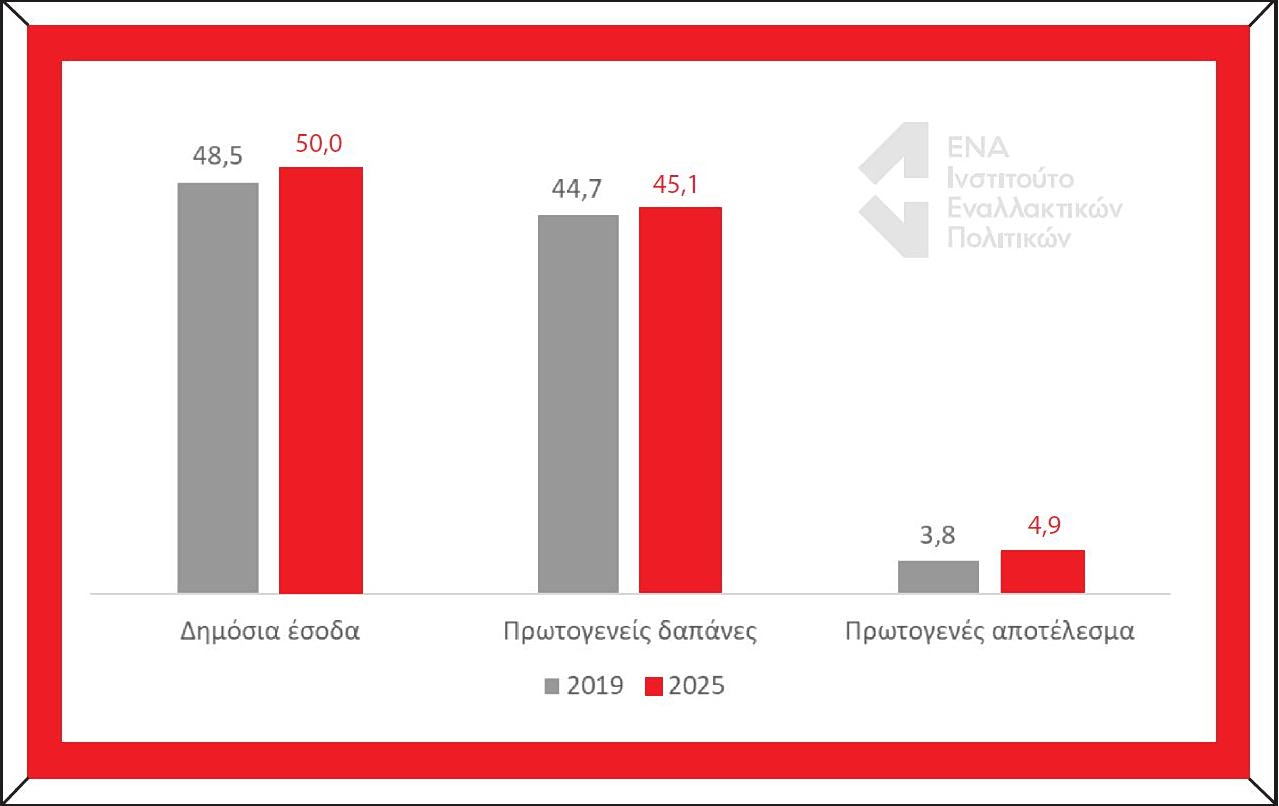
The individual elements of public revenue and primary expenditure are of great interest.
Increase in VAT revenue, income and property tax
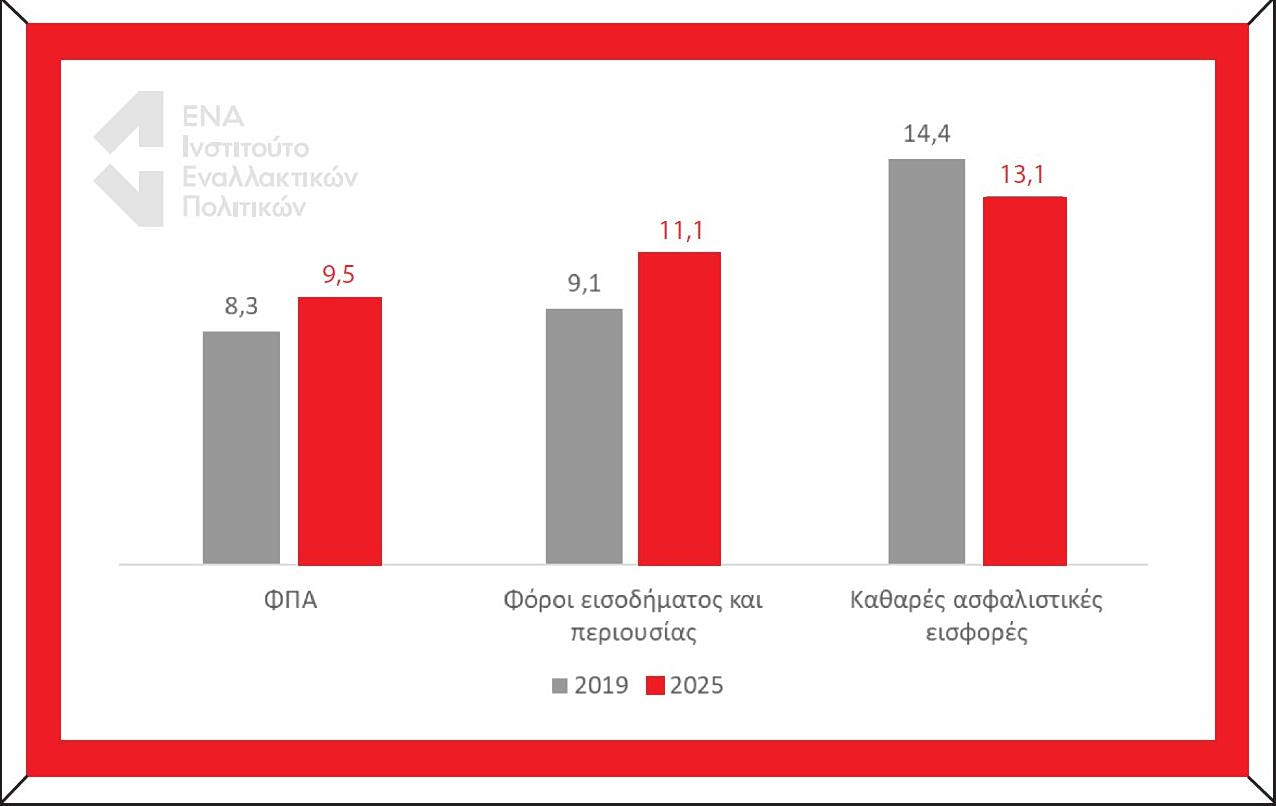
According to the HSY analysis VAT revenues have increased by 1.2 units of GDP (EUR 8.1 billion in nominal terms) and income from income and property taxes by 2 units of GDP (€106 billion in nominal terms). On the contrary, insurance contributions have decreased by 1.3 units of GDP (but have increased in nominal terms by EUR 5.8 billion).
«This is a remarkable change in the composition of public revenue, with the increase in tax revenue exceeding the reduction in income from insurance contributions», according to the Institute.
Increase in public investment, decrease in remuneration for civil servants
Another aspect of the analysis is the cost side, namely public investment, civil servants' pay and social benefits.
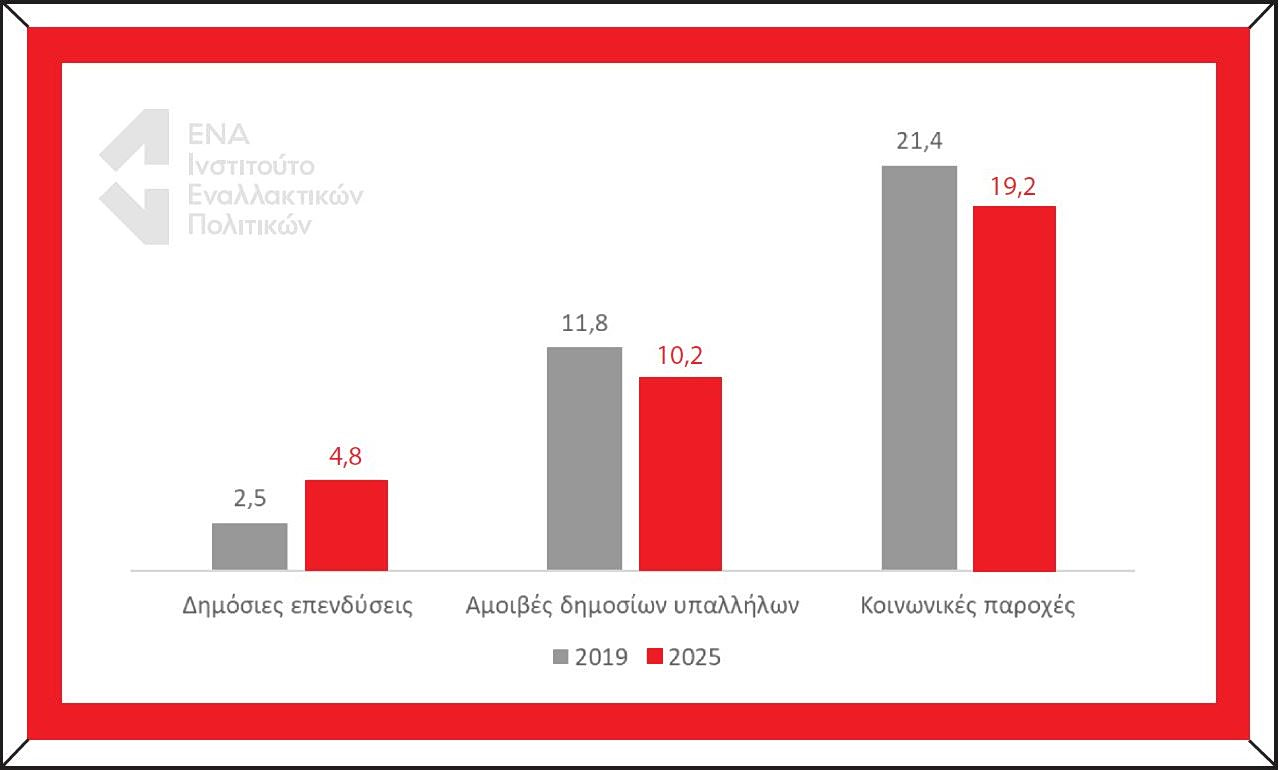
As in the case of public revenue, there is a change in composition in primary expenditure. Public investment has increased by 2.3 units of GDP (7.3 billion euros in nominal terms) public servants' wages have decreased by 1.6 units of GDP (EUR 3.31 billion in nominal terms) and social benefits have decreased by 2.2 units of GDP (EUR 8 billion in nominal terms).
«In other words, 2019-2025 the remuneration of civil servants and, above all, social benefits did not follow the increase in nominal GDP in our country.», notes ONE.
Public debt
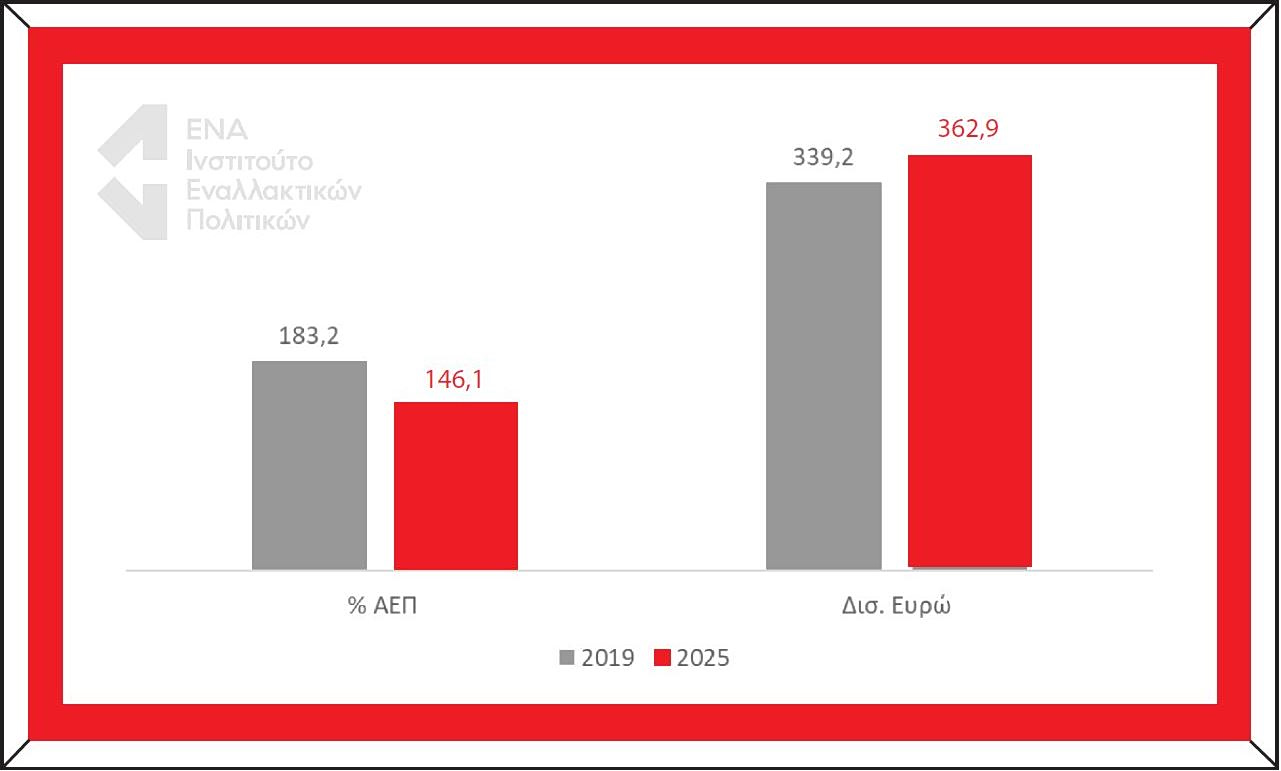
Meanwhile, public debt has recorded an impressive 37.1 reduction in GDP. However, this reduction is not due to the debt reduction, which appears to have increased by EUR 23.7 billion, but to nominal GDP growth, mainly because of inflation.
In conclusion, «Inflation in recent years, which disproportionately burdenes the economically weaker social strata, has significantly improved the image of the Greek state's public finances. This is evident in the development of debt/GDP ratio, but also in the primary surplus».
In particular, «While tax revenue is clearly rising from inflation, i.e. rising prices and nominal incomes, primary expenditure seems to be more modest. This is particularly evident in public wages and especially in social benefits (such as pensions), whose nominal increases fall short of inflation, resulting in a decrease in GDP».
Intense Concern
While surpluses offer stability, their impact on the economy is the subject of intense debate. «As inflation in recent years is not socially neutral and acts as a mechanism of considerable redistribution at the expense of the economically weaker, the role of a strong, effective and socially fair social protection system becomes increasingly important and necessary, through a coordinated strategy of social expenditure and social investment (education, health, culture, human capital etc.» The Institute concludes its analysis.
In society, super-surpluses create a sense of injustice. Citizens see the budgetary targets achieved, while their everyday life (accuracy, hospital quality, public transport) is deteriorating.
All this while the development targets for 2026 are being revised from 2.4% to 2%, while inflation is increasing temporarily due to international developments and the effects of war on energy and supply chains.

