
The tax burden It has significant differences across Europe, as the level of income is the determining factor. Some countries apply uniform rates of taxation, while others use progressive systems, which means that those with higher incomes pay a higher share.
As for Greece, despite the increases in wages for which the government boasts, it is in the case that workers have poor incomes and pay for it. «Clutters» taxes.
Generally speaking, whether a person is single or lives in a couple, whether he has one or two incomes, and whether he has dependent children, all this affects clean wages.
So let us assume that someone earns 100,000 euros annually mixed. He's single and has no children. How much would he finally get in hand? How would net wages be shaped in different European countries?
Estimates
The calculation is difficult as it depends on various variables. The tax systems themselves differ, with some countries having a simple approach, while others are more complex.
The Euronews Business calculate net income for a gross salary of EUR 100,000 based on the report «Tax Wedge 2026» OECD, OECD country archives, OECD countries «Worldwide Tax Summaries» PwC and national sources.
The tax rates used relate to 2025. Non-euro area currencies were converted on the basis of the ECB reference values on 31 December 2025.
Bulgaria tops ranking
Between 31 countries (EU Member States, as well as the United Kingdom, Switzerland, Norway and Turkey), the net salary for gross annual income of EUR 100,000 ranges from EUR 50,750 in Belgium to EUR 86,930 in Bulgaria.
Bulgaria is the only country where the net annual salary exceeds 85,000 euros. The following is Estonia with 74,400 euros. The Czech Republic (EUR 72,800), Malta (EUR 72,500), Switzerland (EUR 70,500) and Cyprus (EUR 70,300) are countries where workers hold at least EUR 70,000 from a gross salary of EUR 100,000.
UK offers highest net income among major economies
In the United Kingdom, workers hold almost 70% of their gross wages at this level of income.
The net income is 69,900 euros, the highest among Europe's five largest economies. Spain (64,200) and France (63,000) are in the middle, while Germany (57,900) and Italy (56,700) offer the lowest net income between the five major economies in Europe.
In the countries with the lowest net income Greece
At the lower end of the scale, Belgium (EUR 50,750) occupies the last position, followed by two Nordic countries, Denmark (EUR 51,500) and Sweden (EUR 52,000).
Austria (EUR 54,200), Slovenia (EUR 55.060) and Greece (EUR 56,615) are also among countries where a gross salary of EUR 100,000 corresponds to one of the lowest net wages in Europe.
Portugal (EUR 57,000) and Romania (EUR 58,500) are also under EUR 60,000 net.
Poland (60,225 euros), the Netherlands (60,500 euros), Lithuania (60,500 euros), Croatia (61,000 euros) and Luxembourg (61,500 euros) are located slightly above this level.
Among the Nordic countries, Norway (EUR 66,900) offers the highest net wage, followed by Finland (EUR 62,200). Both are much higher than Denmark and Sweden, which are just over 50,000 euros.
The following table clearly shows the position of Greece, which is sixth of the... bottom, between 31 countries.
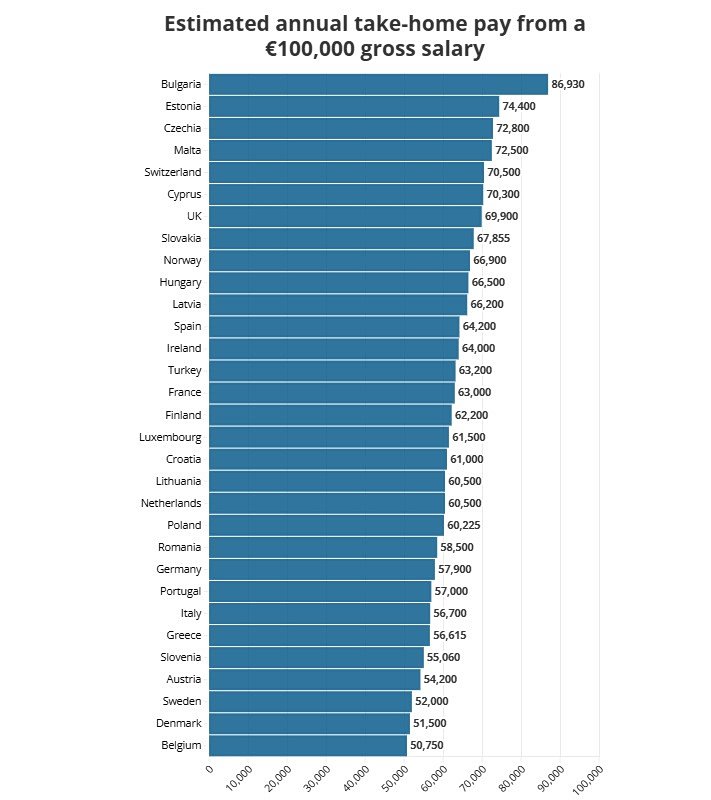
In Ireland (64,000) and Turkey (63,200), workers receive only less than two-thirds of their gross annual salary of 100,000 euros. Slovakia (67,855) and Hungary (66,500) are slightly higher, with a difference of about 2,000 to 3,000 euros.
Eastern versus Western and Northern Europe
In Eastern Europe, workers generally retain more than the gross annual salary of EUR 100,000. These countries often have more uniform income tax systems, lower maximum rates or ceilings on social security contributions.
Western and Northern Europe tend to have lower net income at this wage level. Countries such as Belgium, Denmark, Germany, Austria, France, Sweden and the Netherlands pay more because of progressive income tax, workers' social contributions and other charges.
Local and regional taxes can also influence classification.
How does the sum of EUR 100,000 compare with the average wages?
While EUR 100,000 is a decent gross salary in some countries, it is above average in most of Europe. According to OECD figures for 2025, Switzerland is the only European country where the average wage for a single person without children exceeds this level, reaching EUR 107,487 per year.
Within the EU, Luxembourg has the highest average wage, at EUR 77,844 per year. Thirteen of the 22 EU Member States listed have average wages of less than 50,000 euros, with Slovakia having the lowest, at 19,590 euros.
Maximum rates of income tax of natural persons
The highest rates of income tax on higher incomes vary widely across Europe and follow regional trends.
The countries of Scandinavia and Western Europe generally have the highest maximum marginal rates, which usually range between 45% and 60%.
Central and Eastern Europe, including the Balkans, tend to apply lower rates.
In Greece, the highest marginal rate of taxation of income of natural persons is 44%. This rate applies to the part of annual income exceeding 60,000 euros for both employees and pensioners and for freelancers.

