
A new report by the World Economic Forum (WEF) entitled «Growth in the New Economy: Towards a Blueprint», published in April, outlines trends, strategies and dilemmas that shape the long-term Economic development worldwide.
The adoption of Artificial Intelligence, geostrategic competition, increasing debt and environmental and demographic challenges are to shape the economy rapidly and therefore new growth strategies are needed.
As the report claims, IT services, advanced processing, health and healthcare, as well as accommodation and recreation are expected to be key levers of development over the next five years.
In this respect, Attilio Di Battista, head of WEF's Economic Development and Transformation, claimed that «the current framework requires bold choices and compromises». Key strategies for strengthening each country and every level of income are for itself «investment in productivity, talent and strengthening the fundamental principles of economic policy».
Medium-income economies (upper-middle income and lower-middle income) are expected to contribute to 65% of global GDP over the same period. On the other hand, low-income economies are predicted to account for only 1% of world growth.
The 5 sectors «Ensigns» in the economy
The first sector expected to lead the world economy by 2030 is IT services, with an estimated capacity of 11,5 %, according to the International Economic Forum.
The advanced Processing, health care, accommodation/recreation as well as agriculture.
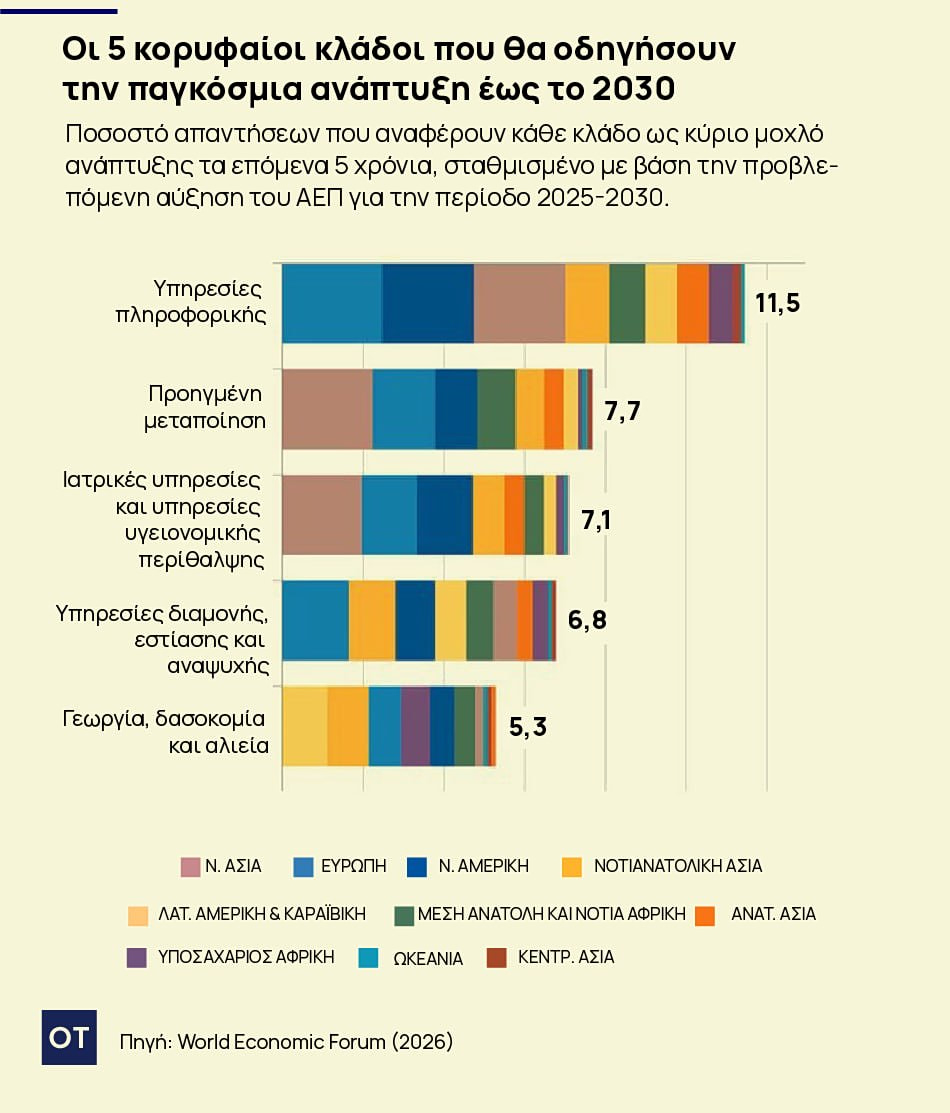
For most sectors, external demand and domestic corporate investments are identified as key growth levers. On the other hand, domestic consumer spending or public expenditure may be limited by the pressure of high public debt and stagnant real income, the report stresses.
Asia: «Engine» Regional development
While the war in Middle East It continues, with its effects on each economic sector, the report highlights what changes will make economic growth in the long term worldwide.
One of these concerns the significant influence a small number of medium-income economies will have on economic growth over the next five years.
At regional level, Asia will continue to be the driving force of global growth, representing more than 50% of global GDP by 2030.
On the other side of the Atlantic, the United States is expected to account for about a tenth of total growth.
Medium-income economies in focus
Another important finding in his report WEF It concerns the contribution of different geographical areas to global economic development.
In particular, medium-income economies (upper-middle income and lower-middle income) are expected to contribute to 65% of global GDP over the same period.
On the other hand, low-income countries will grow faster —7.4% per year— but together they will account for only 1% of world growth, despite hosting 8% of the world's population.
Obstacles and opportunities
According to a WEF survey of more than 11,000 executives worldwide, high energy costs and political instability are highlighted as the most common inhibitory factors in economic growth worldwide.
The obstacles vary by geographical region and level of income. For example, in high-income countries the lack of skills is most commonly referred to as a hindrance to growth, while in low-income countries key obstacles are limited access to funding and lack of infrastructure.
The respondents then consider it very likely that demographic changes will create divergent development paths between individual states.
As research reports, ageing and population decline are expected to negatively affect growth in Europe and East Asia.
On the other hand, in areas such as South Asia, Sub-Saharan Africa and parts of the Middle East are listed age younger populations, who could support development, reports WEF.

