
Sixty-six years after her first flight, Joan Prince Crandall is a live connection between two completely different times of her life. aviation.
ARTICLE SUMMARY
- Joan Prince Crandall began her career in 1959, at a time with strict rules of appearance for flight attendants and restrictions such as forced retirement from work due to marriage or age.
- During her course she experienced the successive mergers of companies and the technological revolution of jet aircraft, which allowed faster flights with greater passenger capacity, transforming air transport.
- The 1964 Civil Rights Act in the US proved decisive, as it banned gender discrimination and allowed women to continue their careers after marriage and motherhood.
- The core of the profession remains safety, but the scale and requirements have increased. After her retirement, Crandall plans to write a book and continue traveling.
When Joan Prince Crandall first wore the uniform flight attendant In 1959, commercial air transport was still in a transitional period. Most passengers considered air travel luxury, aircraft moving with propellers, cabins accommodated a few dozen people and flight attendants were treated more as symbols of elegance than as safety professionals. Sixty-six years later, as she prepares to retire from Delta Air Lines, Crandall is a live connection between two completely different seasons of aviation.
ARTICLE CONTINUES AFTER ADVERSION
Delta claims that Crandall is the longest-lived operative flight attendant in the world. She began her career at a time when the term «fly attendant» There wasn't yet. Then the women who worked on the planes were called «Stewardesses» and their image was a key element of airline marketing. «That was my entire business route.»She says she's talking to CNN. «From old-time stewardess to modern flight attendent».
Young Joan was hired in 1959 by Pacific Airlines. The first aircraft he worked on was a Douglas DC-3, a plane just 24 seats, currently considered a civil aviation legend. In those years companies sought young women with a certain appearance and a sense of elegance. High heels, gloves, well - combed hair and flawless presence were considered almost as important as professional skills.
A much harsher reality
«The airlines wanted young women with a bright appearance»He remembers today. It was a time when air travel was advertised as a luxury experience and flight attendants were part of this picture.
But behind the charm was a much harsher reality. Women in the industry worked in a deeply male-occupied environment and faced restrictions that today seem unthinkable. Many companies imposed strict weight limits, appearance rules, even mandatory retirement from work when a flight attendant was getting married. In some cases women had to leave the profession as soon as they reached the age of 32.
ARTICLE CONTINUES AFTER ADVERSION
«In today's day these could never happen»Crandall says. Although she did not face the most extreme forms of these policies, she clearly remembers their existence. For many young women of the time, work as a flight attendant was considered temporary employment for a few years, until they were married. However, several – like her – fell in love with the aviation world and struggled to stay in the profession.
During her career American aviation was radically transformed. Pacific Airlines merged and was successively renamed Air West, Hughes Airwest, Republic Airways, NorthWest Airlines and eventually Delta Air Lines. She always remained in the air, following the evolution of the industry.
The technological changes he lived through
The technological changes he has experienced are almost impossible to summarize. It started on aircraft with piston engines and propellers, limited range and small capacity. Then came the revolution of jet aircraft. «Higher, faster, more places», says he enthusiastically reminiscent of a young first appearing flight attendant rather than a woman who is about to retire after six decades of work.
ARTICLE CONTINUES AFTER ADVERSION
He even remembers the feeling of the first jet, their interior, even the smell of fuel. When it began, traveling from one end of the United States to another was a big deal. Today transatlantic flights are carried daily by aircraft carrying hundreds of people.
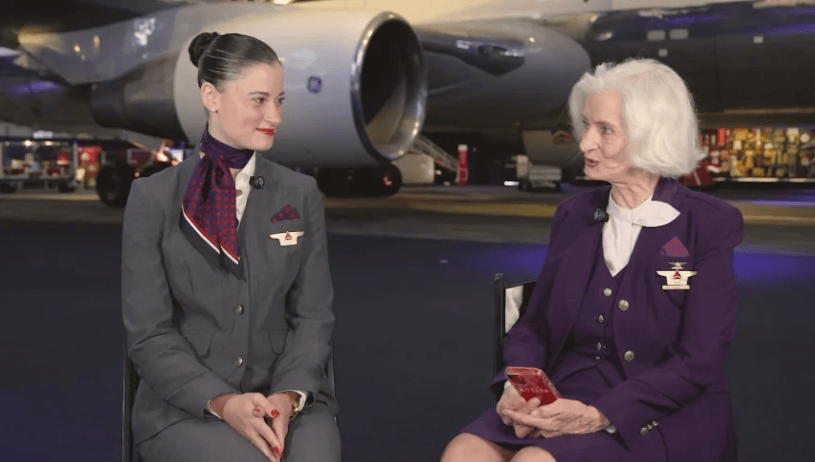
Delta claims Crandall is the longest-running flight attendant in the world / DELTA
Equally important were the social changes that accompanied her career. She recalls with particular thrill the passage of the 1964 Civil Rights Act in the United States. Although the law became known primarily to combat racial discrimination, the addition of gender-based discrimination proved decisive for thousands of working women.
«He changed your life, mine and all the women in the country.»He says. «For flight attendants it was a huge change».
ARTICLE CONTINUES AFTER ADVERSION
From that moment on women could marry or have children without fear of losing their jobs. The profession gradually ceased to be considered a brief parenthesis before marriage and turned into a real career with prospects for evolution.
The first line of defense in case of accident
Despite changes in the image of the profession, Crandall points out that the core of the job remained the same. Many passengers still see flight attendants primarily as people serving drinks and meals. In fact, however, they are the first line of defense in the event of an accident or emergency. They are the ones to evacuate an aircraft within seconds, face fires, provide first aid or manage dangerous passengers.
This piece of work, he says, has never changed. What has changed is the scale. Delta's Airbus A350 can carry more than 300 passengers, almost eight times more than the small aircraft with which she began her career. The responsibilities are much greater and the pressure is much more intense. «Work is harder and more demanding», admits.
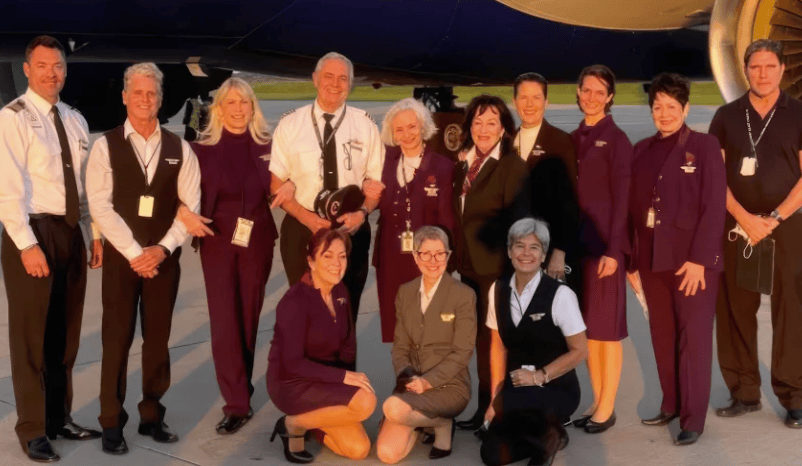
She began her career at a time when the term «fly attendant» There wasn't yet. Then the women who worked on the planes were called «Stewardesses» and their image was a key element of airline marketing / DELTA
ARTICLE CONTINUES AFTER ADVERSION
Today, on most of its flights, Crandall serves as a flight purser, i.e. chief flight attendant, the senior cabin worker coordinating the entire crew. Despite her years, she still enjoys her work and imparts her experience to younger colleagues.
She recently met newly graduated flight attendant Alice Brussar, who just completed her training at Delta. For Crandall, this meeting was a moment. «Déjà vu»She saw herself as she was over sixty years ago. On the other hand, Brussar saw a woman who had lived the entire history of modern aviation.
When she finally leaves the heavens, Joan Prince Crandall does not intend to stay still. She wants to write a book about her experience and of course continue to travel. Paris, Mumbai and Hong Kong remain her favorite destinations.
«I was lucky.»He says. «I'm healthy and it's still fun». This time, however, when he boards a plane, he will not have to give safety instructions or take orders for drinks. He will just sit in the window, watching the world he spent six decades helping others discover.
ARTICLE CONTINUES AFTER ADVERSION
Follow it. on Google News and learn all the news first
See all the last News From Greece and the World,

