
The doubling of electricity costs for households from 2008 to now is one of the key factors in reducing their purchasing power. Rents have also increased significantly, but, with 70% of homes being privately owned, the effects concern a smaller part of the population.
Many attribute the price of electricity to business speculation. But the issue is more complicated.
The increase in electricity prices is not due to a single factor, but to a combination of developments.
Increase in production costs
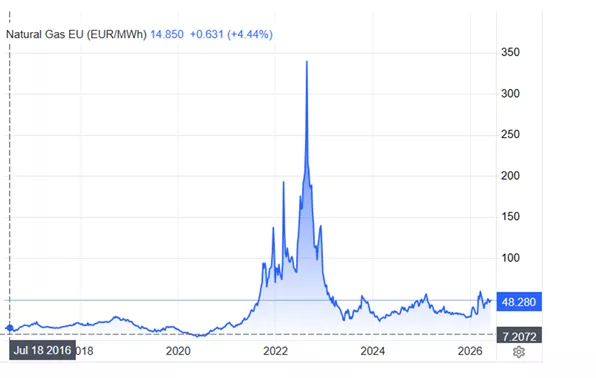
Gas, which is a key power fuel in Greece, is much more expensive than it was 15-20 years ago. In addition, in addition to its significant share of power generation, it is also the fuel of the base units that keep the system in service when the RES are out of production.
So natural gas largely shapes the prices of the entire system.
The 2020–2023 energy crisis, due to the war in Ukraine, launched wholesale prices to unprecedented levels.
Cost of CO2 rights
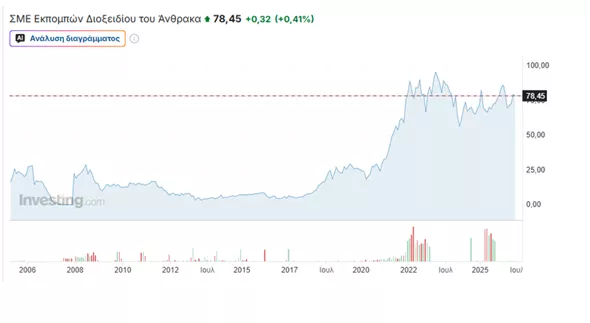
In 2008 carbon emission allowances had a much lower cost. Today electricity producers pay significant amounts for each tonne of CO2 emitted. This particularly increased the operating costs of lignite and natural gas plants.
Investments in networks and RES
In recent years large investments have been made in transport, distribution, island and renewable energy networks. Part of these investments are transferred to the accounts through regulated charges.
These are some of the reasons why we pay more expensive electricity.
In 2008 Greece had an electricity price of around 0.10 €/kWh, significantly lower than EU average (0.16 €/kWh). Today the price is around 0.24 €/kWh, while EU average is set at 0.29 €/kWh.
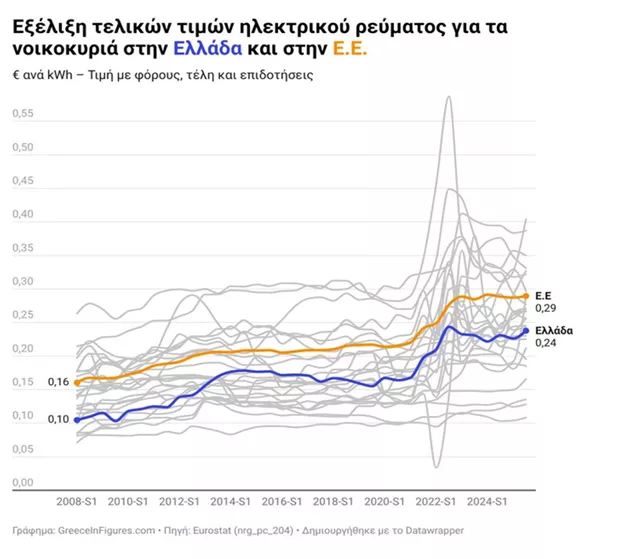
📊 What's on the chart?
Despite almost doubling the price in Greece, the country is still below the European Union average. The great rise came mainly from 2021–2023, when the energy crisis, gas prices and the cost of CO2 rights launched the power costs.
The most interesting finding is not that the price almost doubled, but that Greece is gradually converging towards the European average, as the old advantage of cheap lignite has virtually disappeared.
Was it a solution to continue burning lignite?
The answer depends on what we mean as «solution».
Short term, maybe.
If Greece had kept more lignite plants in operation in 2021-2023, it would probably have:
-less dependence on expensive imported natural gas,
-more energy security,
- less exposure to geopolitical crises (Russia, Ukraine),
- Lower fuel imports.
That is why many European countries, including Germany, brought back temporary coal plants after 2022.
In the long run, no.
The problem is that lignite is no longer the cheap lignite of the 2000s.
The cost of production is borne by CO2 rights, the ageing of units, the increasing mining costs and environmental compliance requirements.
In many cases, the cost of lignite production is now close to or even exceeds the cost of production from natural gas plants when gas prices are at normal levels.
If Greece had maintained more lignite plants as a reserve by 2025-2030, it would probably have greater energy security during the crisis and perhaps lower prices in some periods. However, the continuation of lignite production would hardly be a viable solution, as the cost of CO2 emissions and the economic burden of fuel itself increased constantly.
The real question is not whether the transition had to be done, but whether it had to be done more gradually.
Another failure that is often mentioned is the huge increase in investments in renewable power plants without corresponding investments in storage infrastructure.
The result of this delay is that in the mid-term hours the supply of electricity exceeds demand and surplus electricity; or «fly» or exported at low prices.
Lack of proper regulatory framework and bureaucracy are the main causes of this delay. On the other hand, if investments in large storage batteries currently planned had been implemented five years ago, they would have lower yields and significantly higher costs.
In 2020-2021 large-scale batteries cost about two to three times more than today, while storage technology had not yet matured.
The absence of storage units today threatens with bankruptcy hundreds of small RES units that have banking obligations. Due to the negative prices prevailing at midday hours due to the oversupply, many units are put out of service and unable to produce at a profit. However, the loan obligations continue to «Run», resulting in several of them risk getting out on the hammer.
These undertakings ask the State to intervene and rescue them. This, however, invalidates the concept of business risk and creates moral risk.
If entrepreneurs take for granted that, when they make mistakes or fail, the state will always intervene and save them with taxpayers' money, then they will take greater risks without the corresponding consequences.
In the good times, when high gas prices set market prices, the profit margins of these companies were particularly high and consumers paid the costs. Now, in difficult times, they are again asking consumers themselves – as taxpayers this time – to finance their survival.
The increase in electricity prices is therefore a pan-European and global phenomenon. The ever greater use of Artificial Intelligence is expected to further increase electricity demand and maintain prices at high levels.
It is good, in any business or personal design, to calculate increased energy costs. If some —companies or politicians— They're trying to sell you the cheapest current account, you better assume that some «There's a hole in the fava.».
📬🖊️ Reader letters
Because people are insane.
Good evening, Costa,
On the occasion of your article «From Varoufakis to Negrepontis» A great truth that I've realized in recent years and wanted to share is something we've heard many times, we've learned it even at school, but we've understood it a little differently. The truth is that man is an animal. But not just that it is another mammal, as we have realized, but that it is an animal. A simple animal like everything else, just a little smarter. If one considers that our difference with animals is great it is wrong, because in research they found that the biggest-strongest mice sometimes leave the smallest-weak to win in the game, because if they never won, they would never want to play. Personally, it seems to me that mice are smarter than even some people.
This explains many things that may seem incomprehensible. Like why man can act against his own interests by even displaying self-destructive behavior. Because within him, emotion prevails instead of reason. Like the animal can, depending on its emotional state, be friendly or aggressive, so is man how you will achieve him. That is why invoking emotion is much more effective than invoking reason. And that's why the people prefer a sweet-talking liar to someone who tells raw truths. Several of us, being rationalists, usually ignore this factor when trying to communicate with people. On the contrary, politicians do not ignore him at all.
Η αλήθεια είναι ότι το συναίσθημα μας κάνει ανθρώπους, ειδάλλως δεν θα είχαμε διαφορά από ένα ρομπότ. Απλώς πρέπει να ισορροπεί με την λογική, να υπάρχει δηλαδή με μέτρο. Να μην έχουν τα συναισθήματα τον έλεγχο του ανθρώπου. Διότι εάν τον έχουν, τότε πας στο άλλο άκρο και αντί για ρομπότ γίνεσαι ένα σκέτο ζώο. Ο άνθρωπος είναι, με αυτήν την έννοια, μία ενδιάμεση κατάσταση, η χρυσή τομή. Εκείνος ο άνθρωπος όμως που έχει εκπαιδεύσει το μυαλό του, όχι οποιοσδήποτε έχει γεννηθεί άνθρωπος. Τα γονίδια μόνο δεν αρκούν.
Το «μέτρον άριστον» είναι τελικά ίσως η μοναδική αλήθεια που ισχύει πάντα. Αφού ακόμα και αρετές όπως η αγάπη και η φιλοπατρία μπορούν να αποβούν καταστροφικές όταν είναι χωρίς μέτρο. Είναι πολύ σπάνιο να ανακαλύψεις μία “συμπαντική” αλήθεια που ισχύει πάντοτε χωρίς εξαιρέσεις.
Φιλικά,
Αλέξανδρος Αγγελής

