
The global financial chessboard is rapidly remodeled, with China And the United States is increasingly developing its economic policies. Through aggressive industrial strategies, tariffs, strict sanctions and restrictions on exports of critical raw materials (such as rare earths), the two superpowers protect their interests. At the same time, however, the European Union seems to be at a disadvantage, facing what experts call «second Chinese shock».
EU trade deficit with China was launched at around 400 billion euros in 2025
While Washington, particularly under the policy of protecting the domestic market that began last decade, has raised a duty wall against Chinese imports, Europe has become the main recipient of these products. The result is a dramatic increase in the EU's trade deficit with China, which was launched at EUR 400 billion in 2025. It is important to note that this is not due to a general loss of competitiveness of the European economy, as the EU continues to record a strong overall trade surplus of EUR 164.6 billion with the rest of the world. The problem lies exclusively in its asymmetric relationship with Beijing.
China's total trade surplus exceeded 1 trillion euros in 2025
On the other hand, China's total trade surplus has surpassed the inconceivable amount of 1 trillion euros. This situation is so extreme that the Director General of the World Trade Organisation (WTO), Ngozi Okonjo-Iweala, openly warned that the rest of the world simply cannot absorb such an export volume. If China does not balance its economy, it risks triggering a new, global wave of protectionism.
The transition from first to second shock
Europe has experienced the suffocating pressure of the Chinese invasion before. The first «Chinese shock» It hit the continent after 2008, targeting mainly the countries of Southern Europe. The clothing, footwear and textile industries in that region were overwhelmed by the competition of cheap Chinese products. In conjunction with the then appreciation of the euro against Wan, the trade deficits of the European South and China were derailed, leading to deep economic hardship.
Today, the second shock strikes the «heart» The euro area: countries such as Germany, France, Italy and the Netherlands. This time, clothing and shoes are not in sight, but the high added-value sectors where Europe has traditionally dominated, such as the car industry, mechanical equipment and green technologies. Beijing's strategy is clear: through colossal state subsidies, it has already wiped out the European solar panel industry (which dominated the world 15 years ago) and now threatens to do exactly the same in electric cars.
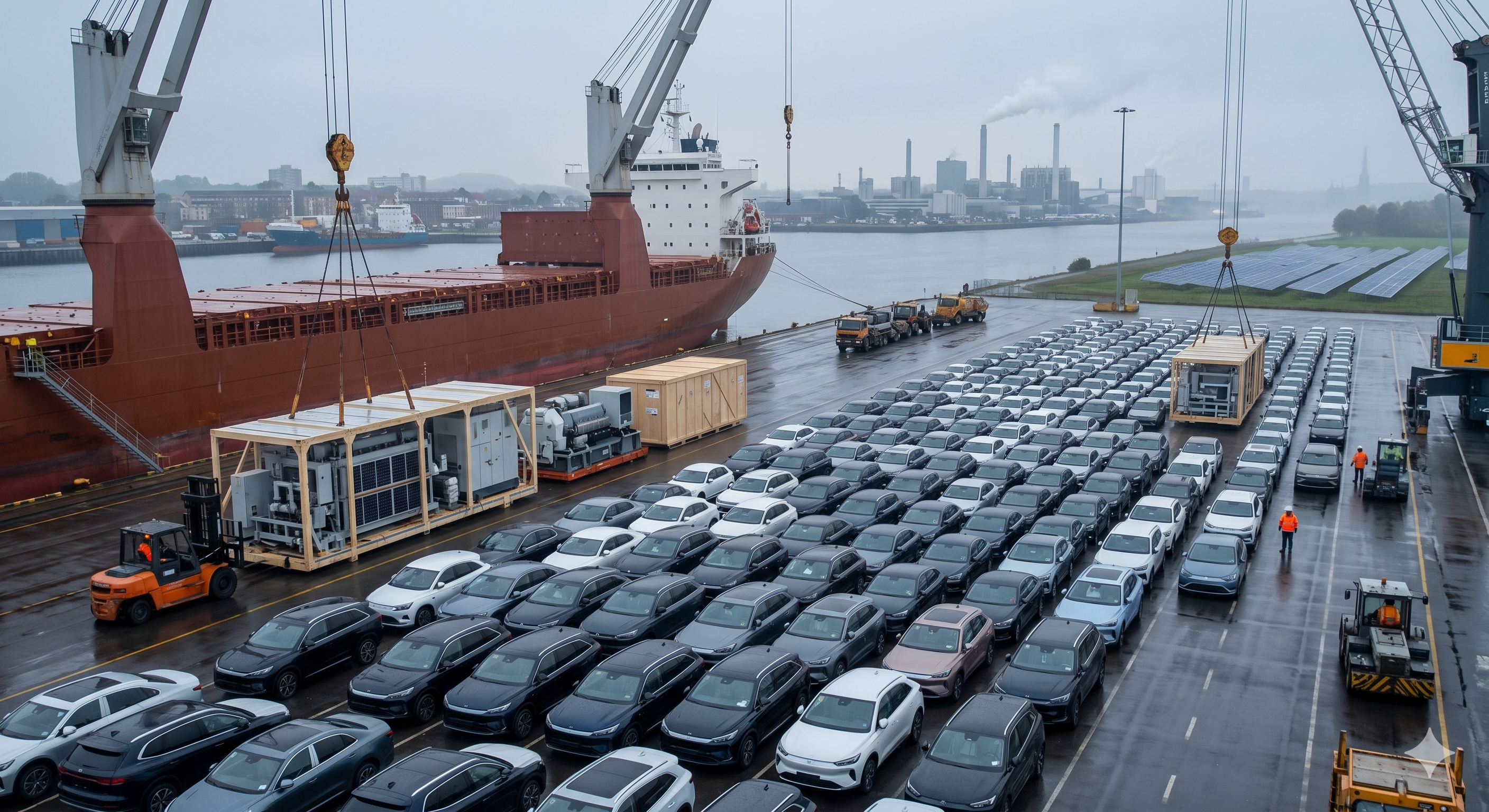
Chinese competition now pushes the core of the eurozone into cars, machinery and green industries
The deviation of costs and monetary dumping
The causes of this imbalance are deep. China, facing the bursting of its own property bubble and weak domestic demand, has turned to exports to keep its economy alive, entering a prolonged deflation phase. On the contrary, Europe has suffered heavy blows from the energy and food crisis that followed the Russian invasion of Ukraine.
The gap in production costs is further widened by geopolitical developments and currencies. The Western embargo on Russian oil and gas turned Moscow into Beijing, offering the Chinese industry abundant and considerably cheaper energy. Furthermore, despite its huge commercial surplus (which, on the basis of economic logic, should lead to an appreciation of its currency), China maintains the Wan artificially undervalued by about 10% against the euro. This ongoing «monetary dumping» offers Chinese exporters an unfair and decisive tariff advantage.
The need for immediate and dynamic reaction
Europe must react immediately before its deindustrialization becomes irreversible. An ideal solution would be to correct/revaluate Wan by 20% to 30%, to reflect China's real trade power. However, given that this is Beijing's responsibility, the European Union should consider imposing horizontal duties up to 20% on all Chinese imports.
At the same time, the framework of sanctions against Russia could become more targeted. A radical proposal is to impose 30% duties on imports of Russian energy (passing barriers of unanimity within the EU), with revenue heading towards the reconstruction of Ukraine.
In the debate on possible Chinese retaliation, Europe has strong tools. The possible duties would have deflationary trends within it, which the European Central Bank (ECB) could compensate for by reducing interest rates, thus stimulating internal productive activity.
However, the most valuable tool remains the formulation of an aggressive and coherent European industrial policy. The EUR 2 billion that it is estimated that customs duties on Chinese electric vehicles should annually not function as a mere consumer tax, but should be reinvested strategically for the technological transition of European cars and the development of R&D, creating the next generation of technologies in Europe.
The time for action is now. If Europe does not protect its productive fabric and develop its own value chains, it risks turning into a continent completely dependent on China — no longer for low-cost consumer goods, but for the very core of its green and technological survival.
Source: Social Europe

