
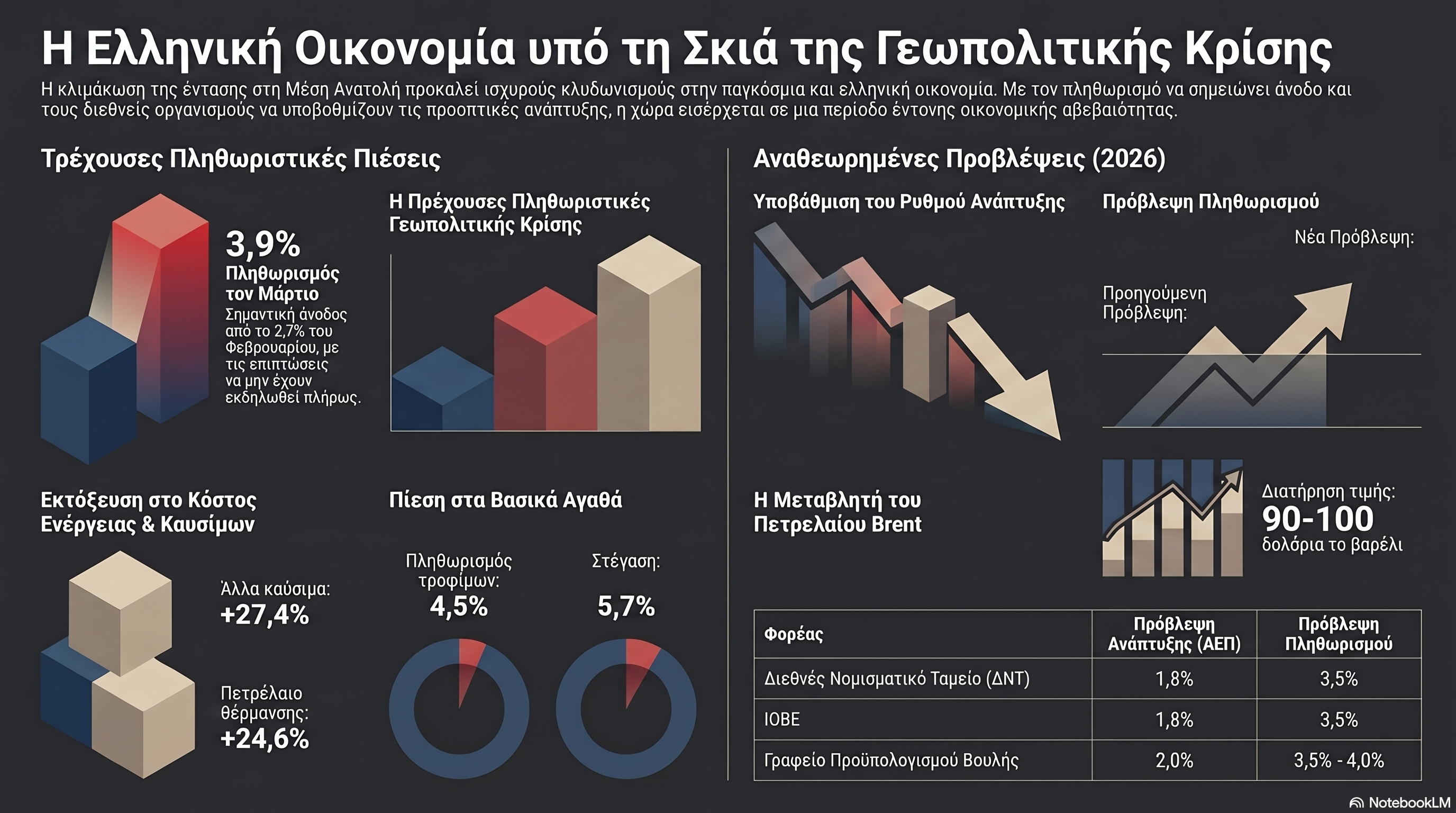
Kyriakos Mitsotakis warned the House about the serious economic consequences of conflicts in the Middle East, describing the prospects «extremely ominous to tragic». Inflation was launched at 3.9% in March, with food at 4.5% and fuel up to 27.4%. The State Budget Office and the IMF revised growth to 1.8%-2%, while inflation is expected to reach 3.5%. With Brent oil at $90-100 a barrel, the initial budget forecasts are overturned, calling into question the government «success story».
Analyticalally:
Under her radar serious political confrontation The Prime Minister's introductory position with an emphasis on geopolitical developments and the economy was passed in Parliament.
Concerns about the progress of the Greek economy, which is directly affected by geopolitical conflicts in the Middle East
THE Kyriakos Mitsotakis He chose not to say a word about his close associate and Deputy Minister Makarios Lazaridis who intends, after the scandal that arose with his degree, to «interest on any unduly paid amounts» and not to comment on the new Adoni Georgiadis's open attack the EPPO.
However, he wanted to mention the latest developments in the Middle East and the shocks caused to the economy and the extremely ominous prospects in the event of conflicts.
Mitsotakis in Parliament: Inescapable economic consequences
The Prime Minister After stressing that «Sorry.» for «the content and timing of the debate in Parliament» said that «We should discuss what is happening in Iran, the Middle East, Lebanon (...). We should, above all, discuss the important, ineffective economic consequences of the crisis on the Greek economy and how they can be addressed or at least mitigated.».
Recognizing «a time when risks are increasing around us, a time when the global economy is crumbling» noted that «the forecasts for the future of the economy, in case of further extension of this conflict, are extremely ominous up to potentially tragic», preparing public opinion that the worst may be ahead.
And indeed a number of elements and predictions are extremely worrying, capable of blowing up the success story of the Mitsotakis administration.
Inflation close to 4%
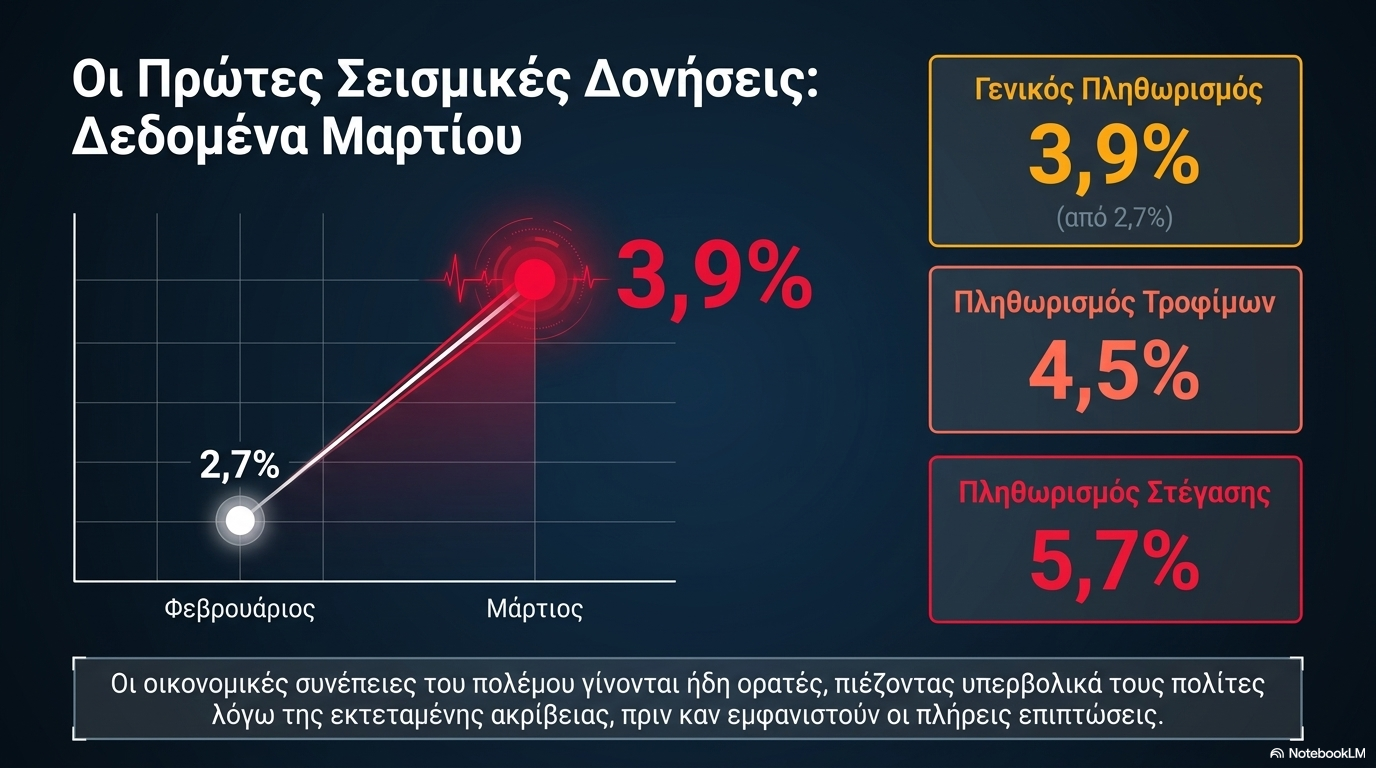
At 3.9% it was formed inflation in March (from 2.7% in February), according to ELSTAT. The economic consequences of the war become visible in Greece with inflation rising, while the effects have not fully appeared. Food inflation reached 4.5%, while the housing equivalent of 5.7%, which shows that the situation is particularly worrying for citizens, who «pressured» too much because of the extensive accuracy.
From then on, the biggest increases were in the categories «Other fuels» with 27.4%, «Heating oil» with 24.6%, «Motor oil» with 22,8%, «Transport of passengers by plane» with 22% and «Beef» 20.3%.
Everything shows a decline in growth
Overturning basic economic data due to international instability and the new energy crisis predicts the State Budget Office in the House (GPCB), in the quarterly report (March 2026). Under the weight of developments in the Middle East, the growth forecast in the country is marginally revised and inflation is expected to move significantly higher this year under certain conditions.
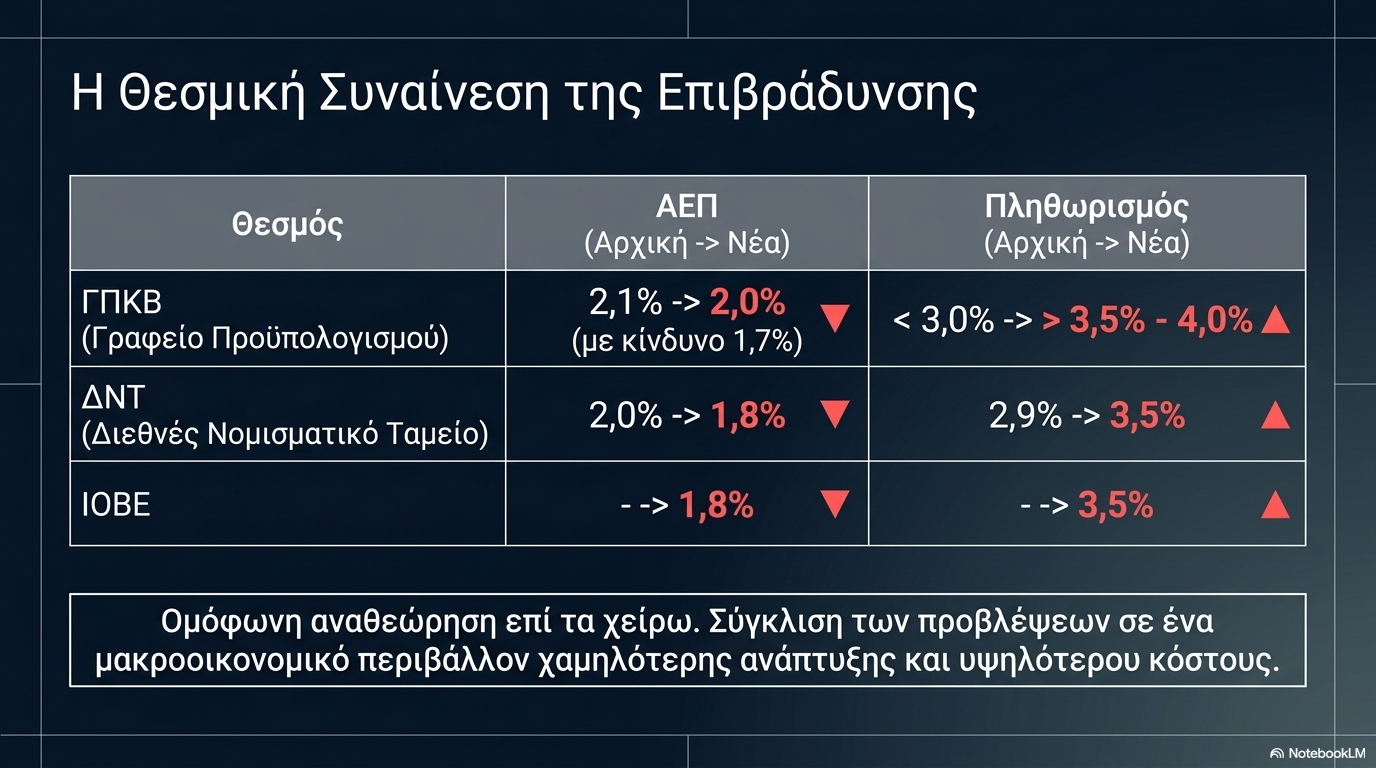
In this context, the principal estimate of the Office's GDP growth rate in 2026 is marginally revised in relation to the December Report (2025) and is set at 2.0%, compared with 2.1%, with a forecast range of 1.7% to 2.4%.
The entire range of revised forecast incorporates the Brent-type oil price maintenance hypothesis at $90 a barrel, on average, for all 2026.
Estimates of GDP growth rate in the lower part of the range from 1.9% to 1.7%, mainly reflect maintaining the price of Brent-type oil at significantly higher levels (more than $90 to $100 a barrel) for the entire 2026 as well as possible limited tightening of the ECB's monetary policy due to inflation pressures in the Eurozone economy.
For inflation, the forecast, based on the bad scenario, is that it will exceed 3.5%-4%, with the previous estimate reporting inflation below 3%.
The «Bells» IMF for the economy
The countries should «to prepare for difficult times» if the price of oil remains high due to the Middle East war, International Monetary Fund (IMF) Director General Kristalina Georgyeva said at a press conference she granted.
A little earlier, the Fund, in a report under the title: «The prospects of the global economy» (WEO), it has carried out a critical review of both growth and inflation for the Greek economy.
The International Monetary Fund, in its assessment of Greece revises down the growth assessment 1.8% for this year, (from 2%) reflecting the pressures caused by increased energy prices and slowing down international demand.
As far as inflation is concerned, the Fund provides that from 2.9% to 2025 «Climb» 3.5% this year.
Below it revises the development of the Greek economy and the IOBE for 2026 to 1.8%, with simultaneously launching inflation to 3.5%.
The Ministry of National Economy and Finance
With the latest data since the start of the Middle East hostilities, the growth rate to be announced for this year is now estimated to be around 2% (from 2.2% in 2025) versus forecasting for 2.4% of GDP growth in the budget, while inflation is likely to increase to 3% (from 2.6% in 2025), rather than falling to 2.2% as provided for in the basic scenario.
This review will be officially printed on April 30, with the submission to the European Commission of the annual progress report on the objectives of the Medium-term Financial and Structural Plan 2026-2029, by the Ministry of National Economy and Finance.
The draft report of the current budget had been based on a forecast for an average year price for Brent oil at $62.4 per barrel, one of the most conservative assumptions in recent years based on the data available at the end of 2025 – as international organizations also predicted a further fall in oil prices.
However, the Ministry of National Economy and Finance had incorporated into the State Budget and forecast of what would happen in 2026 in an adverse scenario, where the average international year price for oil would eventually be 50% higher than expected.
Today, this scenario is no longer theoretical: for almost a month Brent has already been negotiating close to the dollars a barrel, far exceeding both the basic and the adverse budget scenario.
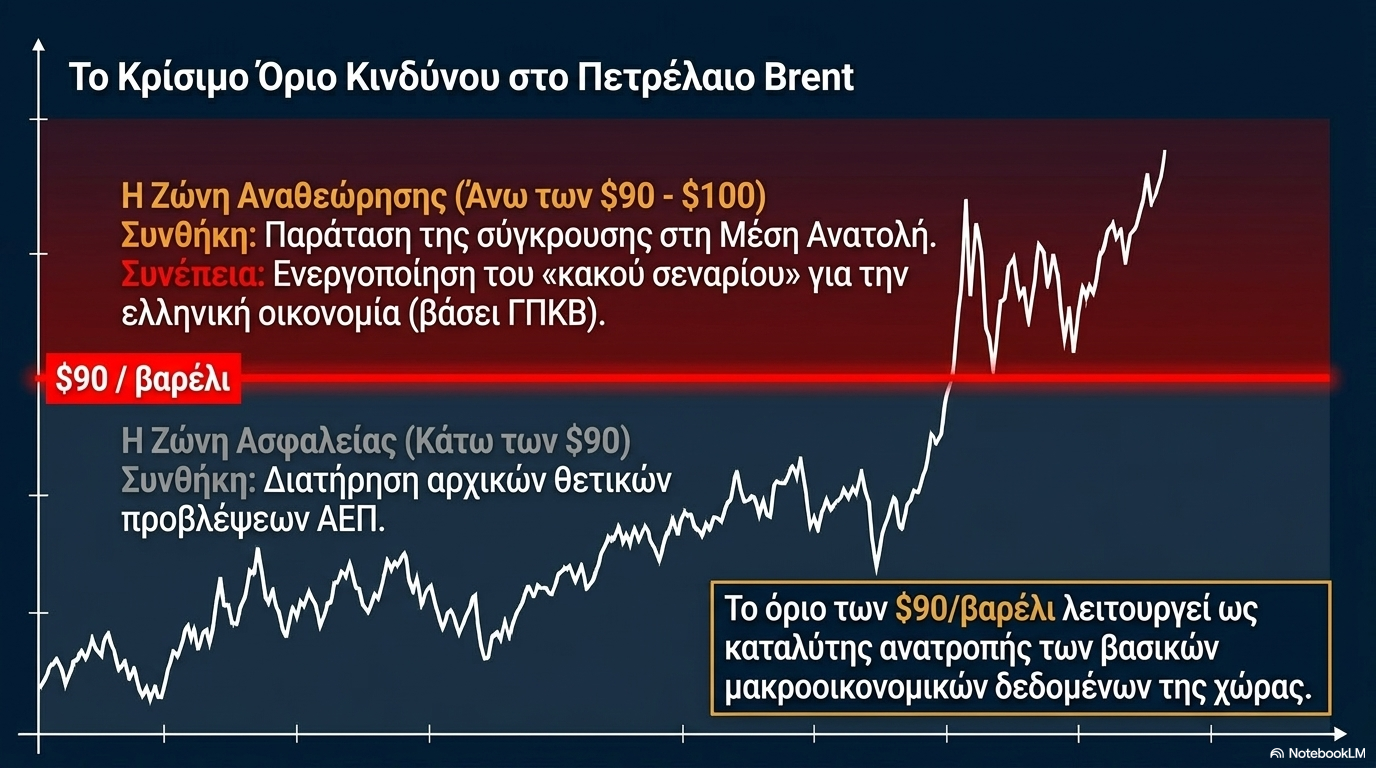
For the rest of 2026, futures show «future» The average sales prices of Brent at 95-100 per barrel at the threshold of exactly «Bad script» providing for a growth drop of 0.5 percentage points.
At a similar wavelength the Bank of Greece is also moving as on the Big Monday officially submitted a new forecast for growth of 1.9% (from 2.1%) and inflation 3.1% in 2026, citing disturbances in energy markets and global supply chains due to war and energy crisis.

