
# Anthropic launches Claude Opus 4.7 with impressive upgrades
Anthropic announced **Claude Opus 4.7**, its new AI model, available on all Claude products, API, Amazon Bedrock, Google Cloud Vertex AI and Microsoft Foundry. Upgrading Opus 4.6 maintains the same pricing (5 dollars per million input tokens, $25 per output tokens) and offers significant improvements in software engineering.
Central innovation is enhanced vision with image support up to 2,576 pixels wide (3.75 megapixels) – triple analysis from older models. Opus 4.7 excels in Finance Agent assessment and GDPval-AA benchmark, while showing improved memory and security. The company also imports the **Cyber Verification Program** for controlled access to safety researchers.
Analyticalally:
Officially, it was just now. Claude Opus 4.7, Anthropic's new AI model, available on all Claude products, the API, as well as via Amazon Bedrock, Google Cloud Vertex AI and Microsoft Foundry.
The company presents it as an immediate upgrade of Opus 4.6, with a significant improvement in advanced software engineering and especially in the most difficult tasks, while the pricing remains the same: $5 per million input tokens and $25 per million output tokens. Developers can use it as a Claude-opus-4-7 via the Claude API.
According to Anthropic, users say they can assign Opus 4.7 the most difficult programming work with greater confidence, even in cases that previously required close supervision. The model is described as capable of handling complex and long-term tasks with rigour and consistency, accurately following instructions and finding ways to verify its own results before delivering the relevant answers.
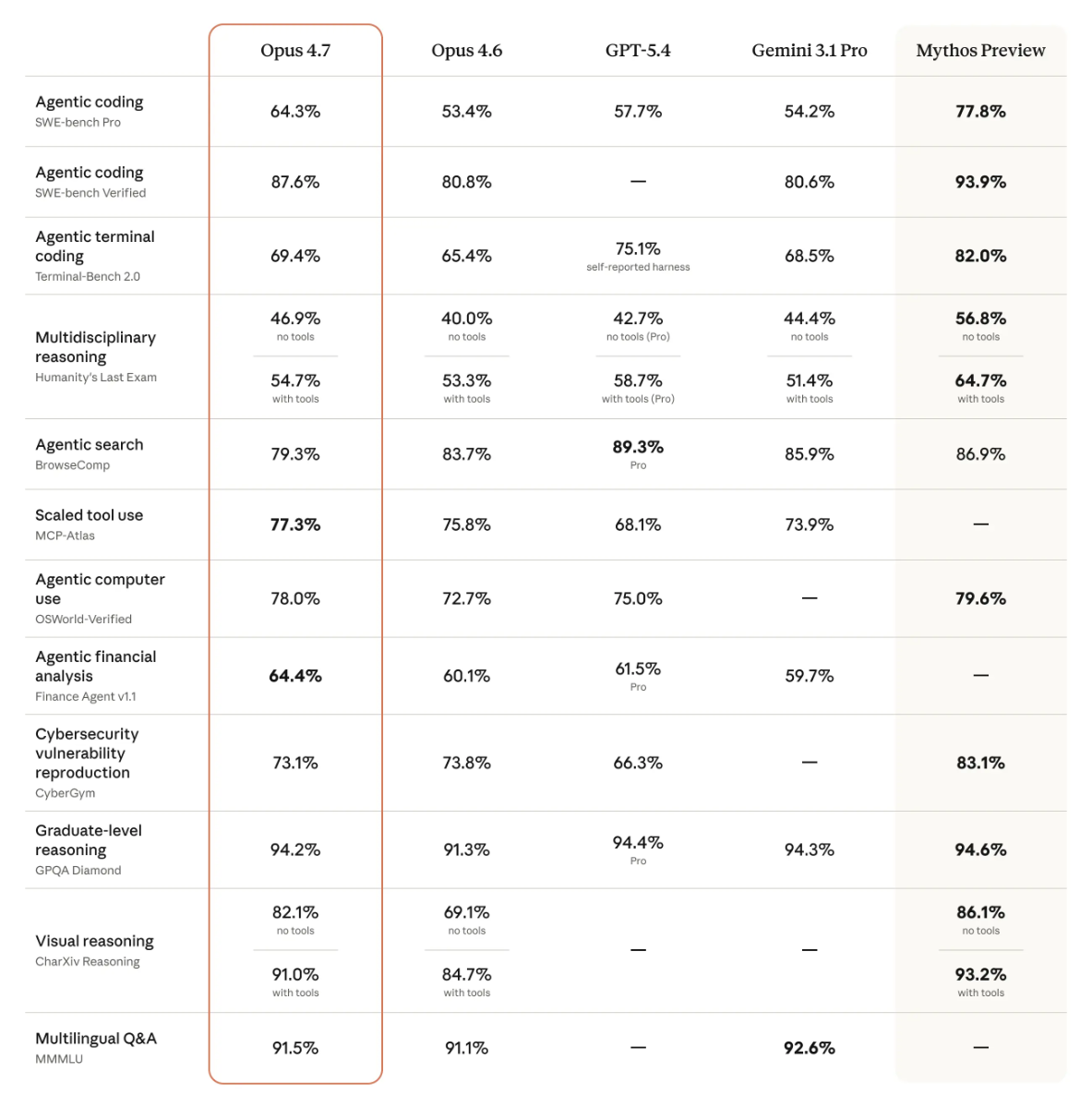
Central change is also the enhanced multimodality (multimodal). Opus 4.7 features «substantially better vision» and supports higher resolution images, accepting files up to 2,576 pixels wide, about 3,75 megapixels. This increase, which corresponds to more than threefold analysis relative to older Claude models, opens detailed-based uses, such as agents reading screenshots with enough information, export data from composite diagrams and tasks requiring accurate pixel reference. At the same time, the company reports that the model is more «apt» and creative in professional work, producing higher quality interfaces, presentations and documents.
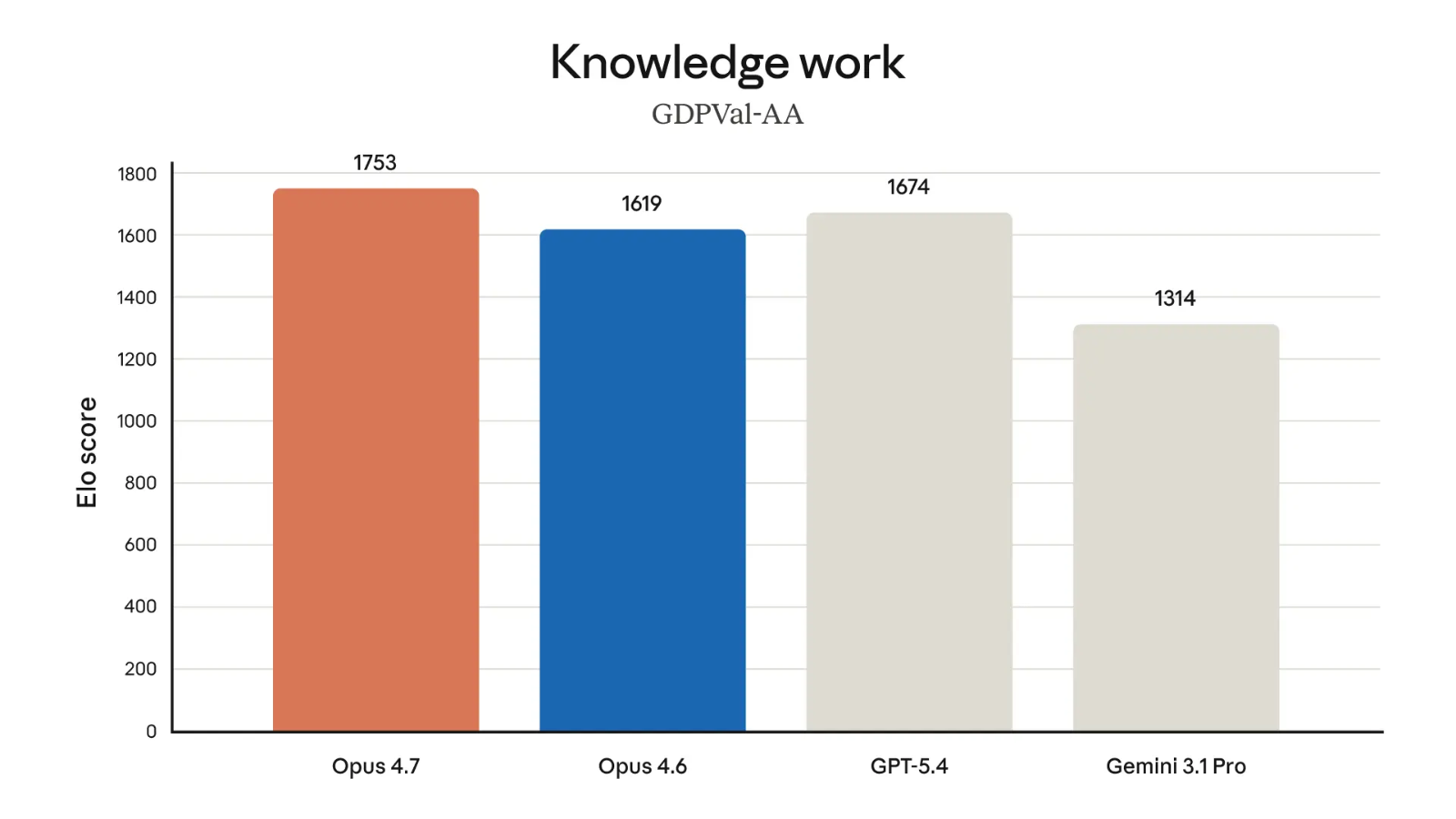
On the evaluation side, Anthropic notes that although Opus 4.7 is less widely capable than the most powerful Claude Mythos Preview, presents better results than Opus 4.6 in a range of benchmarks. In addition, the company's internal test recorded it as a more effective financial analyst than Opus 4.6, with more rigorous analyses and models, more professional presentations and more "tight" consolidation work. A top performance is also reported in Finance Agent assessment and state of the art at GDPval-AA, a third assessment that measures financially valuable knowledge of work in economic, legal and other sectors.
The company also emphasizes memory, saying Opus 4.7 is better at using file-based memory. So he can remember important notes in long, multi-session work and use them to move on to new tasks with less initial context.
As regards the critical safety sector, Opus 4.7 displays a similar profile to Opus 4.6, with low rates of alarming behaviors such as deception, flattery, and co-operation in abuse. In some indicators, such as honesty and resistance to malicious attacks «Prompt introduction», improvement is reported, while others, such as the tendency for too detailed damage reduction advice for controlled substances, are recorded slight deterioration. The alignment assessment characterizes it «largely well aligned and reliable, although not fully ideal», with Mythos Preview remaining the best model according to company ratings.
As part of the Glasswing Project on dangers and benefits to cybersecurity, Anthropic states that it retains the mood of Mythos Preview and tests new diclaves on less capable models, first with Opus 4.7. It is reported that experiments were carried out at the training stage aimed at controlling the limitations of cyber-attack-related capabilities, while the model is available with built-in protection mechanisms that detect and block requests related to prohibited or high-risk uses.
At the same time, for professionals seeking legal exploitation in areas such as vulnerability research, penetration testing and red-teaming, the company introduces Cyber Verification Program, a framework that allows controlled access under specific conditions.
Finally Anthropic makes it clear that Opus 4.7 is an immediate upgrade of Opus 4.6, but bringing about two key changes affecting consumption tokens. On the one hand, it uses a new tokenizer, which improves text processing but can increase the number tokens for the same input (about 1,0–1.35×). On the other hand, at higher levels "effort" the model produces more thought and therefore more tokens, especially in complex or multi-stage work.
Consumption can be controlled through settings such as efort, task budgets or shorter prompts.
-

2

