
The news that an owner sells five super-preserved apartment buildings in Chelsea's heart in London It would be remarkable in itself, if anything, because these properties are close to total value. EUR 220 million.
But there is an additional element that magnifies the interest - in the naught, especially for us - around this particular mega sale: owners of these properties-thesaurus are Greek, specifically his family Dimitrios-Nikolau-Alexandrou Panagopoulos, of his German wife Sandra-Ursula Panagopoulos-Burkhardt of both their children, Nicola and Sofia.
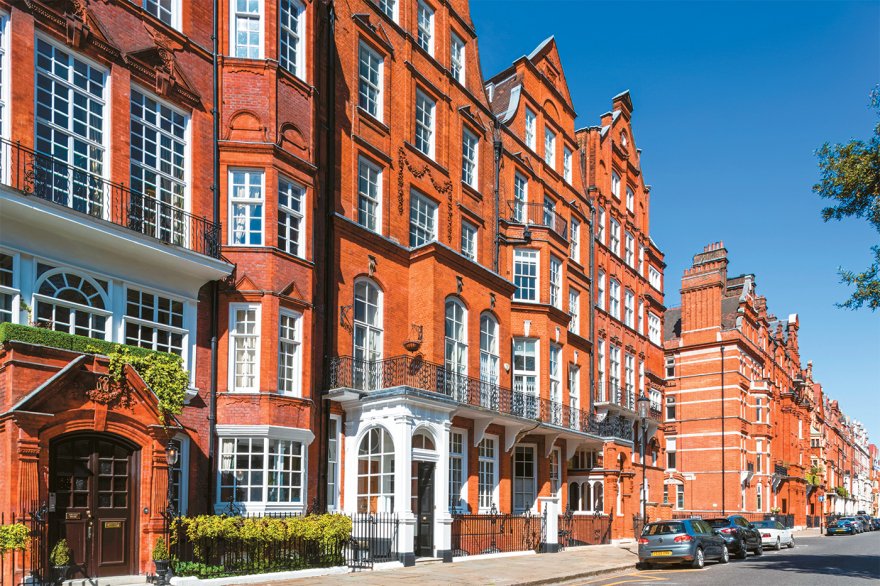
Five apartment buildings that are described as newer monuments for London, about 150 years old. These are a total of 32 apartments, which, despite almost foundational renovation and their complete modernization, retain as magic the unique patina of an aristocratic old age, British characteristics.
In these 32 luxury apartments four mews houses, former stables, should be added to the back of these apartment buildings, which have been converted into maisonettes with the appropriate luxury that suits the environment.
Where the environment is just the factor that makes the difference: Cantigan Square, Chelsea, Nitzbridge, London. Otherwise, one of the untouchables «Bon fillet» for the real estate in the British capital, if not worldwide. As long as it is noted that renting these 36 properties in Cantorgan Square gives rise to revenue £6.13 million per year.
Their sales price, in the form of a five-fold package of apartment buildings, for anyone interested in investing, has been determined by independent auditors of real estate. EUR 219,5 million (£187 million), according to its valid information «THEME».
The secret identity
The five apartment buildings, one within a few meters of each other, along the perimeter road at Cantorgan Square, belong to the collection «Cadogan Square Collection». Undoubtedly its most curious, bizarre parameter is how these 32 apartments and four mews houses were found in the possession of Mr Panagopoulos.
And perhaps, more spectacular than the astronomical value of immobiles themselves is how this man, registered in every public register in Britain as a Greek citizen, architects in the profession, born November 1955, managed to remain completely invisible.
In addition to a judicial dispute he had in 2020 with Cantorgan family, the original owners of the entire area, Mr. Panagopoulos never appears anywhere. The dispute with the Cantorgans was resolved by a court decision in favour of Mr. Panagopoulos and has since been a precedent for the ownership and legal status of shared areas. However, this was one of the few times the name «Dimitrios Panagopoulos» It sounded public in Britain – and anywhere else.
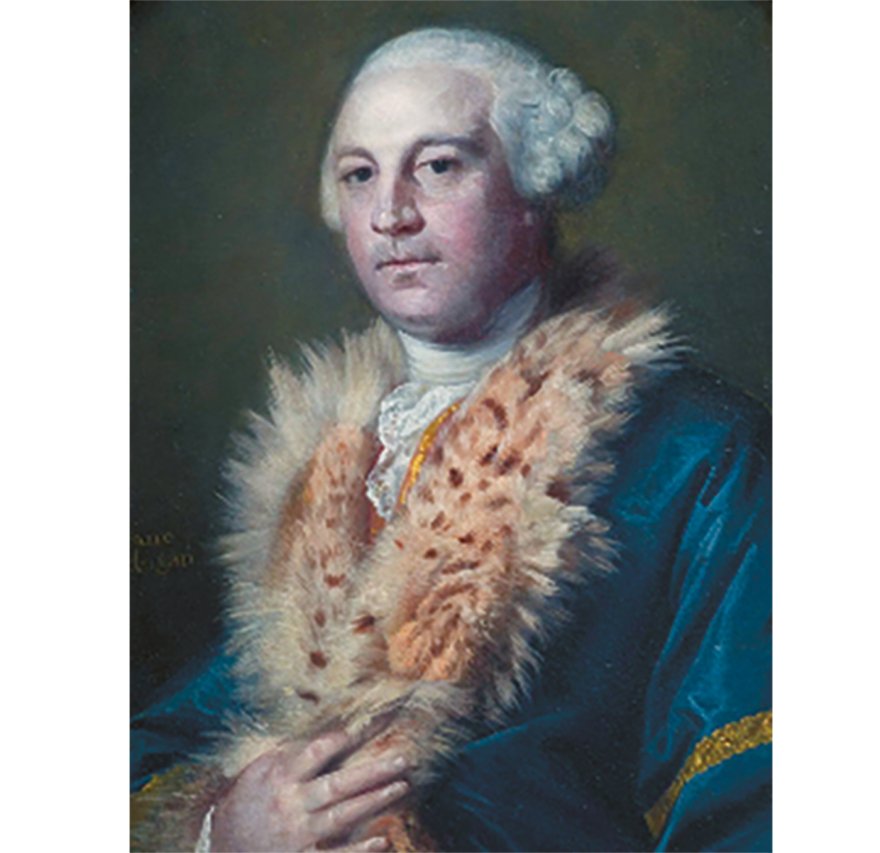
Earl Cantorgan (1769-1784), 1st lord of the so-called house, was the head of one of the richest aristocratic families in Great Britain
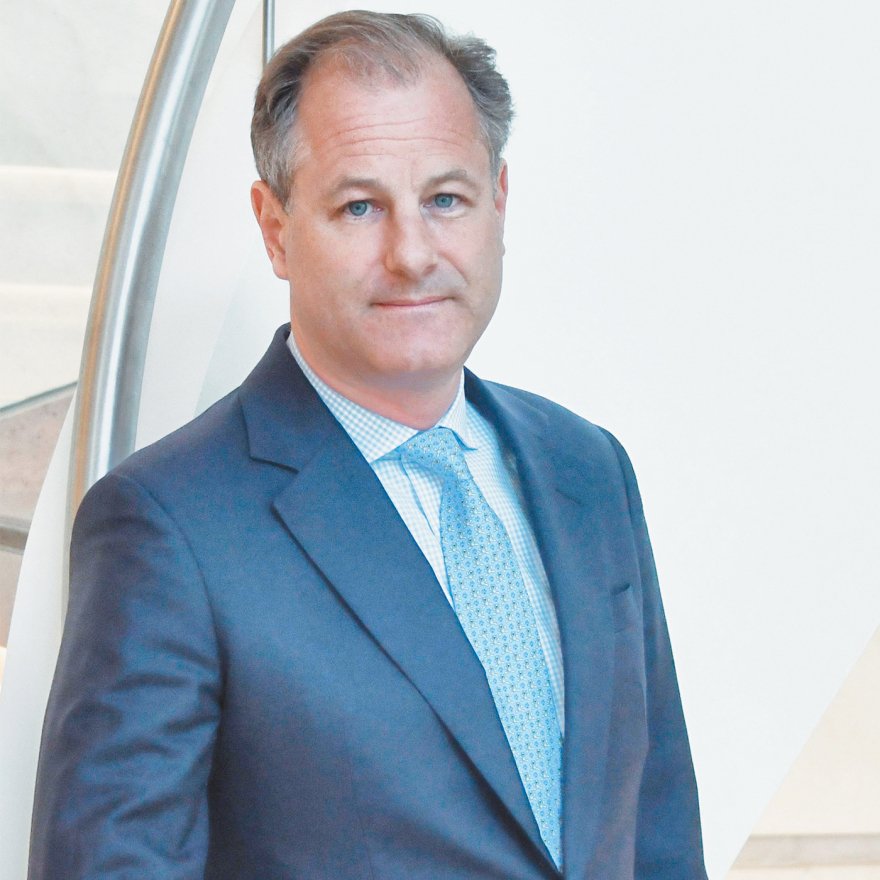
Today's title holder is Edward Cadogan, 9th Earl of Cantorgan, who manages a real estate empire over £6 billion in London
According to information from real estate agents involved in finding clients for the 5 properties of Cantorgan, the Dimitrios Panagopoulos He died suddenly. And his wife, Sandra, prefers to sell the Victorian architectural diamond mine that was inherited from her.
As the public records testify, Mr. Panagopoulos, usually along with his wife, founded numerous companies, offshore and non-shore. Most of them have ceased to exist and, of all, Mr. Panagopoulos had resigned from the position of president/director succeeding as a rule by his wife.
And she is treated as directly or indirectly involved, other than her husband's companies, in public utilities with names such as Gorgias, Myrovlytis etc. but no further signs of public presence.
Thus, the only hope of revealing the identity - or even part - of the Panagopoulos family is to publish details about the sale of their almost mythical property. Which appears to have been accumulated by Mr. Panagopoulos with real estate purchases in Kdogan Square, starting in the early 1990s.
When Chelsea was a village
Cantigan Square is often called the heart of Chelsea. Section of An aristocratic Nightbridge, the entire Cantigan area is one of those London districts that were baptized with the surname of the original landowner, in this case Lord Cantigan.
The descendants of which still play a leading role in the protection of the mansion character and the preservation of the particular glamour surrounding the Cantorgan region since the end of the 19th century.
Furthermore, the same family of aristocrats remains owner of 376,000 sq.m. real estate in the Greater Chelsea area, including parts from Nitzbridge and Belgravia – essentially in one of the most aristocratic and expensive parts of London.
As for Chelsea, 300 years ago it was just a village, diluted with some large farmhouses that stood out between meadows and orchards. However, between 1877–1890 there was huge reconstruction in the area, mainly on the initiative of visionary George Henry Cantorgan, 5th Lord of the eponymous house, who had the inspiration to build the apartment buildings, with characteristic red facades, lined along a building front, opposite the Cantorgan Square park.
Architecture
The apartments within the five-storey apartment buildings were intended for the urban class, otherwise the newly rich of the time – a demeaning designation that was not only valid metaphorically, but literally. However, the Lord Cantigan had correctly read the spirit of the period, with the profound transformation that was involved in the social stratification of the United Kingdom due to the Industrial Revolution.
So the bourgeoisie, who quickly put aside the traditional aristocracy of landowners, rushed to reside in the newly built, comfortable, airy apartments, overlooking Cantorgan Square and with amenities considered state-of-the-art in the west of the 19th century.
Reflecting the spirit of the thirsty urban class for success, the estate array in Cantorgan presents a remarkable paradox: apartment buildings bear strong similarities, but not one is an exact copy of the next one or any other. Like their tenants, who sought to dwell where appropriate, where they belong on the basis of their status and economic comfort, while at the same time they were not homogenized.
The differentiation through the similarity in Cantorgan was achieved by mixing different variations of the Victorian style of architecture. Decorative details using ceramic reliefs, the addition of elaborate patterns and large windows captured the eccentric experiments of various distinguished London architects during the last two decades of the 19th century, such as William Young, J. J. Stevenson and J. T. Robinson.
The result was the red apartment buildings, a sample of a transformation of the classical Victorian school, which stayed in the history of architecture with the style names «Queen Anne Revival», «Pont Street Dutch» et al.
Protection and respect
The Cantorgans showed rare devotion, to a degree of worship, for the area bearing their surname. Particularly the founder of the district, the 5th Lord Cantorgan, had provided for his ambitious residential plan to be integrated into a specific urban approach which provided that reconstruction would be developed on the basis of strict and inviolable specifications: arrays of apartment buildings with luxurious apartments, but built around large parks and green areas.
He saw independent urban domes, which by definition would prevent the chosen permanent residents from the city's noise and market disturbance – regardless of whether in 1880 London was decades away from what we mean today as bustling, often chaotic, metropolis.
In 1931 the garden of Cantorgan Square joined a wider protection program for London's green spaces, while since 1971 the district's buildings were classified as preserved.
Therefore, the systematic and persistent care of the Cantorgans prompted local public bodies to take the necessary initiatives to double its protection: by prohibiting further construction at the expense of green and open spaces, but also by draconian limitation of uses.
The exclusive use of real estate for habitation contributed to Cantorgan never losing her original color and commercial value. Which is confirmed by the fact that Cantorgan Square and around it constitute one of the most expensive markets real estate in Britain. For example, the average selling price of an apartment in the region is EUR 3.8-4 million.
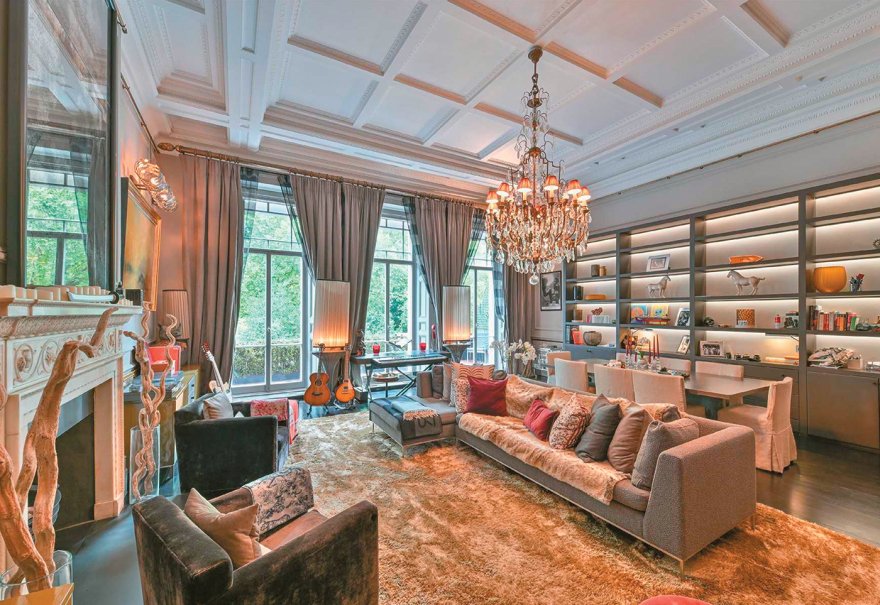
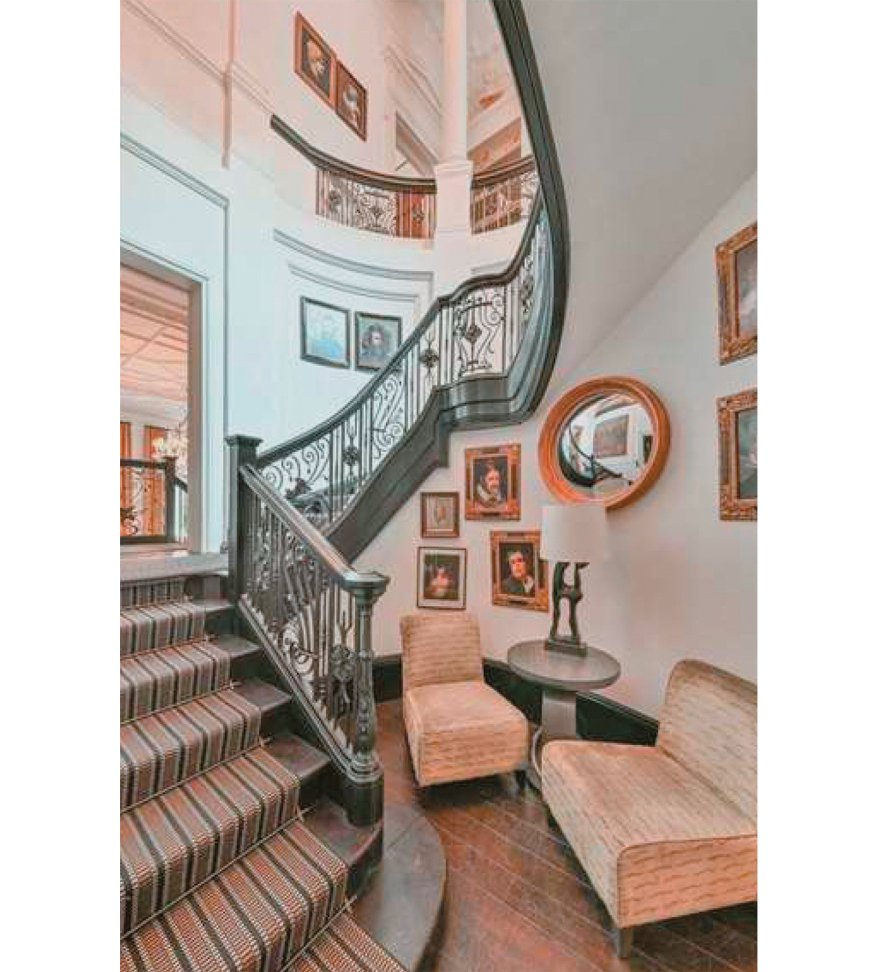
Real estate included in the portfolio «Cadogan Square Collection» have been described as being preserved since 1971. The average selling price of an apartment in the region is EUR 3.8-4 million
The properties Panagopoulos
The twin apartment building on Cantorgan Square 27-29 is the largest of the properties included in the portfolio «Cadogan Square Collection». If someone approaches Cantorgan Square from the north, possibly coming from Hyde Park, which is about 3 km away, the building at number 27-29 is the first to meet.
Even for the ultra-luxury data of the area and despite architectural uniformity, as an additional factor of imposingness, this structure stands out, mainly because of size. It extends to a total of 1,432 sq.m. and five floors – although the list of floors is relevant, as the interior layout of the spaces creates additional levels (hemibasement, elevated ground floor etc.).
However, the apartment building of Cantorgan Square 27-29 includes seven apartments and a mews house, which is located on the back of the building, on Pavilion Street, as the building is through and through, covering the entire width of the block.
On the second floor there is the compound of the double apartment building, between its two wings. These have been allocated the seven apartments, which have one to four bedrooms.
Currently, most of the apartments are inhabited. They are fully and newly renovated, combining balance keeping the original Victorian architectural style with modern aesthetics and obeying the motto that, regardless of season, the calm – even conservative – approach to luxury maintains its dynamism.
Speaking of fashion, at a distance of a short walk on foot, those residing in Cantorgan Square can be found in the center of the so-called «Prime Central London» for shopping the highest precinct on the famous Sloane Street, with several raids on the shops-galleries of houses such as Cartier, Hermès, Dior, Louis Vuitton etc.
According to the Eson2 real estate agency, which has undertaken the portfolio's promotion and sale «Cadogan Square Collection», this property may provide its new owner with revenues of EUR 1.7 million per year from leasing the seven apartments and the mews house.
And assuming that the current owner is looking for the buyer who will pay a total of £187 million for the five properties on Cantorgan Square, with a very rough calculation and a proportion of the total, the 27-29 building should be sold for around £75 million, i.e. EUR 88 million.
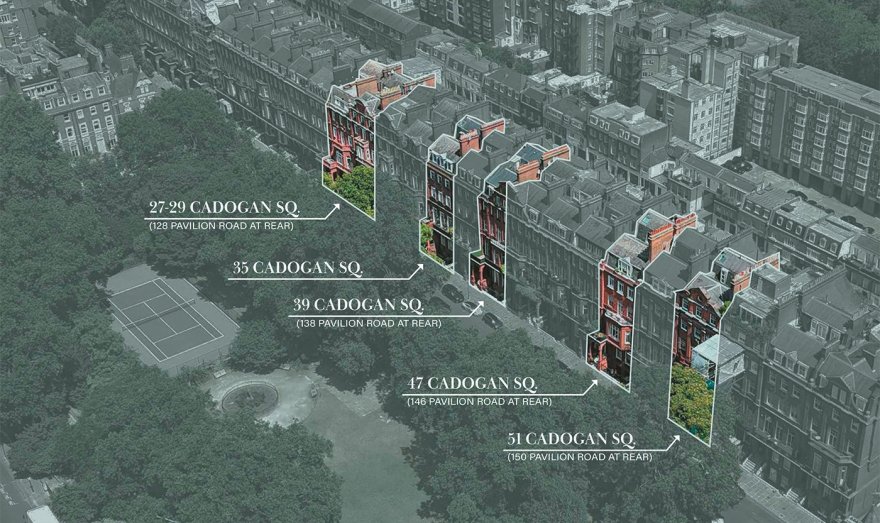
The five apartment buildings owned by Dimitris Panagopoulos in Cadogan square
Bars and rods
The irony of history lies in the fact that the original exploitation of the Cantigan region was aimed at creating a district that would meet the demands, needs and taste of the rising middle class. A category of citizens of the United Kingdom who actively claimed their own vital space in the socio-economic field, having gained power and prestige thanks to the leading role they played in Industrial Revolution.
Then, given the technology of the period, when even steam and horseback carriages dominated, mews Houses were necessary, mutatis mutandis, «parking»Stables, i.e., which were separated from the main residence, for reasons of hygiene, practicality and aesthetics.
Today, the mews houses, just like those located on the back of the five properties which co-exist the «Cadogan Square Collection», are one of the most sought after apartments – or, rather, maisonettes. Unrecognizable in relation to their distant past, the old resting grounds of horses and wagon maintenance have never been transformed into bright, fashionable, modern gold mines for the London real estate.
Of course, a property in Cantorgan is not necessarily accompanied by mews house or elevator, such as that in number 27-29. The second of the collection, at number 35, is considerably smaller than the double apartment building and consists of three apartments with two bedrooms, while the remaining four have one, three and four bedrooms.
As part of the promotion of this five-storey and also long-term apartment building, real estate brokers stress that there is the possibility of further expansion of the premises to be exploited – certainly after some work to amend the arrangement.
A major advantage for this property is that permit for building work already secured and approved by the bodies responsible for installing an external lift. Estimatedly, the rents that the next owner of the building can take at number 35 of Cantorgan Square exceed 1.3 million euros per year.
And for the sale, the negotiation is not expected to bring the final price below EUR 35 million, regardless of whether the property is the smallest of the portfolio «Cadogan Square Collection», with a total surface area of 851,36 sq.m.
The gold mine
The rest three Victorian apartment buildings Mr Panagopoulos and his family are classified among the two previous ones. Buildings vary as to the number of apartments and the existence or not of mews house, installed or approved lift etc. All three, however, are equally sought after and certainly surrounded by the unique aristocratic glamour of old London.
In detail, the property on the 39 Cantigan Square, opposite the main entrance of the park, includes six apartments and a mews house, with a total area of 1,000 sq.m. Its weekly rent may yield around 24,500 euros and the annual over 1.2m euros. In addition, the signed state permit for building interventions provides for a remarkable expansion of residential sites, which potentially increases the value of the building.
The fourth property of the Panagopoulos collection is located in number 47 of Cantorgan Square, is a total area of 948 sq.m. and includes six apartments and a mews house. The latest renovation, with serious interventions in the interior layout, was completed only three years ago. Hence the revenue expected from renting this building is estimated at EUR 1.45 million per year.
Finally, the building of Cantorgan at number 51 has a total surface area of 1,200 sq.m., includes seven apartments and one mews house, with the possibility to lease instead of 28-30,000 euros per week or 1.5 million per year. With the relevant authorisation already secured since last January, the property at this stage is under extensive remodeling, which means that after the completion of the work its value will have multiplied.
Photo by Getty images / Ideal image

