
Almost four years after the adoption of the European Directive on Adequate Persons Minimum Wages, the Commission has adopted the first assessment report on Member States, which also contains data on Collective Labour Conventions (CRPs). Greece incorporated the Directive with Law 5163/2024, binding on the European objective to cover at least 80% of workers from collective bargaining.
The National Social Agreement passed in February 2026 and presented by the government as a restoration of Collective Contracts, is only the culmination of the mandatory application of the European Directive. The agreement partially restores the principle of post-energy, but does not achieve full coverage of workers after the expiry of the CIU», as explained in in Professor of Labour Law Aris Kazakos. The constitutional right to a unilateral appeal to the Arbitration remains mutilated, while the Tripartite Committee is added, an additional barrier that removes powers from the Referees.
The above may look similar «legal» for younger generations of workers, the only contracts they have met are individual or better operational, which in their majority do not even offer wage increases as confirmed by TE. But these are matters of substance as they shield collective rights of workers, which when they negotiate alone, they are in a position of weakness towards the employer.
What about the minimum wage?
Of the 27 Member States, 20 have a statutory minimum wage while in seven countries (Austria, Belgium, Denmark, Estonia, Finland, Italy, Sweden) protection is granted exclusively through collective agreements. In 2023 the highest nominal minimum wages were recorded in Luxembourg (EUR 2,509), Germany (EUR 2,023) and the Netherlands (EUR 1,965). The lowest in Bulgaria (399 euros), Hungary (615 euros) and Latvia (620 euros). Differences shrink when measured in purchasing power units, where the distance between higher and lower minimum wages falls from about six times to less than three.
The report points to a convergence trend, as countries with lower starting levels noted the largest nominal increases, typical of Hungary (40.8%) and Romania (33.7%). In real terms, 10 of the eighteen Member States with available data showed a higher minimum wage in 2023 than in 2021. Germany recorded the biggest real increase (9%) and Romania (8.7%) followed. On the contrary, the largest real losses were found in Slovakia (-9.7%) and the Czech Republic (-11.4%).
The position of Greece
Greece joined the group of nine Member States with a minimum wage of between EUR 700 and EUR 940 in 2023, together with countries such as Croatia, Cyprus, the Czech Republic, Lithuania, Malta, Poland, Portugal and Slovakia. In terms of actual wage increases – that is, those covering inflation – Greece is at low speeds, with 3.1%, behind Croatia and Hungary (3.5% and 4.3% respectively).
Greece is also among the six countries where the minimum wage reached 60% of the median wage in 2023, along with Portugal, Slovenia, France, Poland and Germany. It is also among the countries with the biggest increase in the ratio of minimum to median wage in the period 2021-2023, with a rise of 2 to 3 percentage points, which the Commission is linking to wage depression on the basis of distribution.
The average wage is the one right in the middle of the scale, with 50% of workers being paid less and 50% more. It is considered more representative than the average, after eliminating the effects of extreme prices. The fact that the minimum wage is gradually approaching the median does not mean an overall wage improvement, but that more and more workers are crowding in on the low and middle pay scales.
Low coverage from Collective Labour Contracts
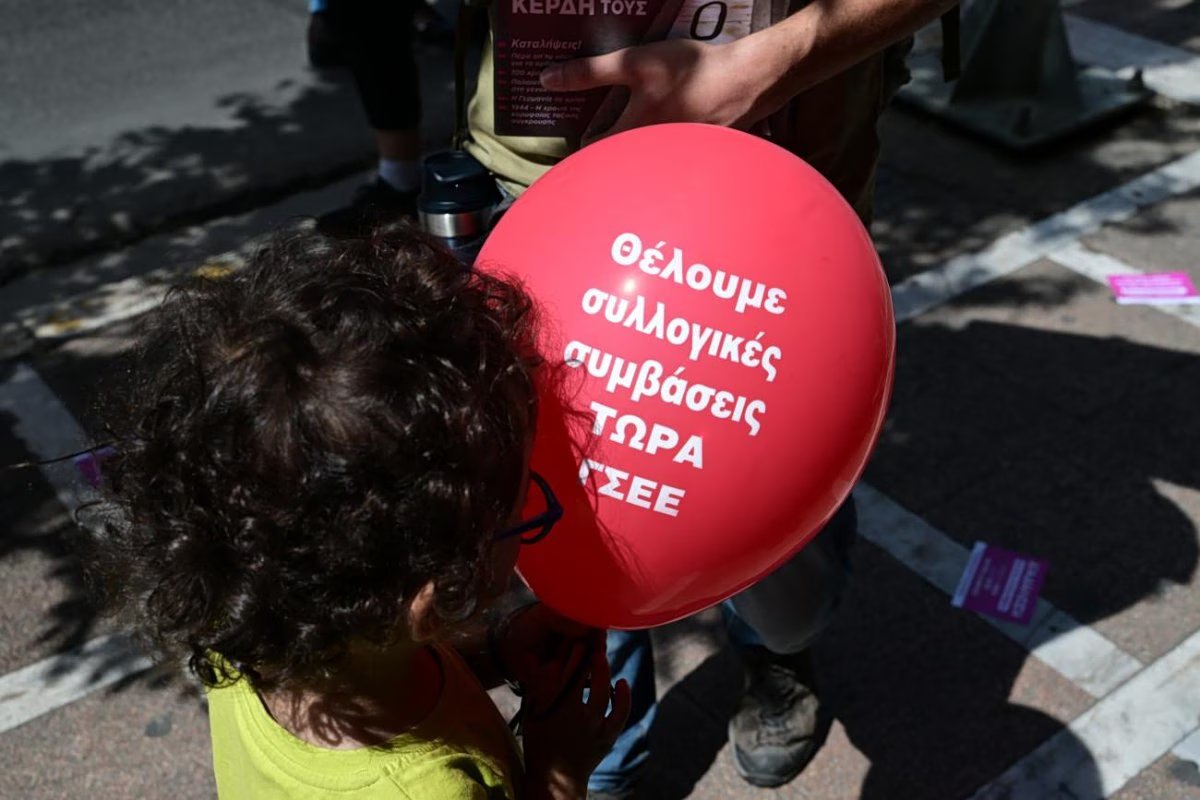
The results of the European Commission's report show that United Racing Movement, a trade union party of the GSC. «Despite the increases in the minimum wage in recent years, Greece is still characterised by extremely low coverage by Collective Labour Contracts, which restricts workers' bargaining power and acts as a brake to improve wages and working conditions» declares in in Elias Gulakis, head of the EAK and member of the GSEE administration.
According to the European Commission, the trade unionist points out, collective coverage in Greece is only 13.1%, which ranks our country in the last positions of the European Union. At the same time, countries such as Austria are covered by 94.9%, Spain 91.8%, Finland 88.8%, Sweden 88%, Portugal 83.3% and Denmark 81%. Even Germany records 49.5%, almost four times that of Greece,
«This difference is not just a number. It captures two different labour market models. In most European countries, workers are protected through strong sectoral and national collective agreements, which define salaries, allowances, hours, security conditions and labour rights. In Greece, on the other hand, the large majority of workers are out of collective protection and depend solely on the minimum wage or individual negotiations with the employer»Mr. Gulakis points out.
The wage gap with Europe is unbridled
The R&D&I representative shall declare:
«Τα μισθολογικά στοιχεία επιβεβαιώνουν ότι η χώρα μας εξακολουθεί να βρίσκεται πολύ μακριά από τον ευρωπαϊκό μέσο όρο. Σύμφωνα με τα τελευταία συγκρίσιμα στοιχεία της Eurostat για τους εργαζομένους πλήρους απασχόλησης, ο διάμεσος ακαθάριστος ετήσιος μισθός στην Ελλάδα ανέρχεται σε μόλις 17.954 ευρώ, όταν ο αντίστοιχος διάμεσος μισθός στην Ευρωπαϊκή Ένωση φτάνει τα 39.800 ευρώ. Με άλλα λόγια, ο Έλληνας εργαζόμενος λαμβάνει λιγότερο από το μισό εισόδημα του μέσου Ευρωπαίου εργαζομένου.
Δεν είναι τυχαίο ότι οι χώρες που διαθέτουν τα υψηλότερα ποσοστά συλλογικής κάλυψης έχουν και τις καλύτερες μισθολογικές επιδόσεις. Η ίδια η Ευρωπαϊκή Επιτροπή επισημαίνει ότι οι υψηλοί κατώτατοι μισθοί και οι καλύτερες αμοιβές συνδέονται συνήθως με ισχυρά συστήματα συλλογικών διαπραγματεύσεων. Οι συλλογικές συμβάσεις αποτελούν εργαλείο κοινωνικής συνοχής, βελτίωσης της παραγωγικότητας και δικαιότερης κατανομής του παραγόμενου πλούτου.
Η Ελλάδα καλείται πλέον να εφαρμόσει ειδικό Σχέδιο Δράσης για την ενίσχυση των συλλογικών διαπραγματεύσεων. Η ίδια η Ευρωπαϊκή Επιτροπή προκρίνει μέτρα για τη διευκόλυνση της επέκτασης των συλλογικών συμβάσεων, τη βελτίωση της μετενέργειας, την ενίσχυση της επίλυσης εργατικών διαφορών, τους στοχευμένους ελέγχους από την Επιθεώρηση Εργασίας και τη δημιουργία ολοκληρωμένου ψηφιακού μητρώου συλλογικών συμβάσεων.
Το πραγματικό ζητούμενο δεν είναι μόνο η αύξηση του κατώτατου μισθού. Είναι η αποκατάσταση του θεσμού των Συλλογικών Συμβάσεων Εργασίας και η διεύρυνση της κάλυψης των εργαζομένων. Όσο η Ελλάδα παραμένει στο 13,1% συλλογικής κάλυψης, όταν η υπόλοιπη Ευρώπη κινείται κοντά ή πάνω από το 80%, θα εξακολουθεί να υστερεί τόσο στους μισθούς όσο και στην ποιότητα της εργασίας. Η σύγκλιση με την Ευρώπη δεν μπορεί να είναι μόνο δημοσιονομική ή οικονομική. Πρέπει να είναι και κοινωνική. Και αυτό περνά μέσα από ισχυρές συλλογικές συμβάσεις, ουσιαστική λειτουργία του ΟΜΕΔ, κίνητρα και αντικίνητρα για τις επιχειρήσεις, αξιοπρεπείς αμοιβές και πραγματική διαπραγματευτική δύναμη για τους εργαζόμενους».

