
On 1 July the EU put a 3 euro cap on every product from Chinese platforms to protect its market. The heat, however, forces her to surrender to a Chinese product.
The climate crisis renews the records high temperature in countries which by the beginning of 2020 did not have the slightest need for air conditioning and are now unable to get out in the summer without them, with the deaths from the heat rising daily.
At the same time, the Europe had created a reduction plan for Commercial deficit China's challenge to the continent and set a new record in 2025.
In particular, its deficit of goods European Union with China reached the EUR 360 billion (it was about 15% more than 2024), while it affected all 27 Member States. Among the most popular imported Chinese products is electric equipment.
Hold this.
In the context of 'how to reduce the deficit', the European Parliament has imposed from 1 July fixed duty EUR 3 per product, orders from Temu, Shein and all other Chinese platforms, as they do not pay the VAT, customs, labour etc. of their European bonds.
To be consistent with World Trade Organisation, the EU imposed this duty in general, not only on Chinese platforms, talking about product safety and market protection.
However, a major issue has emerged, vitally important: Chinese air conditioners that have huge demand this year, for many different reasons.
Chinese air conditioners are no cheaper because they are worse than Europeans
The truth of "what you pay" has been questioned for many years, since the entire planet has access to any product of any other country (a combination of globalisation and capitalism).
The Chinese air conditioners, then, are cheaper not necessarily because they lack quality, but because
- is significantly lower labour costs in China compared to Europe, in particular about 1/4.
- is lower cost of raw materials and energy China, where there is also state support at energy, land and loans level. In China there is everything that has an air conditioner: a vertically integrated supply chain, meaning they produce everything domestically, from screw to compressor. In Europe there is a split, with many elements being Chinese.
- China produces 80% of the global air conditioning market and its components. Suppliers are thousands and mass production greatly reduces unit costs. In Europe production is much smaller and therefore more expensive.
- European air conditioners must meet stricter standards Ecodesign, Energy Labelling, for cooling, noise and safety, with research and development and certifications raising costs. It is necessary to know that Chinese exported are also adapted to requirements, but basic production is cheaper.
- European and Japanese brands charge higher prices for the reputation they have "built" and their certified durability and quality. Chinese that are still at their beginning, have the value for money as a priority.
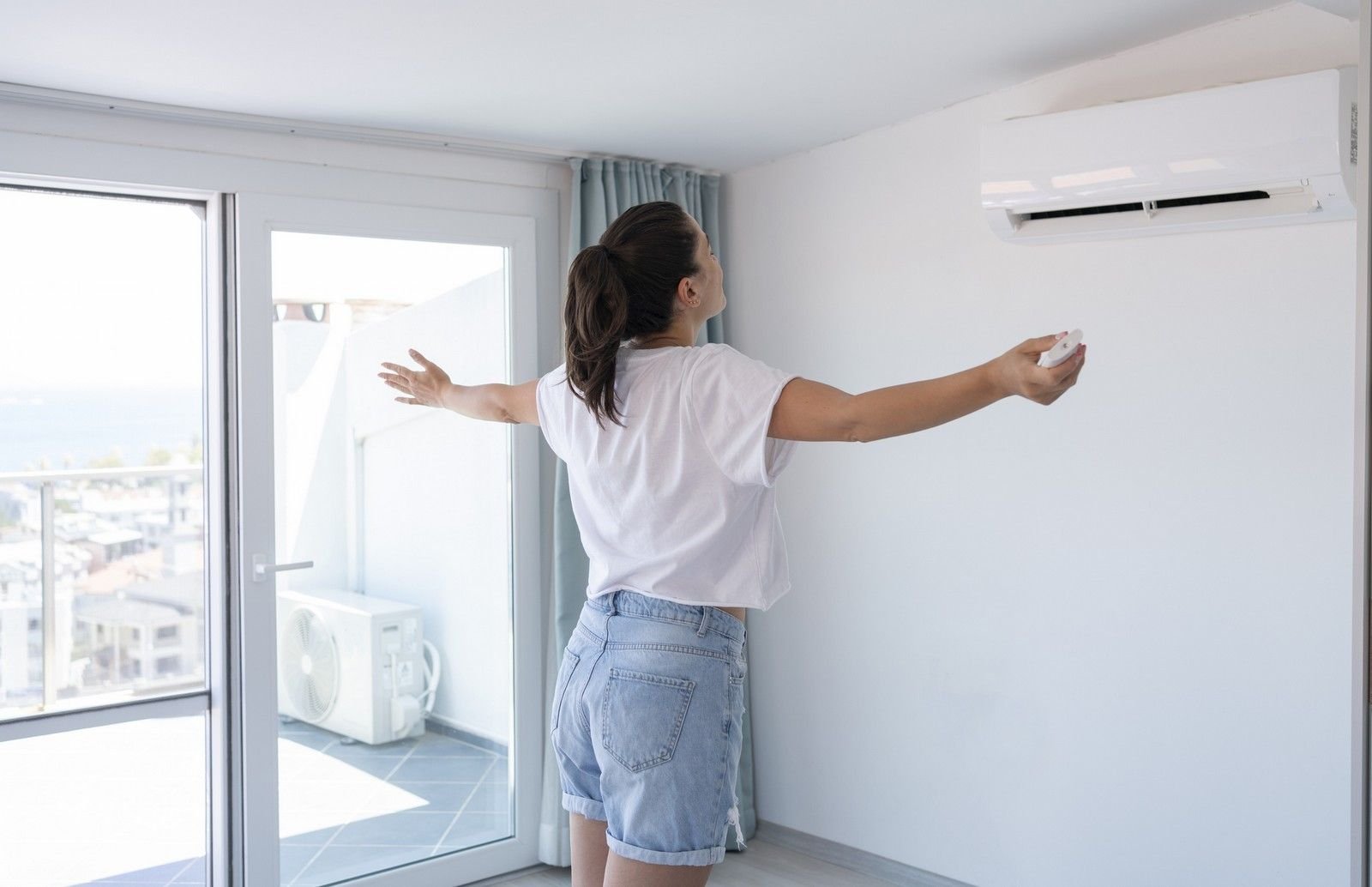
The Chinese brand that exhibited European
In Europe air conditioners have only 20% of households, which are attempting to change manufacturers from Asia.
At the moment, of the top five air conditioning brands sales in Europe, none are European, according to Euromonitore International. Two Chinese people held around 32% of the market in retail in 2025.
EU leaders have just found that there is an industrial gap, which they have decided they have to deal with. Until then, however, they will need China's help.
According to CNBC The Chinese air conditioner market has grown enormously this summer.
A specific brand sells out the model, whose outer unit can be fixed base in window And there's no need for a wall puncture.
Thus, it has no problem with the bans on the modification of the facades of historic cities in Europe, such as Paris. And the amount of cooling medium is 1 kilo and 99 grams below the French 2 kg limit.
Could he not have caught this race a European product? Yeah. Did he? Nope.
EU complaints from China and tubalin
On Monday 29/6 the European Union and China They issued a - rarely - joint declaration, following the meeting of the European Trade Head, Maros Sefkovic with the Chinese Trade Minister, Wang Wendao.
The two sides agreed to set up a bilateral working group to monitor trade flows, exchange data and manage tensions.
The main objectives of the agreement are: balancing trade and investment, export controls, intellectual property and reform of the World Trade Organisation - which regulates trade between countries.
In this regard, the WTO makes complaints when it believes that a country violates trade rules and examines the case through a committee of experts. It should also allow retaliation (e.g. customs duties), if this country does not comply.
The EU has complained about China's -high - subsidies it gives to electric cars, steel, solar panels etc., decisions by Chinese courts on European patent rights and restrictions on exports of critical materials (rare land).
China has responded with complaints of duties on Chinese electric cars, the investigation of subsidies (which the EU considers to be high) and the aid in the control of platforms (including Digital Services Act) which acts as a barrier to the entry of Chinese products into the European market.
The Eurozone chief of trade said that «Not everything will be solved, not everything will be fixed, but we believe that between now and October, our teams have enough time to deliver the tangible results.
Chinese exports to the EU continue to increase, while our market share in China continues to shrink», trend which as he said is unsustainable.
Beijing made it clear that it will not hesitate to react to any new trade restrictions aimed at addressing the issue of overcapacity.

