
Greece is in its penultimate position Euro area for the adjusted gross disposable income per resident in 2024, with Latvia occupying the last position, as stated by the Alpha Bank in the last financial statement.
Among other things, in Alpha Bank's economic development report, it is noted that among the Eurozone countries it is penultimate at the same time that according to its data European Central Bank (ECB), the value of gross household wealth in Greece exceeded 1 trillion euros.
Specific, based on the latest data available for 2024, Greece was in the penultimate position, recording higher performance only compared to Latvia. It is noted that for the same period no data are available for Bulgaria, which in 2022 recorded lower per capita adjusted disposable income from Greece.
The value of gross household wealth in Greece exceeded 1 trillion euros at current prices in the fourth quarter of 2025. In this development, the wider improvement in macroeconomic conditions, the strong performance of tourism, the strengthening of the country's fiscal credibility especially after the recovery of the investment tier, as well as the rise of the domestic stock market, as the bank estimates.
The gross disposable income households in Greece remains in upward orbit over the last two years, with an average annual growth rate of close to 5%The upward trend continued in the first quarter of 2026 (+ 3.2%, on an annual basis). At the same time, the increase in gross disposable income was stronger than average annual inflation in the same period (3%), contributing to the gradual recovery of part of the actual income losses suffered by households in the two years 2022–2023, due to the intense inflationary pressures.
Saving, however, remained negative (approximately -3% of gross disposable income), as private consumption in nominal terms exceeded the disposable income of households, which shows that part of consumer expenditure is still funded by alternative sources, such as the exploitation of savings accumulated during the pandemic period, but also bank lending.
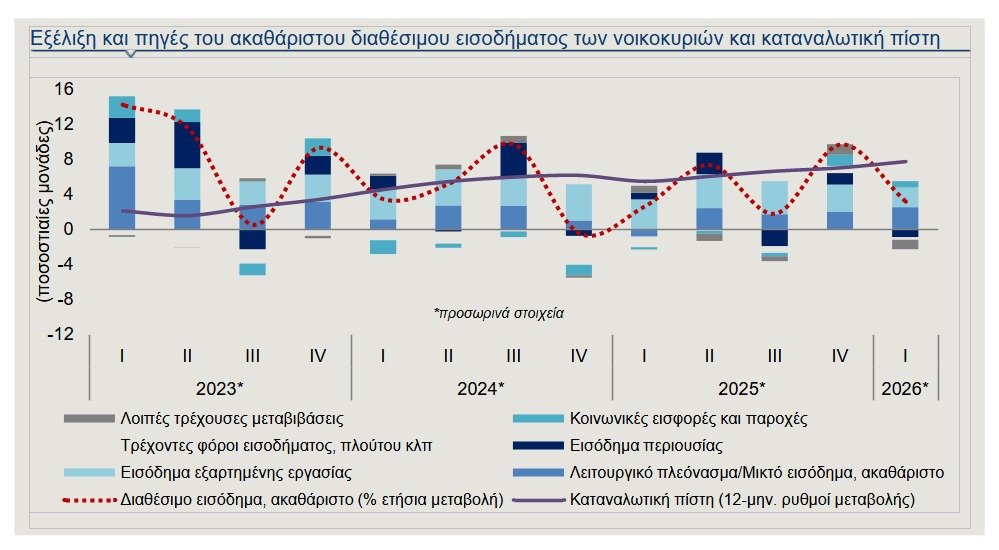
With regard to the latter, the 12-month rate of change in consumer loans in the domestic banking system is moving heavily upwards, with the latest available element (June) being formed at 6.9%. Moreover, the more the value of household assets increases, the greater the sense of economic security, which can lead to an increase in consumption.
The growth in economic activity and employment in recent years, it is one of the key factors that boosted the disposable income of households, notes Alpha Bank. This is reflected in the financial composition of the increase in gross disposable income. In particular, the rise in household incomes in the two years 2024-2025 It came primarily from dependent labour pay and secondary to the operating surplus/mixed income of self-employed and individual enterprises.
These two categories continued to record rise in the first quarter of 2026 Case 4.3% and 6% respectively. Property income also contributed positively in the two years 2024-2025 - although to a lesser extent - while the rise in gross disposable income of households was partially limited by the negative contribution of direct taxes. It should be noted that this latter category is positively related to household income.
Over 1 trillion households' wealth
As to the value of the wealth of households in Greece, It has been growing strongly since mid-2022, while accelerated further over the last two yearsThis rise can be interpreted by the appreciation of existing assets and, to some extent, by the creation of new wealth.
According to data from the European Central Bank (ECB), the value of gross household wealth in Greece over EUR 1 trillion at current prices in the fourth quarter of 2025, recording cumulative increase of 19% or 161 billion euros over two years 2024-2025.
Of the individual subcategories of financial wealth, mutual/investment funds that have doubled their value over a two-year period are distinguished. Financial business wealth and quoted shares followed, followed by bonds, life insurance and deposits.
Regarding non-financial wealth, the value of real estate increased by 16% and non-financial business wealth by 13%. Notable is the change recorded in recent years in the proportion of financial and non-financial wealth in favour of the former.
In particular, in the fourth quarter of 2018, the year in which the recovery of the Greek economy began, the value of financial wealth represented only 26% of total gross wealth of households, with this rate increasing steadily and being shaped since then 37% at the end of 2025.

