
The case has been registered in the European RASFF system as «serious risk», while the Greek authorities are now involved in the process of tracing and following p
European dimension is taken into account in the Case of recall of olive oil originating in Crete in Germany, after formal registration of the case in the European Rapid Alert System for Food and Feed RASFF as «Alert notification» with evaluation «serious risk» because of excess 3-MCPD, chemical pollutant associated with industrial processing of vegetable oils. The notification was submitted by the German authorities, following an official market inspection and already bears the indication «EC validated», which means that it has been ratified at European Commission level.
SEE ALSO | Metal fragments in ice cream known brand – Remove 5 flavors
The European Food Safety Authority EFSA has assessed that 3-MCPD may cause nephrotoxic effects in animals and may affect fertility at high doses, Therefore, tolerable daily intake has been set in 0,8 μg/k g weight per day. glycidyl esters, often seen together with MCPD compounds, are considered to be even more aggravating due to the metabolite glycidol, which is characterised by genotoxic and possibly carcinogenic, without a safe exposure limit established.
SEE ALSO | Parasite crawls out of sushi on a restaurant dish before being consumed – Unbelievable video
The product is recorded as «Olive oil for frying» in category «Fats and oils». According to the official information of the alert, levels were identified 3-monochloropropane-1,2-diol (3-MCPD) at 2356 ± 706,8 μg/kg, with a maximum permissible limit of 1250 μg/kg. The indication «±706,8» concerns scientific uncertainty of laboratory measurement. In other words, the actual value can be statistically found around ~1649 to 1649 ~3063 μg/kg. That is, even in the lowest possible range of analysis, the recorded value remains above the institutionalized limit, which led to the categorisation of the case as «serious risk».
SEE ALSO | The boiling egg diet: What includes, how many pounds you can lose and what restrictions are
SEE ALSO | Group action against colossal e-commerce why «hides» dangerous ingredients in sunscreens
The product withdrawn was marketed on the German market under the name «Bratolivenöl aus Kreta» the GHORBAN® brand (see photo below) in a package of 750 ml. The withdrawal concerns the lot LOT 250471 with a minimum durability date of 20.02.2027. The product was disposed of viaretail chains, including REWE and Edeka. Ghorban Delikatessen Manufaktur GmbH called on consumers not to use the product and return it to market points for a refund, even without proof of purchase.
SEE ALSO | What milk is most at risko oor high temperatures? What a new study reveals
SEE ALSO | 2,000-year-old bread was found intact in an ancient Roman camp in Switzerland
The new formal notification differentiates some data presented in the German authorities’ communication, which referred to total MCPD esters levels at 2386 μg/kg and a 1950 μg/kg limit. Official European notice shall refer specifically to 3-MCPD and records a different ceiling at 1250 μg/kg, which relates to the type of pollutant, the form of analysis and the product category. The limits for MCPD and glycidyl esters in the European Union are established through the regulatory framework for food pollutants and its related amendments under Regulation (EC) No 1881/2006.
SEE ALSO | Children's anger bursts and aggression: Scientists have discovered that the best medicine is fruit!
It is of particular importance that the notification shows the indication «Greece (ffup)», that is «Flagged for Follow-U p». This particular indication means that the Greek authorities are now officially involved in the batch investigation and tracing process. Controls are therefore expected in lots, standardisation facilities, storage tanks, refining and blending procedures as well as in the export and handling chain. The activation of a follow-up process does not mean that there is currently a new withdrawal on the Greek market, however it shows that the case remains open at European level.
SEE ALSO | Why two European company cheesecakes were rejected, although they comply with the legislation
So far neither the German nor European authorities have made public the name of a Greek production or printing company associated with the lot. In private label products of this type, the indication of geographical origin often concerns the raw material and not necessarily a particular branded company appearing on the packaging. In the vegetable oil marketing chain, refining and final processing are not necessarily carried out in the country of origin of the raw material, which is the main subject of the tracing process. Traceability exists at food control level, but without always making all elements of the production and standardisation chain public.
SEE ALSO | Fish: How to identify if it is fresh in 5 steps
A critical element of the case is also considered to be the product designation as «Olive oil for frying». On the food market products of this type are usually not simply extra virgin olive oil but refined olive oil or blend of refined and virgin oils, designed for use at high temperatures. This type of industrial process takes place stages such as refining and deodorization, in which oils are exposed to temperatures that often exceed 200°C. In these circumstances, triglycerides and chlorinated compound residues can react by forming MCPDs and glycidyl esters.
3-MCPD and 2-MCPD compounds and their fatty esters are not natural ingredients of olive oil in the olive grove or during primary production. Their presence is mainly linked to subsequent stages of processing, mixing and standardisation. This means that the case does not automatically refer to a problem with the Cretan olive grove or a specific Greek producer, but mainly to processes of the industrial chain of quality processing and control.
SEE ALSO | Dairy products: What will happen to your body if you stop consuming them – Benefits and hidden risks
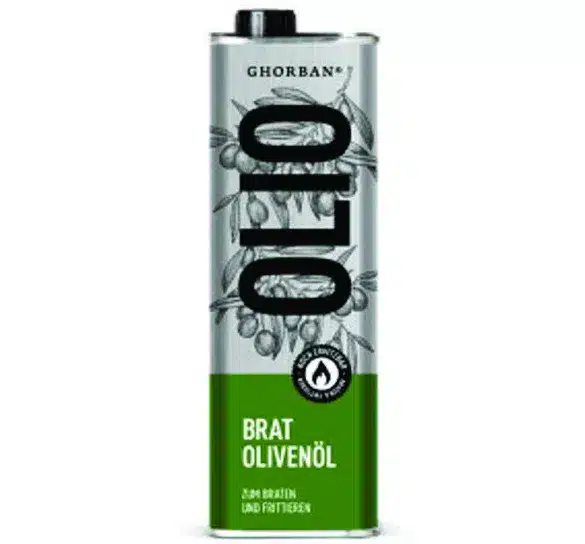 Olive oil withdrawn in Germany
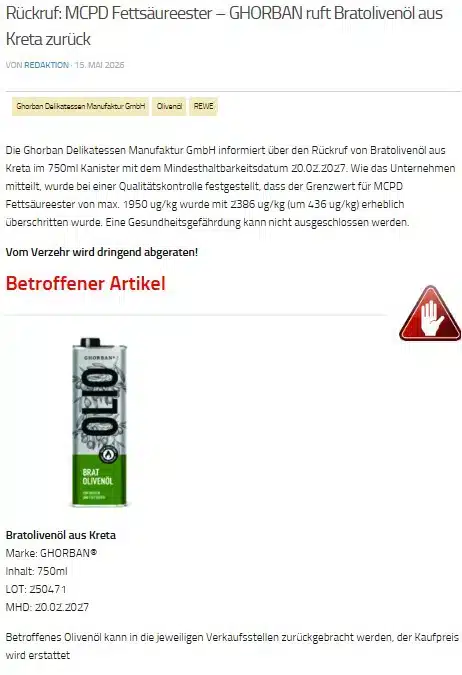 The announcement of the German authorities
SEE ALSO | Why are 90% of people born right-handed?
SEE ALSO | Finally, sales of cannabis products from stands and mini markets
SEE ALSO | They are sweeter potatoes than sweet potatoes. «classic» potatoes?
SEE ALSO | Test device for batteries (!) gives «fingerprint» in the coffee and reveals the secrets of its taste

