
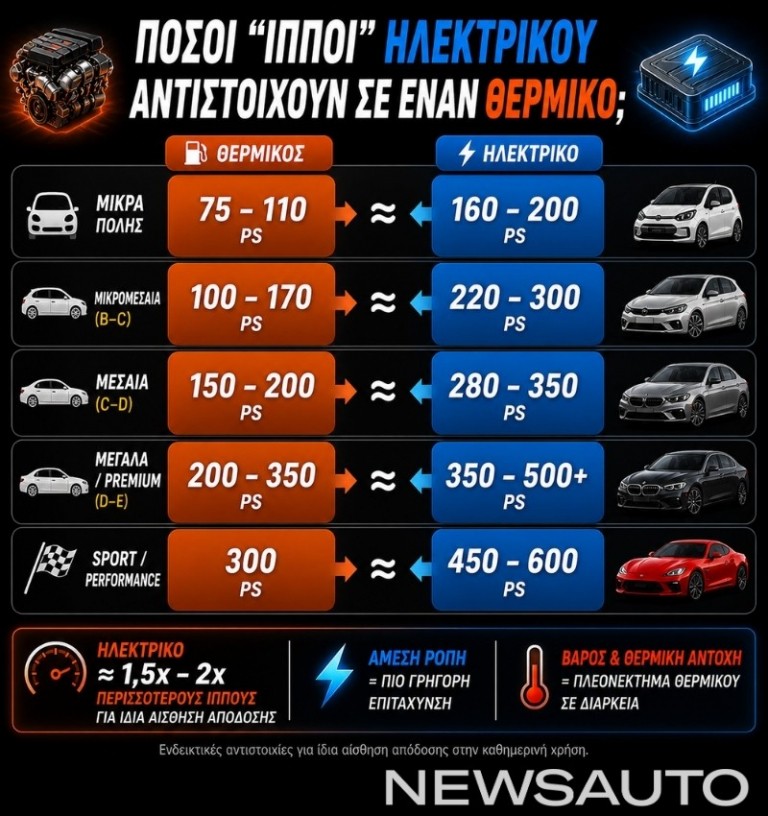
Hundreds of horses — once a minimum privilege, exclusively those who could spare tens or even hundreds of thousands of euros for a high-level thermal car — have now found their way into many more hands. Electrification made them accessible. This does not mean, however, that the hands that hold them are ready to handle them.
Three hundred horses for all
To understand the magnitude of the change that has taken place, a simple comparison is sufficient. In a thermal engine, 300 horses mean a high performance car that costs too much and requires experience to be safely driven. In the world of electricity, this number is released on middle-class models. The new KOK, the programmes «Moving Electricly» and the vertical fall in the cost of batteries have brought cars with huge horsepower and direct, violent acceleration, to the citizens garage that a few years ago drove a 1,400 family.
The issue is not ideological or unmotivating. Electric cars have undeniable advantages — Environmental, economic, technological. The point is, the laws of physics don't change depending on the energy source. Three hundred horses from an electric motor are actually three hundred horses, except the electric engine yields its maximum torque from zero rpm — That is, from a stop, immediately, without warning, without reaction time for the untrained driver.
The lamps speak
This reality is not abstract. Lighthouses and body repair workshops throughout Greece see the picture daily. Electric cars have flooded their yards. A typical example is its authorised body repair crews Tesla, where the waiting time for a lamp factory appointment exceeds one and a half months to two months — and this despite the expanding partner cycle, such as Karenta, that has joined the certified body repair network of the American company in our country. The workload is such that even with better organization and enhanced staff, demand leaves behind large waiting lists.
These figures are the tangible evidence that thousands of drivers manage daily vehicles with performance that do not correspond to the training they have received.
A training designed for another era
The Greek driver training system remains largely unchanged — a system designed for slower, thermal cars. Education focuses on signals, priority rules, violations a course and a parking reverse. These, of course, are necessary, but not enough for a driver who suddenly sits behind 400 horses responding in 3-5 seconds.
Where is the Greek driver taught how the dynamic movement of a heavy electric car differs? — with hundreds of pounds of batteries down the body — From a conventional? Where does it learn that regenerative braking radically changes the way the vehicle slows down? Where does he get familiar with the reaction of such a car to a high-speed turn, a wet road, an emergency? The answer, in general, is nowhere. And this is a void that cannot be ignored for much longer.
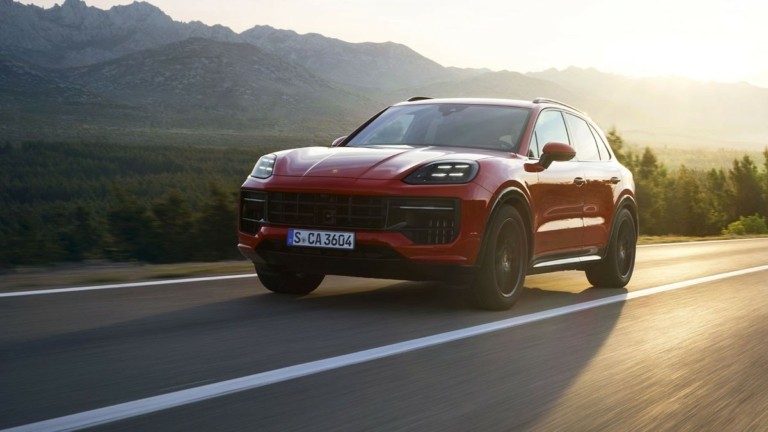
The new Porsche Cayenne delivers 1,156 horsepower!
Europe...
In other European countries, dealing with the issue has already begun. In Germany, the extension of electrification was accompanied by a review of educational protocols and mandatory insurance coverage differentiated according to vehicle power. In Spain, accidents with electric motor vehicles led to significant increases in the legal framework and the introduction of compulsory insurance. The general trend in Europe shows that increasing the power and penetration of electric vehicles cannot only be addressed by traffic rules — requires renewed education, especially specialist.
In Greece, the private initiative of some driving schools to use electrically as an educator is a promising signal, but remains an isolated move — an exception that confirms the rule.
What does he need now?
The Ministry of Transport is called upon to deal with this reality by substantial interventions, not announcements. Three things seem to be urgently needed.
In this direction three are the key changes affecting developments:, the revision of the training framework for the award of new diplomas to include practical training in vehicles with high horsepower, electrical or thermal strength. Second, introducing optional — and maybe eventually mandatory — re-education programmes for existing holders of diplomas who first acquire a strong electric vehicle.
Third, the integration of traffic education from very early in school education — a proposal that representatives of the Driving Instructors Federation have repeatedly put into the public debate without even being heard.
Electrokinesis is present. The horses... are already running on the Greek streets. The question that remains unanswered is whether the state will take responsibility for training those who hold them.
Share it

