
Israel and Lebanon's ceasefire deal has led to a decline in international prices oil, however the uncertainty over the duration of the truce and the final outcome of the talks, along with Iran's threat of remaining «with his finger on the trigger if Israel violates the truce», they do not help markets return to pre-war levels.
The temporary withdrawal of Brent to $98 or even $96 per barrel appears not to be enough to reduce the prices of Fuel in the domestic market, moreover, it is recalled that oil prices had jumped about 50% in March over $100 a barrel.
Despite the reduction in international prices, consumers should not expect a return to pre-war levels the former president of the Pan-Hellenic Federation of Fuel Agents estimates features George Asmatoglu, who in his statements this week reported that «the price close to 2 euros per litre appears to be shaped as the new normality in the fuel market».
It is worth noting that the reduction in the price of oil in international markets does not directly translate into a corresponding drop in the pump, although many consumers noted that the price increase «Come in.» almost immediately at the cost of petrol and diesel traffic.
Which areas have the most expensive petrol
In the islands of Cyclades, Kefalonia and the Dodecanese, the largest average prices appear in 95 octane amulet, according to the latest daily follow-up bulletin Prices Fuel the Ministry of Development.
In particular, at the time that the first price reductions are already shown marginally below two euros in some fuel stations, the average price in Kefalonia is 2,115 euros/litre, in the Dodecanese touched 2,131 euros/litre and in the Cyclades reached 2,208 euros/litre.
At the same time, in the Cyclades and Dodecanese, the highest prices of petrol are recorded with 2,213 euros/litre and 2,112 euros/litre respectively.
See all the prices here:
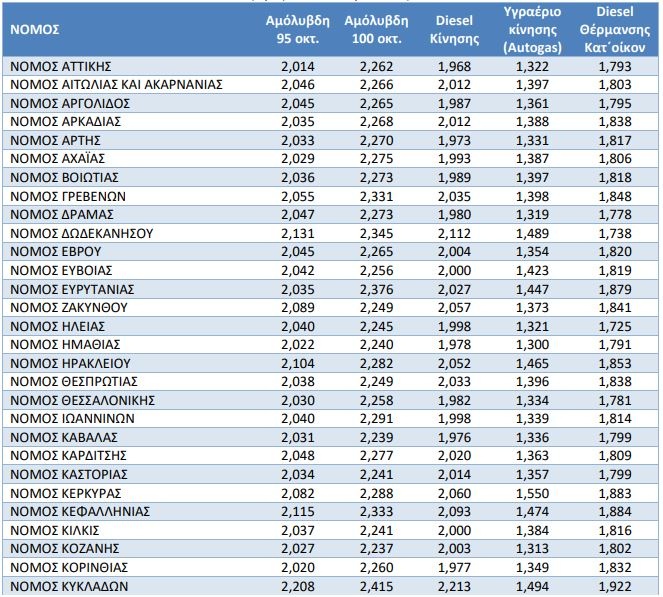
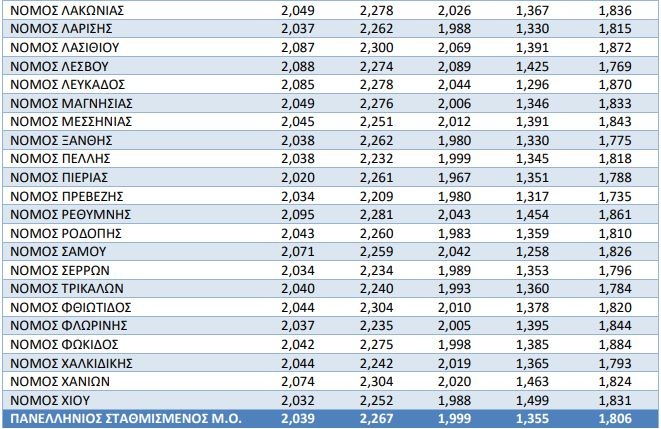
At EUR 1,968/litre, the average price of diesel traffic in Attica is EUR 1,967/litre in Pieria Prefecture, where the lowest average price is recorded.
How likely new aid is to be granted
According to government sources, the economy remains a priority and the economic programme is already being re-evaluated.
The constant reversals on the war front, vindicate those in government who said before Easter that «It doesn't seem like the truce is holding.» and the Maximus Palace will soon be called upon to decide whether to proceed with an extension of measures for oil, fuel pass and fertilizers.
As they say from the financial staff, scenarios for new measures are being considered, but there are still no concrete decisions, as there is no clear picture of the duration and intensity of the crisis and careful use of budgetary resources is required for 'fuel' and for longer-term support. Read more here.

