
Gen Z enters the financial markets in a way that no previous generation has done. By pushing digital tools, social media and increasing economic uncertainty, young adults invest earlier, more often and more confident than their parents did at the same age.
Ambrico Ranginui first came into contact with cryptocurrencies at the age of just 12, Like he told the Guardian.
At 16, he was already investing money he had saved from his allowance and birthday gifts. His mobilization, he says, was shaped by the fact that he grew up in a single-parent family and wanted to secure economic independence early.
«I wanted to find new ways to make money and cryptocurrencies were so exciting at the time.», explain.
Ranginui's experience is increasingly common among Gen Z investors entering the financial markets in their teens or early 20s, often before achieving full economic independence or stable employment.
The rise in early investment
Recent evidence underlines how important Generation Z differs from previous generations.
According to a report by the World Economic Forum, nearly 30% of persons born between 1997 and 2012 begin investing in early adult life — or even earlier — compared to 15% of the millennials and only 9% of the X Generation.
This shift is due to a combination of accessibility and necessity. Investment platforms, mobile applications and online communities have eliminated traditional entry barriers. At the same time, economic pressures encourage young people to seek alternative financial routes earlier in their lives.
Many Gen Z investors describe the feeling that traditional financial security systems are no longer reliable.
Increasing living costs, job instability and the weakest retirement structures have transferred responsibility for long-term financial planning to individuals much earlier than in the past.
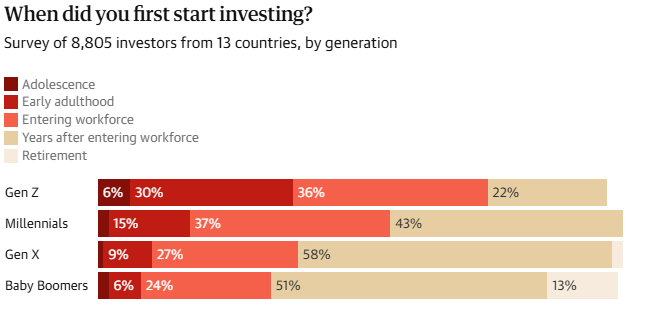
Guardian's Graphic, Source: World Economic Forum, World Report on Individual Investors 2024
Economic pressure and breakdown of security networks
The wider economic environment plays a central role in shaping the financial behaviour of Generation Z.
Unemployment among young adults aged 22 to 27 is almost 8%, compared to about 6% seven years ago and 4.3% in the wider US population. Meanwhile, inflation and housing costs continue to increase worldwide.
At the same time, social security nets shrink.
Pensions funded by employers become less common, while public social welfare systems in many countries have suffered cuts or restructurings. Overall, these changes have created a generation that feels less financially safe than the previous ones.
Natalia Guseva, head of the financial market initiatives and resilience at the World Economic Forum, clearly describes this change: Generation Z has «less economic stability and social security nets, so the weight shifts to the individual to think about his economic well-being».
It also highlights technology as an important acceleration factor. With the investment platforms available on smartphones, young people can now have direct access to global markets — something inconceivable for previous generations at their age.
Applications, social instruments and normalisation of investment
Digital platforms have played an important role in shaping Gen Z's economic habits.
Investment applications such as Sharesies in New Zealand have made transactions simple and visually accessible, while social media have normalized discussions on investments, cryptocurrency and wealth creation.
Ranginui credits platforms such as Sharesies the influence they exercised on his generation.
«They appeared on the grounds of Generation Z in social media and, with all the resources of economic education available on the platform itself, it was very easy to trust and invest them.»He said.
This combination of education, community and accessibility has reduced psychological entry barriers.
Investment is no longer considered to be intended solely for financial sector professionals — is increasingly treated as a common habit of personal finance.
Slow and steady: The rise in long-term investment
Despite headlines on the dangers of cryptocurrency and trade, the majority of the investors of Generation Z actually follow a careful approach.
Many give priority to low-cost, differentiated mutual funds, such as negotiable mutual funds (ETFs), which distribute risk to broad market segments.
Andy Reed, head of the behavioral economy survey in Vanguard, notes that Gen Z is unusually cost sensitive.
«It is probably the generation with the greatest cost sensitivity, which will pay off in the long term»He said. «They learn about investments early on and show real interest in participating in the market».
The data supports this trend. About 75% of Generation Z investors hold ETFs in their pension accounts, compared to about 60% of baby boomers, according to a Nasdaq study.
Creating wealth early and automatically
For many new investors, the focus is not fast profits, but long-term economic independence.
Shivana Anand, a 23-year-old software engineer in California, began investing as soon as she entered the university.
He opened an IRA Roth account and invested in index mutual funds while working on a paid-up practice.
Her strategy is simple: we automate and forget.
«My money must work for me.»He said. «I invest slowly and firmly, which is the tried and reliable method».
Her portfolio has now reached the $500,000 range, built through fixed contributions rather than through high risk speculation.
Transactions, cryptocurrency and speculation
While many G Generation investors tend towards sustainability, a smaller group is attracted to high risk trading strategies. These include daily transactions, cryptocurrencies, and speculative markets.
Experts warn that this behavior sometimes resembles gambling rather than investment. The volatility of these markets can lead to significant losses, especially for inexperienced investors.
Minwoo Lim, founder of the PnL trading application, recognizes the risks firsthand. After starting dealing with trades after his military service in South Korea, he focused on commodities such as crude oil instead of traditional shares.
«Gambling, by definition, is risking everything to earn a lot of money.»He said.
«The same applies to transactions».
Lim appreciates that only a small percentage of day traders earn steady profits and emphasises that discipline and psychology are more important than strategy alone.
«First it's strategy, then discipline and then psychology.»He said. «We're very greedy. We want to earn more and work less».
Despite his success, Lim does not encourage others to engage in full-time trading, but recommends long-term investment in indicators as a safer course.
Artificial intelligence and the new era of making financial decisions
Artificial intelligence becomes another significant influence on the behavior of the investors of Generation Z.
Almost 41% of its respondents say they trust artificial intelligence tools to manage their portfolios.
For many, artificial intelligence acts as a financial assistant — summarising reports, analyzing portfolios and proposing diversification strategies.
Kelly Noel Mbunui Kameni, a 22-year-old economics student in Kenya, regularly uses ChatGPT to analyze her investments.
«I photograph my portfolio and ask ChatGPT for suggestions.»He said.
«Artificial intelligence is just very convenient».
Kameni has invested about $400, a small but deliberate start to long-term economic independence. She plans to continue building her portfolio while attending higher education.

