
From that day on, no new car will be able to be sold to the EU unless it fully carries the envisaged security systems, regardless of when its platform was designed.
It is worth making an important clarification that is often lost in the public debate: most of these systems are not new. It was already mandatory since July 2024, but only for cars then receiving new type approval. 2026 marks full implementation without any exception — Any model that does not comply is withdrawn from the market. Manufacturers with elderly platforms not upgraded in time are in a difficult position.
Systems for each driver
The most directly perceived technology is the Emergency Stop Signal (ESS). When a vehicle brakes sharply at a speed above 50 km/h at a deceleration of more than 6 m/s2, the rear lights begin to flash quickly rather than remain constant. Aim: to warn the driver back in time, reducing the risk of carambolas — the most classic cause of accidents on Greek highways.
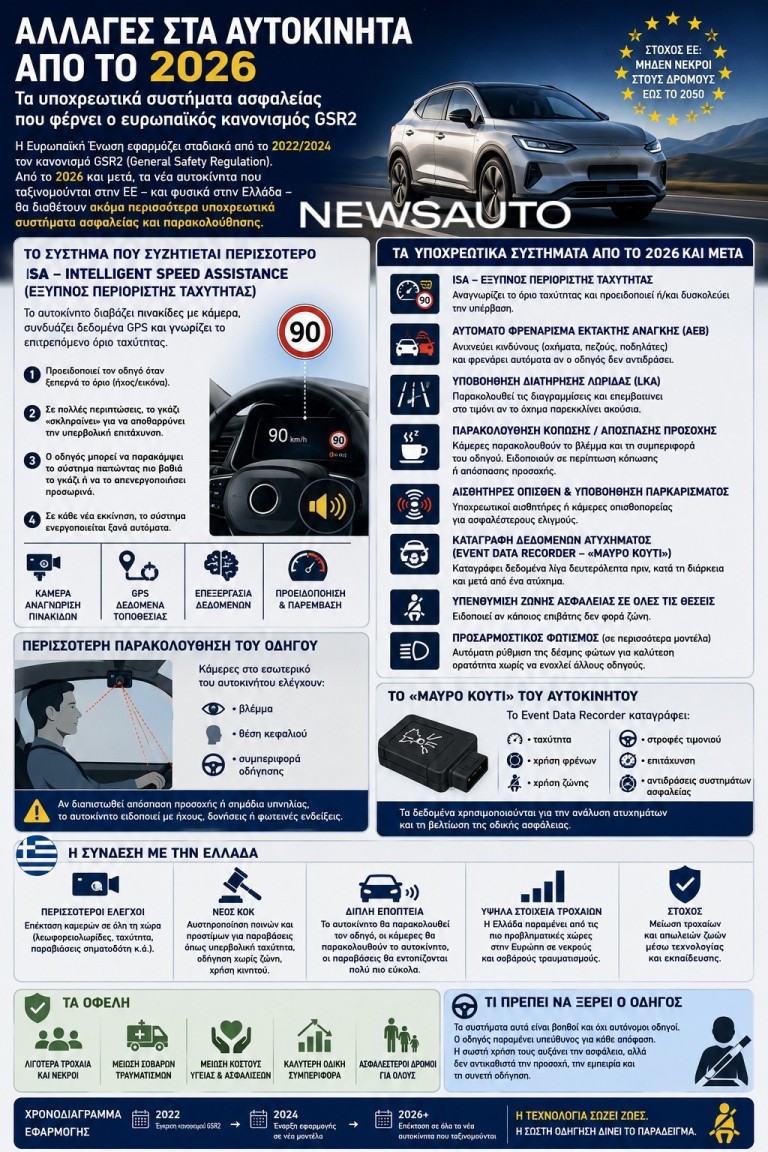
At the same time it is mandatory: the Intelligent Speed Assistance (ISA), a system that recognizes speed limits and alerts the driver or interferes with the engine· Automatic emergency braking (AEB) by detecting pedestrians and cyclists· Lane Keeping Assist· DDAW· and cameras or retrograde sensors.
Two more mandatory elements causing wider concern: the accident data recorder (EDR) — the so-called «black box» car — which stores the latest motion data before each collision, and the pre-installed interface for an alcohol test system that can in future block the vehicle's startup if the driver has consumed alcohol.
How expensive will cars be?
The cost is impossible to ignore. According to estimates from the European Commission, the integration of all required systems adds between EUR 400 and EUR 1,500 per vehicle, depending on its category. The charge is proportionately heavier in small and economic models — an extra cost of 1,000 euros in a car worth 15,000 euros corresponds to more than 6% of its price.
This is why manufacturers such as Volkswagen and other European giants have been running for the last few months to unload the stocks of older models with attractive offers — cars not yet required by new systems and therefore cost less. For the Greek consumer who is considering buying a new vehicle in the coming months, this translates into a short window of opportunity.
The question that remains open
The argument in favour of new regulations is strong: Greece remains stable in the latest road safety positions in the EUWith dozens of dead every year in preventable accidents. Technologies such as the AEB and the ESS have proven to have reduced the number of back conflicts in countries that adopted them early.
However, the issue of intervention remains. The ISA, for example, receives strong criticism from drivers who consider that a system that is «He's fighting.» with the gas pedal instead of letting the driver judge for himself, it does not improve but weakens driving ability. And the «black box» raises reasonable questions about who will have access to the data and under what circumstances.
These are questions that Europe does not seem to have answered with sufficient public debate. The new era of motorism arrives in the meantime — Whether the drivers are ready or not.
NEWS TODAY
End of season for old cars – What comes in Greece
Find it and take it easier than ever.
Share it

