
Compensation trends characterize the Greek labour market in the first quarter of 2026. On the one hand, the Employment It moved downwards in most sectors of the economy. On the other hand, wage costs increased at a marginal rate than in the corresponding period of 2025. As for the wage and salary index, there was a fall in both of the four sectors of industry, and in three of the eight sectors of services.
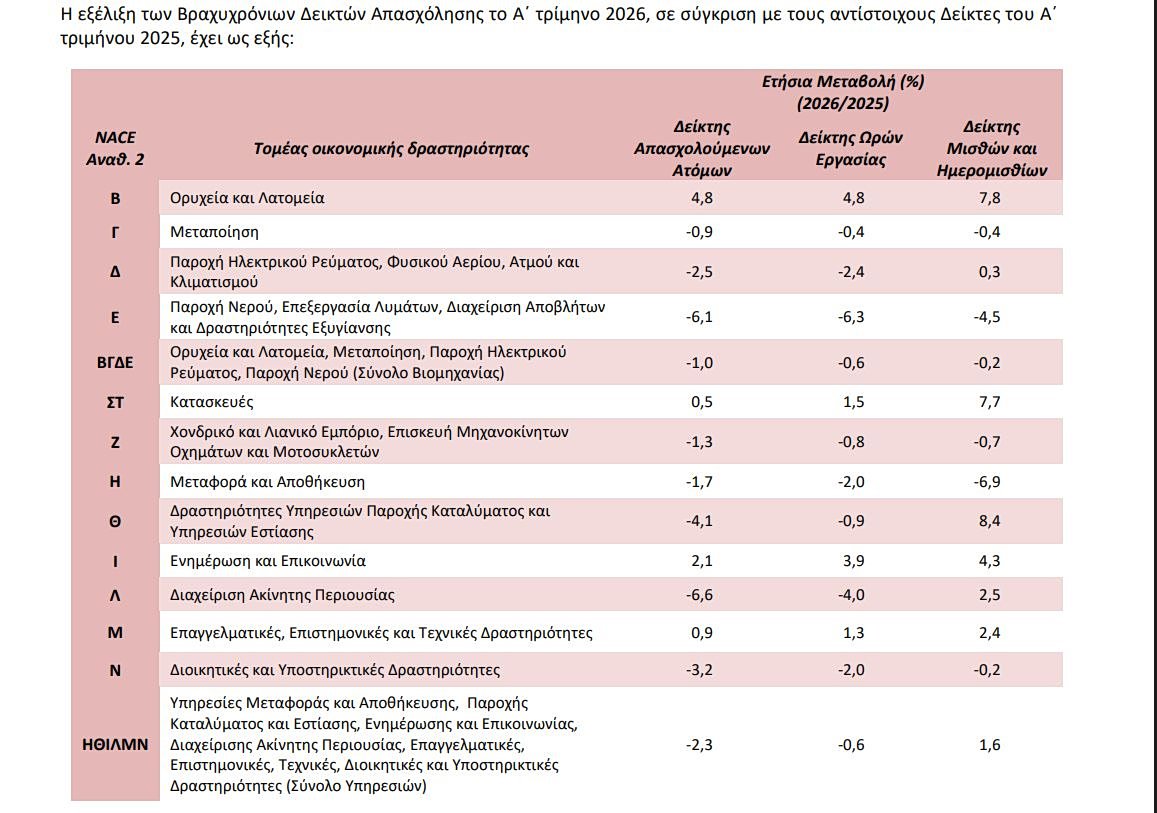
The largest deviation occurs in restaurant and accommodation, with employment shrinking at the fastest rate of all other sectors, while the wage and salary index increased, also at the highest speed.
source: ELSTAT – press image to enlarge
«Elevator» the labour market
In particular, the employee index fell to 8 of the 12 main sectors of economic activity, as well as to the whole industry and services.
The biggest reduction in employment was the management of real estate, with a drop in the index by -6.6%
The water supply, wastewater treatment, waste management and remediation activities will be reduced by -6.1%.
In the third worst position are accommodation and catering services, with a reduction in the employee index by -4.1%.
A noticeable drop in the employment index occurred in administrative and supporting activities (-3.2%), electricity supply, gas, etc (-2.5%), transport and storage (-1.7%).
The picture in wholesale and retail trade (-1.3%) and processing (-0.9%) was also negative.
The biggest rise in employment was in mines and quarries with an increase of 4.8%. The image in information and communication (+2.1%), as well as professional, scientific and technical activities (+0.9%). In construction there was a marginal rise, just 0.5%.
Overall, however, for the labour market employment account was negative, with a decrease of -1% in industry and - 2.3% in services.
At the same time, working hours declined by -0.6% in both industry and employment.
As for the wage and wage index, marginally negative in industry (-0.2%) and rising in services by 1.6%.
How the remuneration by branch was moved
The picture of wage developments is mixed. The largest increase in wages, compared to the corresponding period of 2025, was recorded by accommodation and catering services with an increase in the wage and salary index by 8.4%.
The mines and quarries are followed with an increase in the index by 7.8% and constructions by 7.7%.
On the contrary, the wage and wage index recorded a large drop in transport and storage (-6.9%) and water supply and waste management (-4.5%).
A fall in the wage index also marked trade (-0.7%), processing (-0.4%), administrative and supporting activities (-0.2%).
source: ELSTAT
How wage costs were driven
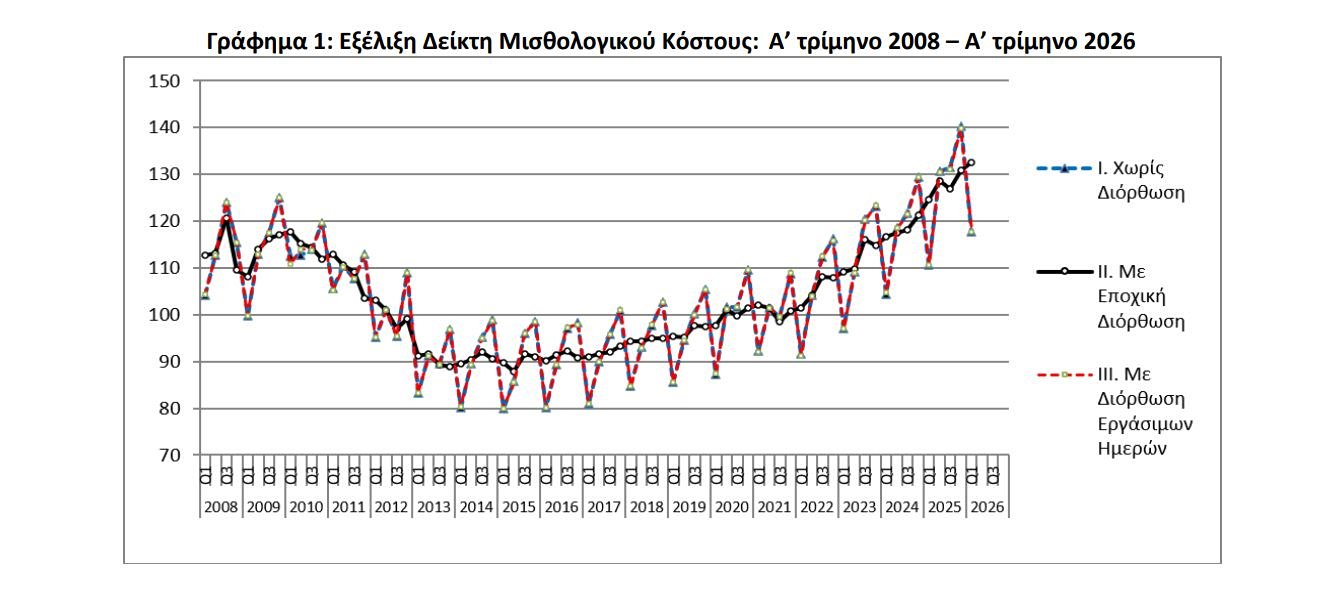
An acceleration of half a percentage point recorded the annual rate of increase in wage costs, which was formed in the first quarter of the year to 6.4%, from 5.9% in the corresponding period of 2025, according to the ELSTAT index.
Even greater is the increase when data is adjusted seasonally, as the seasonally corrected index recorded a 6.7% increase on an annual basis, compared to an increase of 6.4% a year earlier.
At the same time, the index taking into account only the correction for working days also showed an annual growth of 6.4%, confirming that the upward trend remains strong regardless of statistical adjustments.
The wage cost index is not identical to the annual nominal wage increase, but is calculated in relation to the 2020 average hour wage.
ELSTAT's data show that the indicator continues to rise in recent years, after the recovery that followed the decade of the economic crisis.
In particular, the uncorrected index was formed at 117.7 points in the first quarter of 2026, from 110.6 points a year ago. The seasonally corrected index was 132.5 units versus 124.2 units in the first quarter of 2025.
Business cab
Although wages do not meet the cost of living, the staff account becomes heavier for Greek companies. In addition to the annual increase in wage costs by 6.4%, the overall picture of the six-year period highlights the magnitude of the change.
From the first quarter of 2020 to the first quarter of 2026, the seasonally corrected wage cost index moved from 101.5 to 132.5 points, with a cumulative rise of 30.5%. During the same period the general consumer price index moved at a slower rate, reaching 126.67 points in May 2026, i.e. +26.7% compared to 2020 prices.
This is interpreted as a disproportionate increase in wage costs compared to inflation, which companies argue is pushing their profitability.
However, in Greece the wage-earning ratio is one of the most unequal in Europe, at the expense of wage labour and for the benefit of business profits. The share of profits in GDP remains among the highest in the Eurozone, while the Share of wages the second lowest.

