
Europe will live a grim winter, warn international economic analysts, as the depletion of gas reserves and the rapid increase in costs cause energy crisis across the continent.
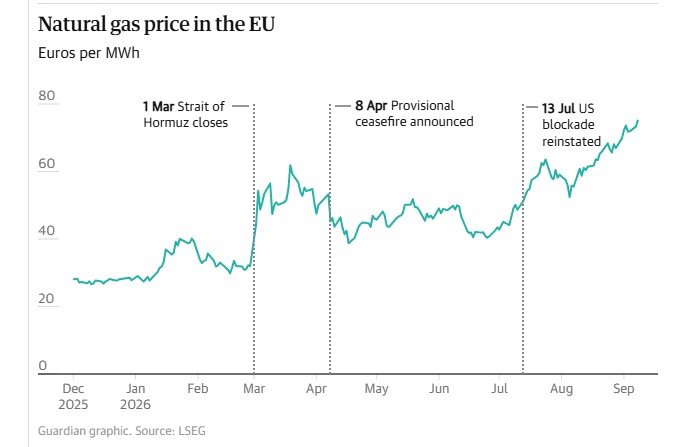
Europe enters the winter with gas reserves at the lowest levels in the last decade, after stopping supplies in the Straits of Hormuz prevented countries from filling in their reserves during the summer, when prices are usually lower. Stocks are now full of about 67%, compared with a seasonal average approaching 80%.
Germany, as noted by British Guardian, which has the largest storage capacity in Europe, is only about half full and it seems that it will not achieve the official 70% storage target this year. It is expected that the Netherlands will not achieve the 80% target.
As one of the largest gas consumers in Europe, the United Kingdom may be particularly vulnerable, as it has one of the lowest domestic stock capacities and is based instead on imports via pipelines from Europe and tankers from the US and the Middle East. Chris O'Shea, CEO of Centrica, owner of British Gas, said last month that Britain «has hardly any gas reserves» for the coming winter.
Growth trends and natural gas shortages in Britain
The conflict has disrupted the global energy supply since Iran began attacking ships in the Persian Gulf and preventing transit through the Straits of Hormuz, the narrow seaway from which one fifth of global oil and gas passes.
British wholesale gas prices rose to 205 pence (p per thermom) this week, the highest level since Russia's invasion of Ukraine in 2022 and an increase of 101% of June's 102 pence. By comparison, in late February the price was 78 pence. The United Kingdom imports about 70% of its natural gas, which makes it particularly vulnerable to price fluctuations.
Bridgnorth Aluminium, which employs 370 people in its Shropshire factory, in the UK industrial heart, already feels the consequences. Her total gas and electricity bill amounts to about £1.1 million a month, becoming 18% of its total cost, and continues to increase.
Its largest contracts include one «safety net» – when gas prices exceed a certain limit, customers pay the difference. This limit was exceeded last month, but the question of whether customers would return. «They have to pay because that's what the contract says, but obviously they won't like it.», points out sales manager Adrian Musgrave, adding that «When the time comes for renewal, this will be a problem».
Characteristic is that Bridgnorth Aluminium is considering taking longer Christmas holidays or carrying out maintenance, originally planned for April, earlier than expected, in January, so that the plant will operate less during high price periods. And that, the workers know, so people start to worry.
Difficulties in German too «Mittelstand»
Alexander Julius, CEO of Macrometal Handelsgesellschaft, a steel distribution company in Hamburg, says his company competes with «producers in areas where energy costs are often significantly lower and where governments provide direct or indirect industrial support».
For branches such as his own, belonging to the German Mittelstand (p. Mittelstand is the backbone of the German economy, consisting of small and medium-sized enterprises), he says that energy is not just another element in the cost lines, but «a fundamental means of production». However, instead of receiving support, «are affected by green taxes, while energy costs are skyrocketing».
They're coming. «padlock» if energy costs are not reduced
Julius, who is also president of the Eurometal trading organisation, warns that companies will be led to bankruptcy and work will be transferred to China or India, unless measures are taken to reduce energy costs.
Eurometal has warned that job losses in the manufacturing sector across Europe could reach 300,000 by the end of the year, partly due to Chinese competition and also due to energy costs.
Axel Egert, Director-General of the European Steel Agency Eurofer, adds that high prices «will inevitably lead to a break in production. Such additional costs cannot simply be absorbed by high energy consumption industries exposed to international competition.
«The longer the crisis lasts, the greater the risk of temporary cuts in production becoming structural, with consequences for investment, employment and ultimately the viability of industrial installations in Europe».
The car industry in Germany has also called for urgent action from Berlin and Brussels, saying that «high energy prices are among Germany's biggest competitive disadvantages as a business destination», with electricity prices being, in some cases, three times that of the US.
«Η Γερμανία, όπως και η ΕΕ, χρειάζεται επειγόντως μια κοινά υποστηριζόμενη ενεργειακή στρατηγική με χαμηλές τιμές ηλεκτρικής ενέργειας και υποδομή δικτύου έτοιμη για το μέλλον», δήλωσε εκπρόσωπος της επαγγελματικής ένωσης VDA. Η ανάπτυξη νέων βιομηχανιών θα αποτελέσει «αποφασιστικό παράγοντα για τον προσδιορισμό» των εισερχόμενων ξένων επενδύσεων στο μέλλον, πρόσθεσε.
«Κρίση χωρίς τέλος»
Η κατάσταση είναι ιδιαίτερα δυσμενής για τον κλάδο των χημικών, όπου οι εταιρείες βασίζονται στο φυσικό αέριο τόσο για την τροφοδοσία των εργοστασίων τους όσο και ως πρώτη ύλη – είναι το υλικό από το οποίο κατασκευάζονται πολλά προϊόντα – πράγμα που σημαίνει ότι κάθε απότομη αύξηση των τιμών τις πλήττει διπλά.
Ο Francesco Buzzella, πρόεδρος της ιταλικής ένωσης χημικών εταιρειών Federchimica, αναφέρει ότι αυτό παραμένει ο «κύριος παράγοντας που υπονομεύει την ανταγωνιστικότητα των χημικών εταιρειών» στην Ιταλία. Η ενέργεια αντιπροσωπεύει πλέον το 18% της αξίας του συνόλου της παραγωγής της ιταλικής χημικής βιομηχανίας, από 14% το 2021 – και θα μπορούσε να φτάσει το 23% αν οι τιμές του φυσικού αερίου και του πετρελαίου δεν μειωθούν. Αυτή την εβδομάδα, το πετρέλαιο έφτασε τα 107 δολάρια το βαρέλι, καθώς οι ΗΠΑ και το Ιράν συνεχίζουν να ανταλλάσσουν πυρά.
Η παραγωγική δραστηριότητα στο Ηνωμένο Βασίλειο έχει μειωθεί κατά 60% από το 2021, σύμφωνα με την Ένωση Χημικής Βιομηχανίας, με το κλείσιμο τουλάχιστον 25 εργοστασίων.
Ο Πίτερ Χάντσμαν, διευθύνων σύμβουλος του ομίλου χημικών Huntsman Corporation, δήλωσε στον Guardian ότι οι συνεχιζόμενες υψηλές τιμές θα μπορούσαν να αναγκάσουν το κλείσιμο του τελευταίου εργοστασίου της εταιρείας που απομένει στο Ηνωμένο Βασίλειο.
Εν τω μεταξύ, πίσω στο Σρόπσαϊρ, ο Μάσγκρεϊβ αναφέρει ότι ο ιδιοκτήτης της Bridgnorth Aluminium, ο βελγικός βιομηχανικός όμιλος Viohalco, επιθυμεί να επενδύσει περαιτέρω στις δραστηριότητες της εταιρείας, αλλά τα οικονομικά στοιχεία γίνονται όλο και πιο δύσκολο να δικαιολογηθούν.
«Είμαι σε αυτόν το κλάδο λίγο πάνω από 20 χρόνια. Τα πρώτα δέκα, το μακροοικονομικό περιβάλλον ήταν πάντα αρκετά σταθερό. Αλλά μετά ήρθε το Brexit, που άλλαξε τα πράγματα· η ενεργειακή κρίση με την Ουκρανία· η πανδημία του Covid· και τώρα αυτό», όπως λέει, τονίζοντας χαρακτηριστικά: «Νομίζεις ότι θα έρθει μια χρονιά που ίσως δεν θα υπάρξουν πολλές αλλαγές. Αλλά οι αλλαγές συνεχίζουν να έρχονται…».

