
In one of the most important pillars of the tourist economy of the islands of the Eastern Aegean and the Dodecanese, the Turkish market evolves, with the visa express facilitating short visits and creating a steady flow of travelers from the opposite coasts.
The special regime concerns Lesvos, Chios, Samos, Kos, Rhodes, Limnos, Leros, Kalymnos, Symi, Kastelorizo, Patmos and Samothraki. It allows Turkish citizens and their families to obtain a short-stay visa up to seven days without having to follow the full Schengen visa procedure.
The programme, which has been implemented since 2024, has been renewed for another year and will remain in force until April 2027, confirming that the facilitation of travel by Turkey is now being treated as a stable tool for strengthening tourism activity on the islands.
The importance of the measure is not limited to the number of arrivals. Turkish visitors move more within destinations, choose the local focus, make purchases and travel frequently outside the narrow peak period. In this way, revenue is distributed to hotels, rooms, restaurants, shops, car rental companies and ferry companies.
Visa Express: From 5,000 to 130,000 in Chios
Chios is perhaps the most characteristic example of the dynamics acquired by the Turkish market. According to the President of the Chios Tourism Agency, Kostas Mundros, in 2010 Turkish visitors were around 5,000, while in 2014 they had reached 85,000.
The arrivals of Turkish visitors now move close to 130,000, with a total of around 200,000 arrivals from abroad. In particular, in 2025 131.324 Turkish visitors were recorded in Chios, which were a determining factor in the progress of local tourism companies.
 The President of Chios Tourism Agency, Kostas Mundros
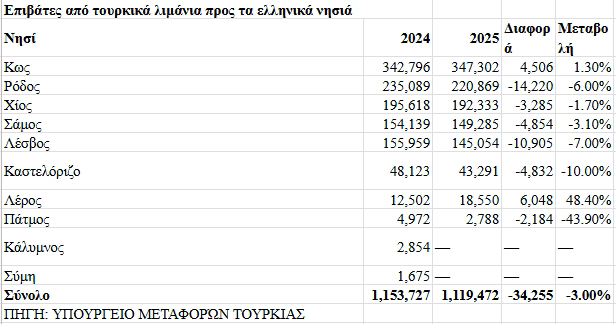
This number is lower than the 192,333 passengers who appear to have departed from Cesme to Chios on the Turkish authorities' table. The difference is explained by the fact that the second number includes all passengers of the line, regardless of nationality, while the figures of Chios concern especially Turkish visitors.
In Mr Mundros' assessment, about 20% of Turkish visitors enter the island using the special status of visa express at the entrance gate, which has given new impetus to tourism from the opposite coasts.
Visitors from Turkey consider prices in the Greek focus particularly competitive, especially in fish and alcoholic beverages, which have become much more expensive in the Turkish market.
«With around 40 euros they can eat fish and have a complete focus experience, which across the street is much more expensive»Mr Mundros reports.
At the same time, consumption in the retail trade is strong. «They come in empty bags and they go in full», says features, describing a market that is not limited to accommodation but strengthens a wide range of local economy.
However, increasing traffic also creates new infrastructure needs. A new customs office is launched in Chios to reduce delays and improve service during high passenger traffic days.
The double image of Lesvos
In Lesvos the Turkish market is treated as a key component of the island's tourist development. The president of the Lesvos Hotel Association, Vassilis Vogiatzis, says the move from traditional European markets showed a decline in June, with a reduction in charter flights and low-cost connections. Visitors from Turkey have to a certain extent covered the gap in arrivals.
However, in the same month the hotels of the island recorded, according to Mr. Vojatzis, a 15% reduction. The strengthening of arrivals from Turkey creates optimism to cover some of the losses, but without the benefits being directed exclusively to hotels.
 The President of the Association of Hotels in Lesvos, Vassilis Vogiatzis
In Lesvos it is estimated that approximately 1,800 short-term rental accommodations are in operation. The large increase in supply via platforms, such as Airbnb, results in an important part of the Turkish drive being channelled outside the organised hotel market.
Mr Vojatzis points out that the issue is balanced development. «Tourism development cannot be one-dimensional or based on a single market», notes, stressing the need to maintain the presence of visitors from Turkey, but also to strengthen flights from Germany, the Netherlands, France and other European countries.
The professionals of the island also point out that the reception infrastructure has improved. However, constant adjustment is required, especially when large numbers of passengers arrive at the same time.
He also stresses the need to maintain the competitiveness of the island at price level. The issue, as hoteliers point out, is not just an increase in charges, but a balanced relationship between quality and cost.
A market for the entire Eastern Aegean
The dynamics of the Turkish market are not limited to Chios, Samos and Lesvos. Kos and Rhodes receive the largest flows from the Turkish coast, while significant benefits are recorded on the smaller islands, such as Symi, Kalymnos, Leros, Kastelorizo and Patmos.
Overall, it is estimated that the introduction of visa express has given new momentum to visits from the Turkish coast, as travellers using the special scheme are estimated to account for about 30% of total arrivals from Turkey.
However, from year to year, a change in arrivals is recorded, but not only for Turkish citizens but for tourists of independent nationality who pass through the Turkish coast on the Greek islands.
The total size of this market is reflected in the data from the Turkish Ministry of Transport's Directorate-General for Maritime Affairs on international shipping lines.
In 2025 they departed from Turkish ports to the Greek islands a total of 1,119,472 passengers, compared to 1,153,727 passengers in 2024. A reduction of 34,255 passengers or about 3% was therefore recorded.
In the opposite direction, from the Greek islands to Turkey, a total of 1,134,041 passenger movements were recorded in 2025, compared to 1,151,459 in 2024.
Total passenger movements in both directions were shaped in 2025 to 2,253.513, from 2,305.186 a year earlier, taking a fall of 2.2%.
Source: ot.gr

