
Reportage: Christos Mazanis
In progress is the last 48-hour investigation of Italian Anti-Mafia Research Directorate after identifying at the port of Trieste cargo with counterfeit money, forged documents and thousands of digital files intended for the production of counterfeit identities.
The operation was executed by the Italian Economic Crime Police and customs authorities, following the exploitation of information and in collaboration with security services in the neighbouring country.
The cargo was inside a truck that had sailed by ship from his Turkish port Gemlik for use in the Hamburg.
The route through Greece
The route of the vehicle on board a known company is reportedly mapped by the Italian authorities via a Ro-Ro sealine (Roll-on/Roll-off), which is the so-called «sea highway» which connects directly to Turkey with Central Europe.
More specifically, he crossed the Dardanelles to get out into the Aegean Sea. He then entered south of the Greek archipelago, passed around the Peloponnese and entered the Ionian Sea. Then he crossed the Adriatic, to the Italian port.
According to the Italians, the cargo appeared to have been shipped by a Turkish company operating in the telecommunications sector and was addressed to a Dutch company providing services to companies.
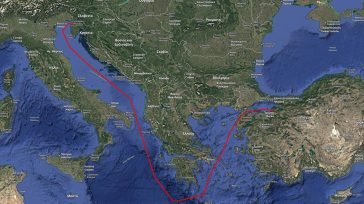
The route reportedly followed the cargo ship
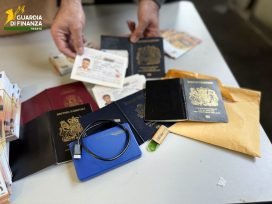
During the operation they were found 23,400 counterfeit notes The EUR 50, total value 1,170,000 euros.
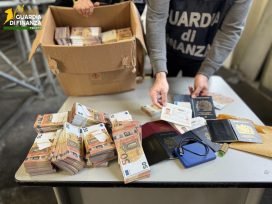
Together with the money many forged documents were also seized from many countries, including Greece (mainly residence permits), the Cyprus Morocco. Passports issued by the UK and US authorities were also found. Residence permits issued by Lithuania, Finland, and entry visas (visits) which appear to have been issued by diplomatic authorities of Spain, Germany and Belgium.
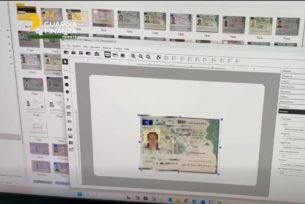
Hard disk and flash drive with 10,000 digital files
However, what has caused the Italian authorities an impression is about digital material located inside the vehicle. A hard drive and a USB flash drive containing approximately 10,000 digital files which could be used to produce forged documents. Among these were official logos, graphics, passport-type photographs, fonts, alphanumeric codes, names, operating instructions and software specially designed for the production of forged documents involving numerous European and non-European countries.
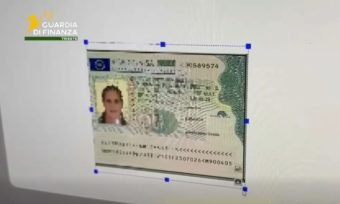
More specifically in digital material 110 certificates were identified, including: 75 visas (entry visas) of different countries (Belgium, Great Britain, Canada, Switzerland, Germany, Denmark, Spain, France, Italy, the Netherlands, Poland, Romania, Sweden, France, United States, Ireland, Brazil). Also 13 identities and 11 residence permits (Belgium, Bulgaria, France, Italy, Lithuania, Luxembourg, Poland, Portugal, Spain, Czech Republic, Cyprus, Finland, Slovakia, Sweden). Another 9 driving licences (Germany, France, Bulgaria, Italy, Lithuania and Switzerland).
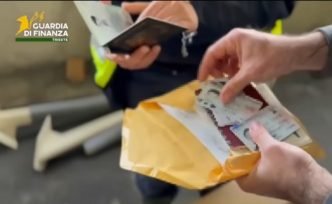
Among the documents, particular attention was drawn to an Italian driving licence in the name Russian national which has been applied for asylum in Italy, is linked to circles of Islamic extremism and has not been identified.
Executives of the Italian Anti-Mafia Research Directorate point out that falsification of money and documents is an increasingly profitable sector for international criminal organizations, which exploit advanced technologies, encrypted platforms, dark web networks and message exchange systems that are difficult to track in order to market this kind of material.
The same officials point out that Turkey and various Eastern European countries are now important centres for producing and distributing forged documents for the European market. In this scenario, the port of Trieste is confirmed as a strategic hub that can be used by criminal organisations as a point of entry into the European Union.
The countries concerned are informed
The entire confiscated material, which could potentially be used to commit offences such as identity theft, electronic fraud, money laundering, money laundering, and facilitation of illegal immigration, was seized while investigations are under way to identify those involved from various countries.
According to information of the zoomla. grThe Italians have begun to inform about the case of other countries, as provided for in international cooperation, including Greece, in order to assist in research. Although they still keep their papers closed, the same information says that a wider network of supplying criminal and terrorist groups in Europe is also being considered. But what is particularly interesting is the transportation of such cargo from Turkey through the Greek archipelago.

