
Developments in the field of AI have long frightened technology experts.
In recent times, however, citizens are beginning to feel the same anguish.
Artificial intelligence is unpopular in the West while climbing the political agenda.
The fiercest battles so far have been fought in America, where protests against data centres have thwarted nearly $100 billion worth of projects, competitive donors of artificial intelligence have just invested tens of millions in an election match for Congress in Manhattan and about 40% of voters tell voters that they want artificial intelligence banned in most branches.
However, disputes erupt elsewhere: after microchip manufacturers' profits were recently launched, Samsung workers in South Korea threatened a strike to secure special compensation.
AI data centers: Young undesirables
The reaction is just beginning, because technology is still in its early stages, supports the Economist.
And the battles for data centers give a taste of the struggles coming.
Every search online, every video shown in flow and every response produced by artificial intelligence depends on a data center. On the occasion of the rapid development of artificial intelligence, cloud computing and crypto-fiction, data centers have become the backbone of modern digital economy.
However, although their main role is to make virtual and remote experiences possible, data centres are natural buildings located in real communities throughout the country and around the world.
These buildings cause a rapid reaction that far exceeds conventional «nimbyism» (the phenomenon) «Not in my yard.»).
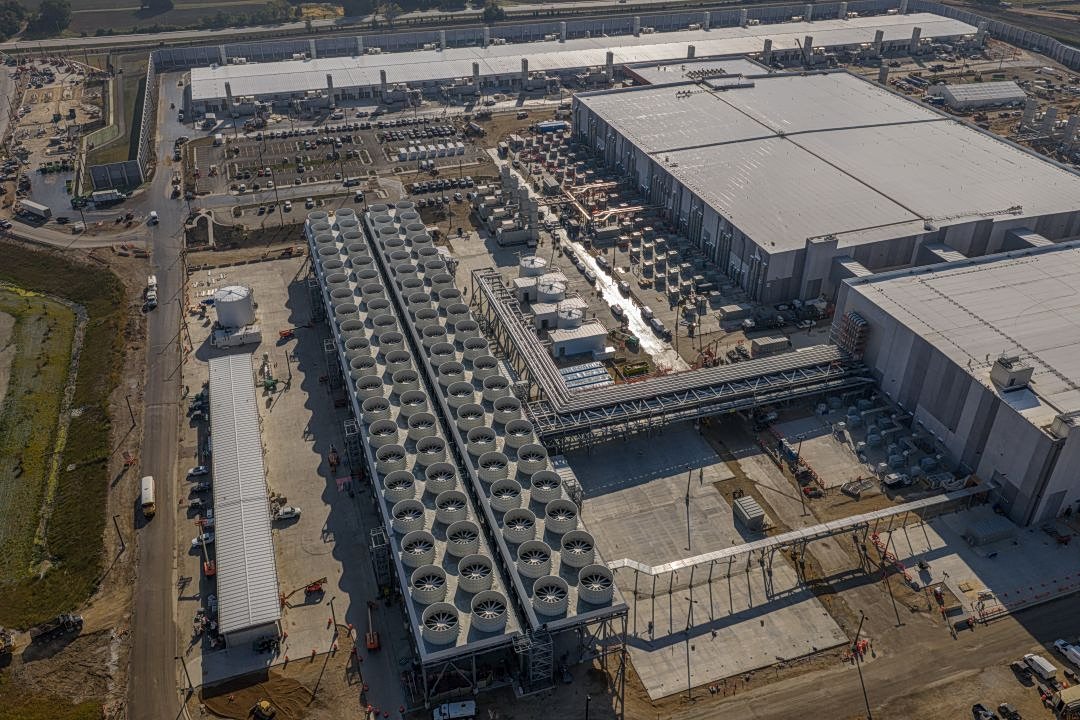
Aerial photography of Microsoft's new artificial intelligence data center complex in Mt Pleasant, Wisconsin.
More Americans say they would rather have a nuclear reactor next to them than a data center.
Even plans to build such a center in the Utah desert have encountered a strong reaction.
Data centers can be bad, that's true.
However, this reaction is not only aesthetic.
The heads of artificial intelligence and by extension popular culture have spent years warning about an imminent «disclosure» of jobs and for the risk of a hypervirus created by artificial intelligence and leading people to extinction.
Opponents of data centres believe, for various reasons, that they protect the environment, preserve jobs and save the human race — And they're not wrong.
AI: The new geopolitical road race
However, there are many who see artificial intelligence as a field of competition.
A new version of the Cold War Battle of Space.
They argue that if America succumbs to opposition against AI, it could grant the global privilege of artificial intelligence, as well as the related cyber- and military capabilities, to China.
Europe and Canada are more cautious about the risk than America is.
If they limit artificial intelligence while the rest of the world continues to move forward, their losses could be irreparable.
Over two centuries after the Industrial Revolution, a few countries managed to catch up with the pioneers.
So the stakes are big. Can governments do something about this?
The grand proclamations about the form of a «Social contract» for a world after artificial intelligence they offer little help today. Otherwise, unknown parameters are still large enough to make the effort almost futile.
🇨🇳 CHINA DOESN’T NEED THE BEAT US AI. IT JUST NEEDS TO UNDERCUT IT.
The US sold Anthropic’s Fable offline, then told OpenAI to release GPT-5.6 customer by customer, government-approved.
Both frontier labs now need federal sign-off to ship.
China’s open models can’t be fed,... pic.twitter. Com/Z440O1bEa8
— CryptoGoos (@cryptoos) June 26, 2026
A view in favour of reform
To this end, Economist (taking a clear stand in favour of AI) gives four instructions for politicians and artificial intelligence companies seeking policies.
First, to spread the benefits of artificial intelligence as widely as possible. It must be shown to opponents that their region will benefit if they stop preventing progress.
Gradually, this approach must be extended to society as a whole, with mechanisms showing citizens that they have an economic interest in the progress of artificial intelligence and that they will receive help to adapt to turbulence through policies such as wage insurance.
Only a common sense of prosperity can mitigate its toxic policy «who wins/who loses» which emerged in the era of globalisation, supports – somewhat utopian – the article.
Secondly, to regulate strictly when intervention is required. The terrifying prospect of cyberattacks or bioterror based on artificial intelligence is still not addressed with the seriousness it deserves. Addressing these and other issues is in itself essential, but would also weaken arguments for indiscriminate ban or restricting artificial intelligence. Ideally, these efforts will involve international cooperation.
Three, count everything. The common view that artificial intelligence already leads to layoffs and an increase in electricity bills is probably wrong, he says.
However, without better statistics it is difficult to be sure. Data centres need to address concernswater consumption, an artificial matter.
The facts will not cure misinformation, but their absence makes it worse. The British Institute of Artificial Intelligence Security and the new Institute of Economics of Artificial Intelligence may offer standards that other countries can follow.
Fourth, let's use artificial intelligence to improve the state. It is not only the private sector that could use artificial intelligence to increase productivity.
Tax returns should be made easy.· State health systems should link data seamlessly and schools should experiment with artificial intelligence-based learning.
Artificial intelligence can also facilitate citizens to monitor the movements of politicians.
People are less likely to oppose a technology if it is behind cancer therapy or helps educate their child. And they're more likely to trust that the state can supervise it if they think the government is working.
Engine policy
Voters are right to be closely interested in how artificial intelligence could change their lives.
The future will be chaotic, strange and unpredictable.
Convinced that their interests are served by the overthrow has become as important as improving artificial intelligence models for power.
However, as long as this new technology is in the hands of technological oligarchy and political elites, even the most gullible citizens are difficult to convince.
From that point on it is to turn this mistrust into a change.

