
The boundaries between professional and personal life are becoming increasingly blurred as teleworking, which is the most important of all. allowed workers to work from their place during the pandemic and remained as a model of employment, begins to turn into a trap.
Off-hour communication reports 63% of those working with teleworking
Although this flexible working model gives great freedom to where and when, there are not few who cannot remember when they last stopped working. Other They're sneaking «Silent holiday» because they're afraid to ask for permission, and others get messages for work even when they're off duty or off-duty.
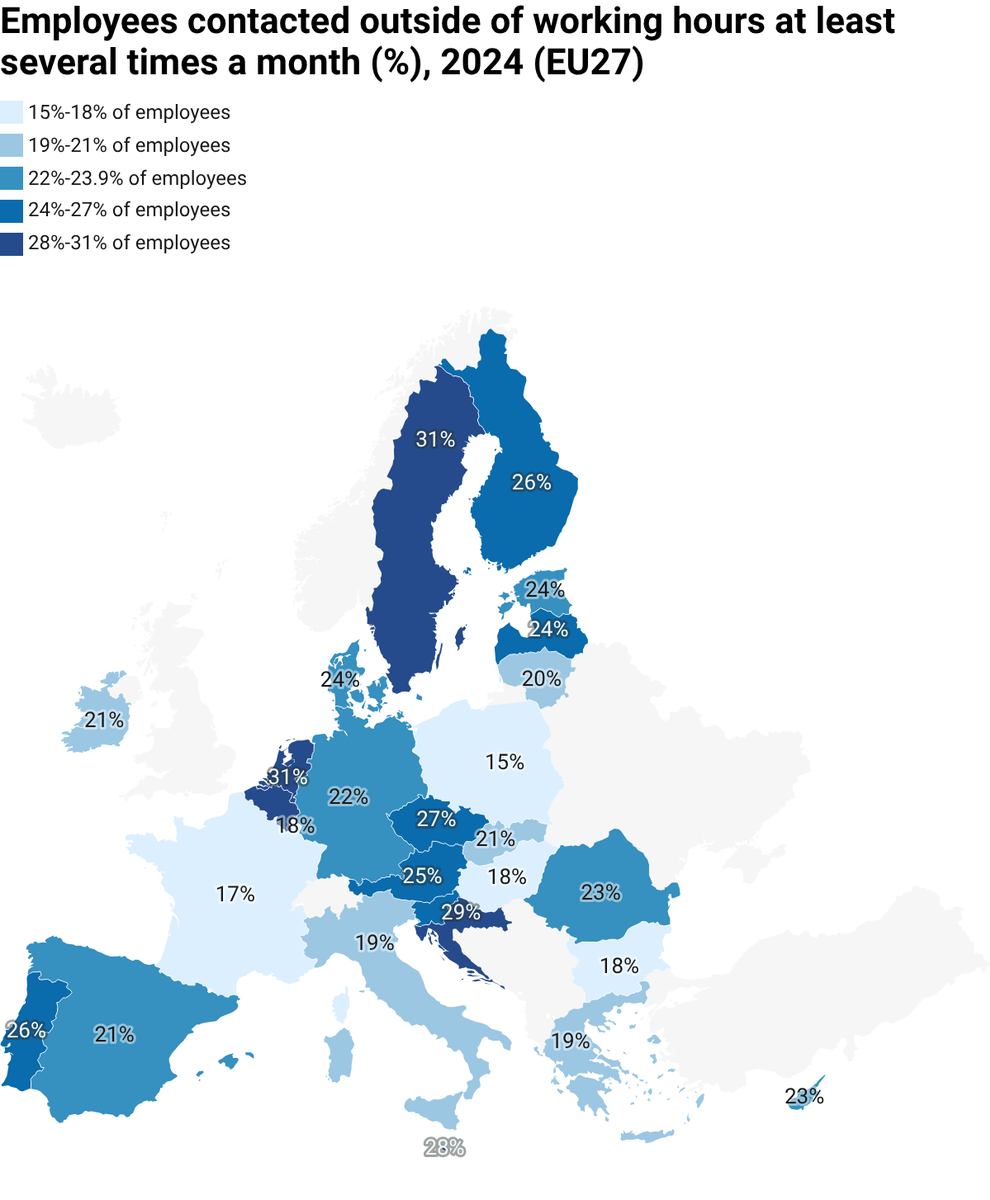
According to Eurofound's pre-publication, one in five workers across the European Union states that it maintains communication for professional reasons outside its working hours several times a month. This corresponds to around 36.4 million people in the EU, based on the working population at the end of 2024.
Regular communication outside working hours is a consequence of a long-term transformation of the labour culture, which contributed alongside increasing digitization. For a significant number of workers, the hours extend beyond the contractually agreed, while some experience this situation so often that it is as if they are constantly waiting.
Please note that the full report expected in July 2026 entitled «Work at any time and anywhere in the EU after the pandemic – Impact on quality of working time» is based on data collected from the European Labour Conditions Survey (EWCS) in 2024.
Continuous «presence» and work stress
Continuous availability is not a neutral feature of modern working life, but has cost in mental stress from the conflict between professional and personal life. Data analysis clearly shows that the frequency with which an employee communicates with off-hour work is directly and proportionally related to his anxiety levels.
Among those who receive communication on a daily basis, nearly six out of ten (59%) say they experience stress at work always or almost always. At the opposite end of the scale, among those who never communicate outside working hours, this rate is reduced to 17%.
EWCS findings show that the most key factor of difficulty «Disconnect» is the workload, since many times workers do not have enough time to complete their duties during normal working hours.
Flexible employment relationships – such as teleworking – and IT and communications technologies – smartphones, laptops and other digital tools – are also factors, although they operate differently.
Among those who have flexible opening and closing hours, 64% say they communicate with him outside of work at least occasionally, compared to 49% of those who typically have hours. A similar pattern is observed depending on the place of work. Out of work communication reports 63% of those working with teleworking, compared to 48% of those working exclusively at the office. These elements suggest that time or place flexibility can increase employers' expectations of employee availability.
The use of digital tools also plays a defining role. Among workers who never use these technologies at work, 59% states that they never receive off-hour communication, compared to 38% of their users.
However, even among those who work exclusively in the office, those who use digital tools are more likely to receive off-hour communication than non-users. This suggests that digital connectivity, not only teleworking, is a key mechanism through which the availability of a worker is extended to its free time.
EWCS findings also show that of all professional groups, management staff are more likely to receive communication, followed by service and sales workers. By sector, education and healthcare record the highest rates.
Inequalitys in the right to disconnect
In an effort to give workers the opportunity to disconnect at the end of the working day, 13 EU Member States have chosen to regulate the right to disconnect, i.e. the right of workers not to respond to off-duty communications without suffering negative consequences. These states include Greece. The rest are Belgium, Bulgaria, Croatia, Cyprus, France, Ireland, Italy, Luxembourg, Portugal, Slovakia, Slovenia and Spain.
However, as the pre-publication of Eurofound states, the existing regulatory framework is far from being homogeneous and some cases distinguish between teleworking and office presence. For example, in Greece, Cyprus, Italy and Slovakia, the right is limited solely to telexers, while Belgium in France and Spain applies to all private sector labour.
Also, the legal nature of the right varies from the absence of an obligation on workers to respond (Bulgaria and Croatia) to the employer's active obligation not to communicate during rest periods (Portugal and Slovenia) and the explicit right to disconnect from electronic labour communications (Greece and Ireland).
The role of social dialogue is another important axis of diversification. In Belgium, France, Luxembourg and Spain, collective bargaining, at both sectoral and corporate level, plays a central role in defining and implementing this right. In countries such as Croatia, Greece and Portugal, on the contrary, no specific procedures have been established for its implementation.
Legislation seems to play an important role, according to the figures. France, for example, which has long been in possession of relevant legislation, presents one of the lowest rates of off-hour communication in the EU (17%).
Ireland which records 21% has a more recent but already established code of conduct on the right to disconnect. The Netherlands and Sweden, which do not have specific national legislation, are among the countries with the highest percentage of non-working workers (31%).
However, legislation does not explain everything. Nordic countries and the Netherlands have a tradition of more flexible ways of organizing working time, and therefore communication outside working hours can be considered more «normal» compared to other EU regions. The picture generated by EWCS 2024 is that of a structural intensity that is at the heart of modern working arrangements.
As flexible work and teleworking continue to expand, the question is what approach would be more effective to effectively limit off-hour work.

