
On the question of deposits In recent years a process of massive theft has evolved. wealth On the other hand, it is important for the Commission to take the necessary measures. Bank, based on humiliatingly low Interest rates deposits.
For many years deposit rates have been practically zero for the large amount of deposits and are permanently at a long distance from the average of euro areaIn September 2026 the day-to-day deposit rate was 0.03% for households (!) and 0.24% for businesses, while the interest rate for forward deposits of households up to one year was 1.28% in Greece, compared with 2.33% in the eurozone, i.e. less than one percentage point.
Moreover, they remain at these... mythical low levels with minimal upward adjustments even when euro interest rates increase and banks benefit directly from it.
Finally, with both inflation and precision cycles, one from 2021 to 2024 and the one at present from March onwards, the gap between very small deposit and inflation rates has grown tremendously, resulting in large losses of the actual value of deposits.
Read more
This is a big one. «theft» the deposits, «guided» by banks and covered by their supervisors (Bank of Greece and Competition Commission), who do not use the means available to force banks to pursue a different policy.
The Competition Commission in its recent report clearly finds the existence of a banking cartel but results in proposals to... third parties rather than measures. The governor of TTE Giannis Stournaras has not even taken the step to talk about banking cartels and in his public interventions he is limited to recommendations to non-hearers. As for the government, it pretends to be inappropriate and does nothing – not even in fact in food, much more for the losses of depositors.
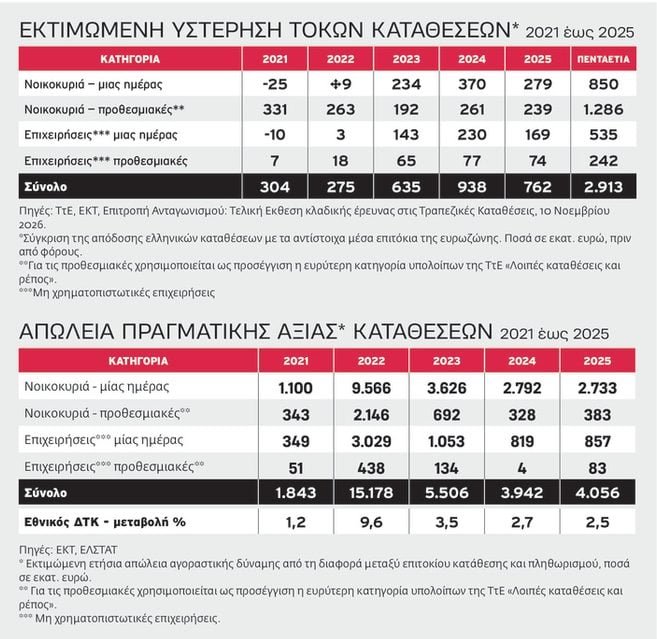 In particular, the account of losses is as follows:
● From the much lower interest rate on all deposit categories in Greece compared to the euro area, interest losses of 2.9 billion euros are recorded between 2021 and 2025. On an annual basis, the highest is EUR 2024 (938 million). Longer higher losses relate to household deposits (one day and time) followed by day-to-day business (see table)
● As regards losses of the actual value of deposits from the combination of very low deposit rates and high inflation, these are much larger (see table). The biggest «haircut» their actual value was in 2022 (inflation 9.6%) and amounted to EUR 15.2 billion! 2025 was 4.1 billion euros.
Competition Committee
There's a bank cartel!
The Competition Committee (E.A.) published its Final Report on Banking Deposits on Tuesday with the data for 2025. The evidence and conclusions of the report are shocking, with the most important of all the finding that in Greece there is and operates a banking cartel – something that, if anything, does not comply with the vows of faith in «free market» and competition.
In particular, the main conclusions of the report are as follows:
1. The banking market in Greece is oligopolistic: the four systemic banks control over 90% of deposits. High concentration limits pressure to offer better interest rates for depositors.
2. In the interest rate increase cycle of the European Central Bank (ECB), the Greek banks transferred only a small part of the increases to depositors, with a delay and uneven manner. With any increase in interest rates, banks benefit, because their deposits have a higher interest rate. So instead of increasing the interest rate of their depositors accordingly, they increase it a little and heterochronously, making an abusive profit.
3. Banks have excessive liquidity. This means that they do not miss but they do have a surplus of deposits, as they convert a small percentage of deposits into loans – the smallest in Europe. Therefore, they do not have a strong incentive to offer higher deposit rates to attract savings.
4. There is an inaction of the depositors. Depositors rarely seek better returns or change banks, as in the majority of them have small amounts of deposits for current use (one day deposits) and know that any interest gain will be insignificant anyway. This behaviour strengthens the power of large banks and weakens competition.

