
The recent report of the International Monetary Fund (IMF) «Inside Greece’s Housing Affordability Paradoxes», examines the issue of affordable housing in Greece, identifying a series of oddities. One key contradiction is that while Greece has one of the highest housing reserves per inhabitant in Europe, households are increasingly having difficulty finding affordable housing.
The answer to the riddle is before our eyes: House prices and, more recently, rents increase up to twice the rate of income. According to the IMF, this phenomenon reflects the «strong and increasingly concentrated demand, including from foreigners, combined with structural supply rigidities and imbalances between supply and demand».
But if the diagnosis of the problem is relatively simple, the solutions proposed are complex and do not guarantee immediate success. The authors of the study acknowledge that a combination approach is required, which will focus on the economic accessibility of the home (housing affordability). This is a term of passover, which is a cornerstone of the European plan to tackle the housing crisis, under the heading «European Affordable Housing Plan».
Researchers and social movements for the roof have criticized the Commission's plan. They argue, inter alia, that it does not deal effectively with the issue of real estate speculation, nor does it dispute The «financialisation» residence, i.e. turning it from human right into an investment product.
source: IMF / Claude edit – press on image to enlarge
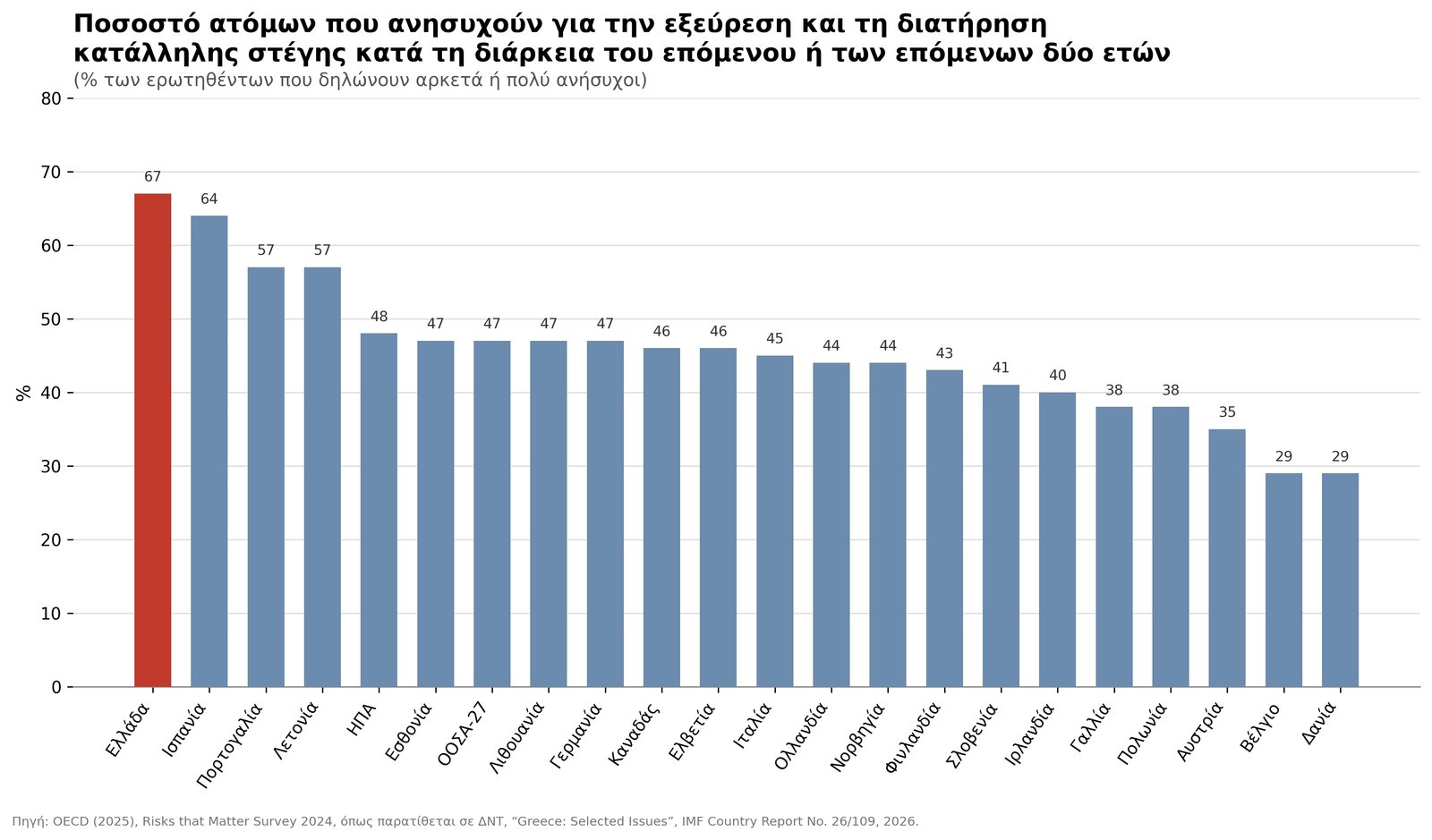
Two out of three are worried if they'll have a home in a year.
The IMF study is part of the specific analyses (Selected Issues Papers) accompanying the periodic assessment of the Greek economy. Experts from the Bank of Greece, the Foundation for Economic and Industrial Research (IOBE) the Centre for Planning and Economic Research (KEPE) and Alpha Bank contributed to its completion. Statistics provided by the Spitogatos and ELSTAT platform. Part of the research findings were presented in pre-published by Spitogatos in June. The full study was published on July 27.
The report is not limited to the well-known and recorded data – such as that Greece has the highest rate of excessive housing burden in the EU and the most expensive housing costs in proportion to income. It presents less well-known quality elements that reflect the social – humanitarian dimension of the housing crisis. For example, as evidenced by a recent OECD survey, almost two out of three residents in Greece live in conditions of housing insecurity. Specifically, 67% of the Greek households surveyed said they were concerned about finding or maintaining a suitable roof within the following year or over the next two years. This is the highest rate among all OECD research countries, above Spain (64%) and Portugal (57%), countries that also face acute housing problems.
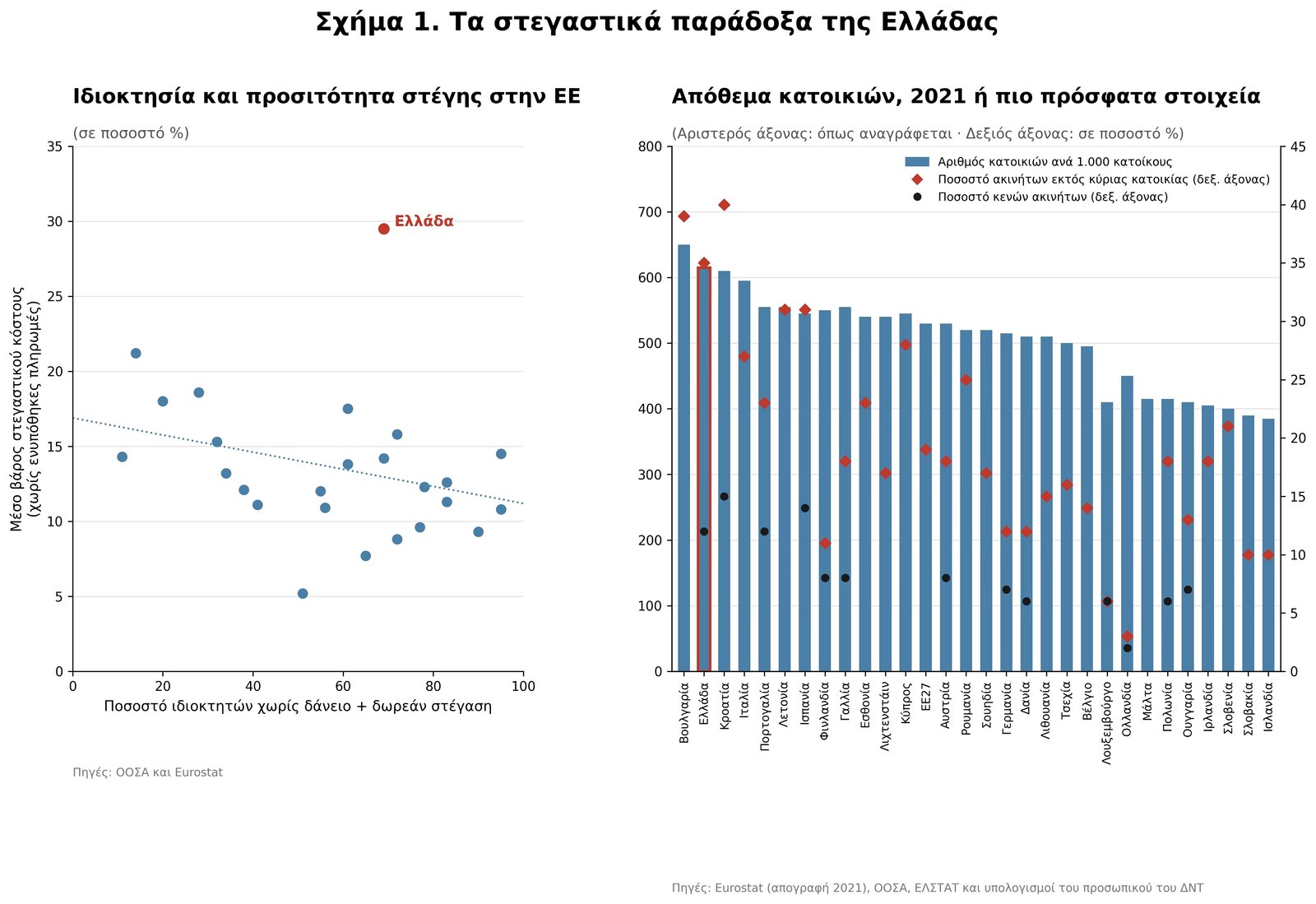
The IMF «Housing paradoxes» of Greece
What concerns the IMF is that housing pressures coexist with seemingly favourable structural conditions. «The high housing cost contrasts with the fact that over 60% of Greek households are full owners (i.e., without mortgages) and are borne only by recurring housing costs» notes the study. The second paradox is that «Greece has one of the highest housing reserves per resident, despite the decline in population, but 35% of these properties are not used as a main residence, of which one third (12-13% of the total stock) is empty».
Unreachable housing for the average household
Another interesting finding that research highlights is the expansion of the psalter between housing prices and average income. «Prior to the public debt crisis, Greece experienced a sustained boom in housing, supported by a strong increase in income, the liberalisation of the financial sector and the expansion of mortgage loans after the adoption of the euro, which helped increase housing investment and demand for housing», reports the IMF.
With the crisis the cycle was abruptly overturned and residential property prices fell over 40% during 2008-2016. Since then, prices have steadily recovered, with a cumulative increase of about 85%, when the disposable income per capita increased only 47% over the same period. As for real income, remains 15% lower than 2009.
Most of the price increase occurred after the pandemic (+61% from the 4th quarter of 2020). Unlike other euro area countries, the effect of tightening the ECB's monetary policy on prices was rather limited.
Overrated real estate
According to the IMF, overestimation of residential properties is estimated at around 10%. It acknowledges that current housing sales prices do not meet the fundamentals of the Greek economy (incomes, inflation, macroeconomic data). But he's not talking about bubble phenomena. It is recalled that the Commission in a similar investigation states that much higher overestimation rate at 18%.
The study estimates that a household with an average income takes about 24 years of saving, not to buy a house, but to collect the house purchase deposit, with a savings rate of 10% annually. The rate of over-burdened housing costs remains high, with two out of five households spending over 40% of their disposable housing income.
Rich in real estate, poor in income
As mentioned above, over 60% of Greek households are full owners without a housing loan, which should theoretically reduce economic pressure. However, according to researchers, many of these households are rich in real estate but poor in cash income, as housing possession does not automatically translate into lower maintenance, energy and taxation costs. The ageing and energy inefficiency of the building stock further burden the owners. Just 7.4% of the houses have energy class B or better, resulting in Greek housing consuming about 65% more energy per square metre than Portuguese.
What the IMF proposes
The authors of the study propose six policy guidelines. First priority is the activation of vacant dwellings through a combination of renovation, tax counter-initiators and reform of hereditary law to solve problems of co-ownership.
The second recommendation concerns strengthening the attractiveness of long-term leases by reducing the risk to owners, while the study calls for a systematic assessment of the effectiveness of short-term lease restrictions before new interventions.
The third recommendation is to strengthen the productivity of the construction industry, with labour training and better access to funding for small and medium-sized manufacturers.
The remaining recommendations concern the extension of social and affordable housing through public-private partnerships, the adaptation of demand support measures to avoid moving to higher prices, and better coordination of labour, energy and regional development policies.
The study concludes that Greece has a housing distribution problem rather than a classic housing shortage. It considers that state measures move in the right direction but need a greater focus on affordable supply and combination of incentives and counter-incentives to mobilise the existing stock.

