
Deutsche Bank foresees a broad weakening of the dollar, with George Saravelos, head of the global exchange strategy, assessing that deescalating the risks surrounding the war in Iran opens the way for a new retreat cycle of the American currency. The bank proposes selling the dollar index, predicting a possible rise in the euro/dollar rate above 1.20. The main factors are the reduction in return in the US, the slowdown of capital flows and the possible strengthening of «petroyuan»With China expanding its role in the Middle East.
Analyticalally:
Negative against dollar Deutsche Bank appears, which comes back challenging the dominant upward account of recent months and appreciating that conditions for a broad weakening of it are being shaped.
As he notes, the gradual deescalation of the dangers surrounding Iran's war marks that «the pieces of the puzzle put in place» for a new dollar weakening cycle. In this context, it proposes selling the dollar index (DXY), predicting a wide decline in the US currency to a new low cycle and a possible rise in the euro/dollar rate over 1.20.
Upward yield curves outside the US are a clear sign of weakening the dollar
It is worth noting, however, that the analysis bears the signature of George Saravelos, head of the bank's global foreign exchange strategy, which had been at the heart of intense confrontation with the American side at the beginning of the year.
At the time, his report had implied that Europe could use its enormous placements in American bonds as «gun», through mass sales, causing strong reactions from the US government. American Finance Minister Scott Bessent described the assessment «false account», pointing out that Deutsche Bank CEO Christian Sewing contacted in order to distance himself from the content of the report.
Negative trend
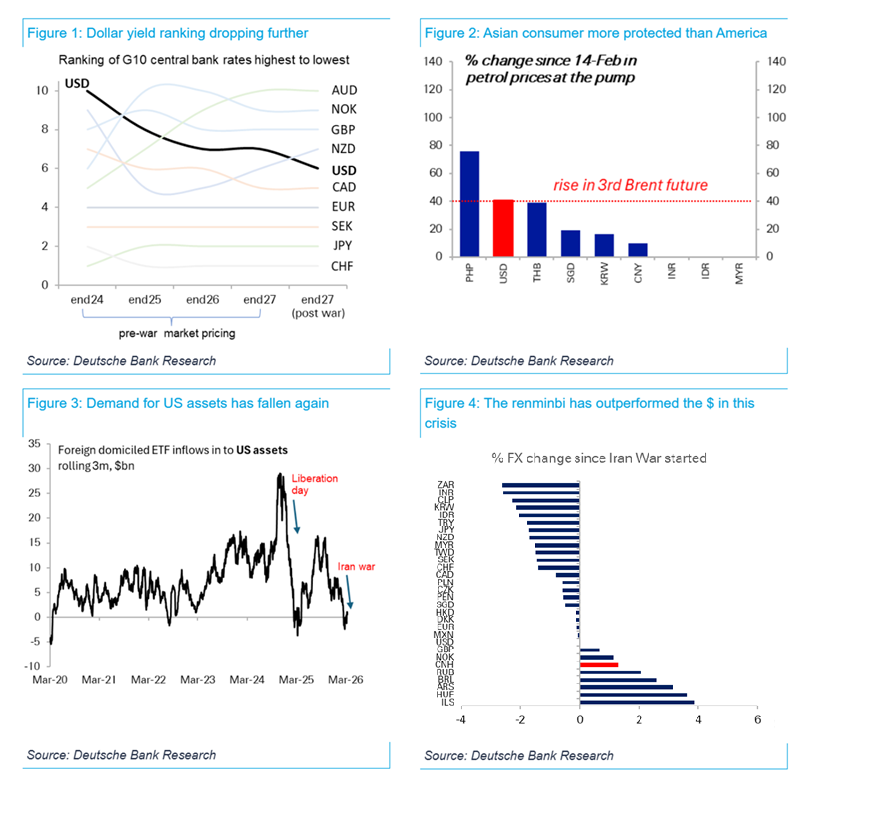
In his new report, Saravelos points out that one of the main advantages of the dollar, high yields, has now faded. U.S. yields have retreated in relation to other economies since the start of the crisis in Iran, as international central banks adopt more «aggressive» attitude compared to the Fed.
At the same time, upward yield curves outside the US are a clear sign of weakening the dollar, a trend that will hardly be reversed if energy prices do not return directly to pre-crisis levels.
At the same time, global budgetary policy, particularly in Asia, is acting as a counterweight to pressure from rising energy prices. Despite concerns about a blow to demand, fuel prices in the most exposed economies have been restrained through interventions, while, as Deutsche Bank points out, American consumers are receiving a higher income blow than in the major Asian economies.
The active attitude of governments limits the impact on global growth, while several countries appear reluctant to tolerate further weakening of their currencies. If progress is made in the US–Iran negotiations, the culmination of negative effects on development may already have passed.
The role of wars
At the same time, the bank estimates that the flow of dollars worldwide is expected to slow down significantly. The war in Iran has already led to short-term sales of foreign assets from Asian and Middle East countries in order to finance increased energy costs. Fed data and high frequency indicators record a slowdown of inputs to the US.
However, the effects are not limited to the short-term arm. Strengthening strategic autonomy in areas such as defence, energy and supply chains reduces available global surpluses directed to the US, limiting availability «borderline» dollar for investments.
The advent of... petroyuan
Finally, Deutsche Bank points out another possible pressure factor for the dollar. The strengthening of the so-called «petroyuan». Although the new geopolitical balance in the Middle East remains uncertain, a possible shift from its system of «petodolar» to a greater role of China, both as a security guarantor and as a payment infrastructure provider, could lead to significant changes in the international sovereignty of the dollar.
For example, the bank notes that the Chinese currency outside the border (CNH) is the strongest currency since the start of the crisis in Iran, surpassing the dollar itself.
Source: OT

