
In November 2025 the water of the Bramian Dam showed conductivity of 2,92 mS/cm, chlorine 688 ppm and sodium 379 ppm. Two years ago, in January 2023, the corresponding prices were: conductivity 1.02 — chlorine 154 — sodium 94. In less than three years chlorine and sodium quadrupled, conductivity more than doubled. If you are a greenhouse producer in Ierapetra or in another Mediterranean region using such water, you can already see the change. — in lubrication, fruit, leaves. This article shows exactly what is happening and what you can do about it.
What electric conductivity (EC) counts — And what he's hiding from you.
When you ask a producer about his water, the first answer is almost always an EC price. «I have 2.5.», «I have 1.8.»The electrical conductivity (EC) is easy to measure and gives a first picture. But it doesn't give the whole picture.
EC tells you how many salts your water carries. He won't tell you who. That's the most important difference. Two waters with EC 2.5 can behave completely differently. If in the first the salts are mainly calcium, magnesium and sulphate, it manages relatively easily. If the second is mainly sodium and chlorine — as in the dam of Ierapetra — You have another problem: toxicity, competition with nutrients, changes in soil. So the EC is only useful with full ion analysis. The EC will tell you how much. Analysis will tell you who.
A second indicator you need to know is SAR. It tells you if sodium will spoil your soil, not just the plant. The higher the SAR, the greater the risk of soil natriosis — that is sodium gradually displaces calcium from soil structure and this «It's falling apart.». The soil becomes less permeable, drainage gets worse, roots suffer. Over SAR=3 begins the FAO worry zone. At the dam, we're stable over five.
All the following data are based on 37 water analyses from January 2023 to April 2026, performed by Rijk Zwaan Hellas' soil laboratory.
39 months – the track
In early 2023 the water was at the limits of the manageable: EC 1,02, chlorine 154 ppm, sodium 94 ppm. In the USDA classification (Riverside, 1954) it fell to Class C3-S1 — «high salinity, low risk of natriosis»Water you can work with the right adjustments. For about a year and a half, prices remained relatively stable around 1,0–1.2 mS/cm.
From mid-2024 the rapid deterioration began. The EC rises systematically almost every month, chlorine and sodium eject. Between April and May 2025, within just one month, chlorine goes from 383 to 550 ppm. In July 2025 the water first passes to Class C4-S2 — «very high salinity, moderate risk of natriosis». Under this heading, irrigation in ordinary agricultural lands becomes problematic. From that point on, he's not coming back.
In November 2025 it hits the top at 2.92 mS/cm — over four times the FAO limit for «no restriction» (which is 0.7). Chlorine 688 ppm — twice the severe containment zone. Sodium 379 ppm.
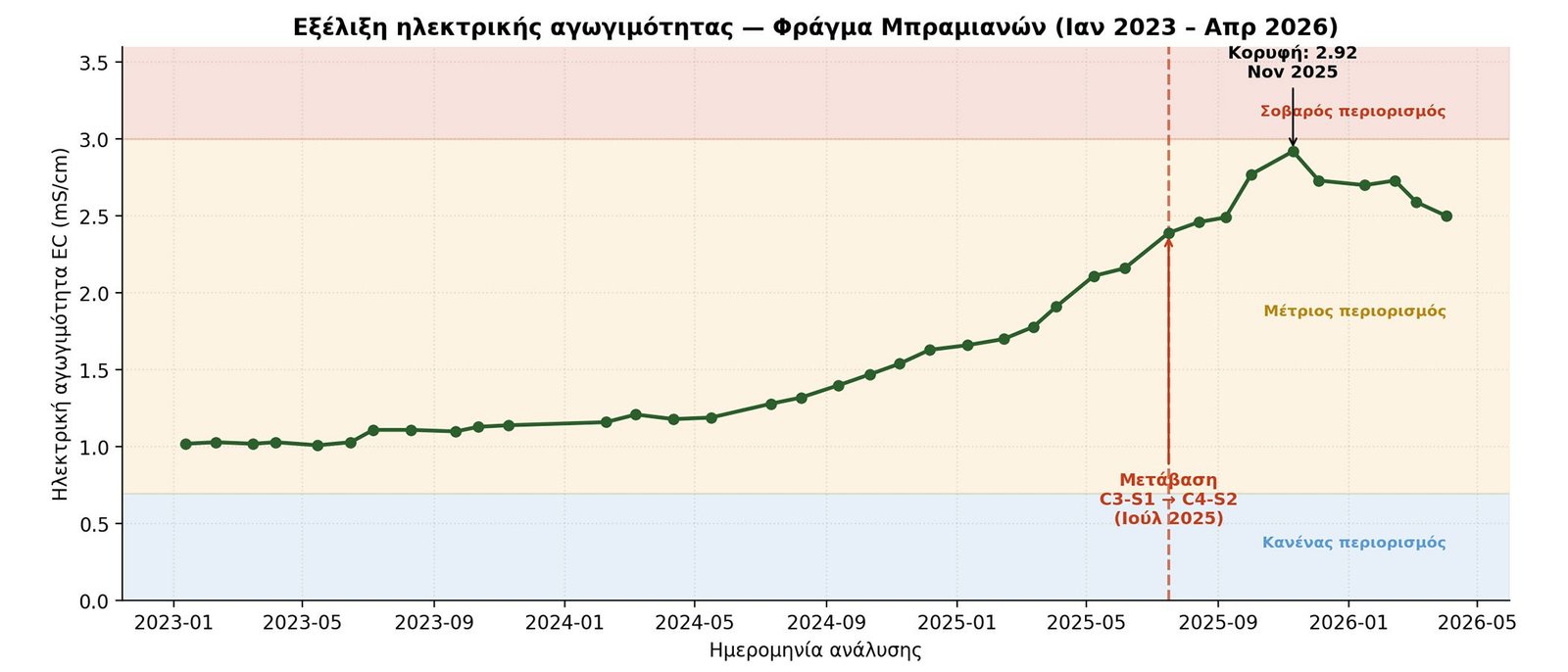
Chart: Evolution of water electrical conductivity from January 2023 to April 2026. Two phases: steady course around 1,0–1.2 mS/cm until mid-2024, and accelerated rise then peaking in November 2025 at 2,92.
Comparison of edges shows the actual size of change:
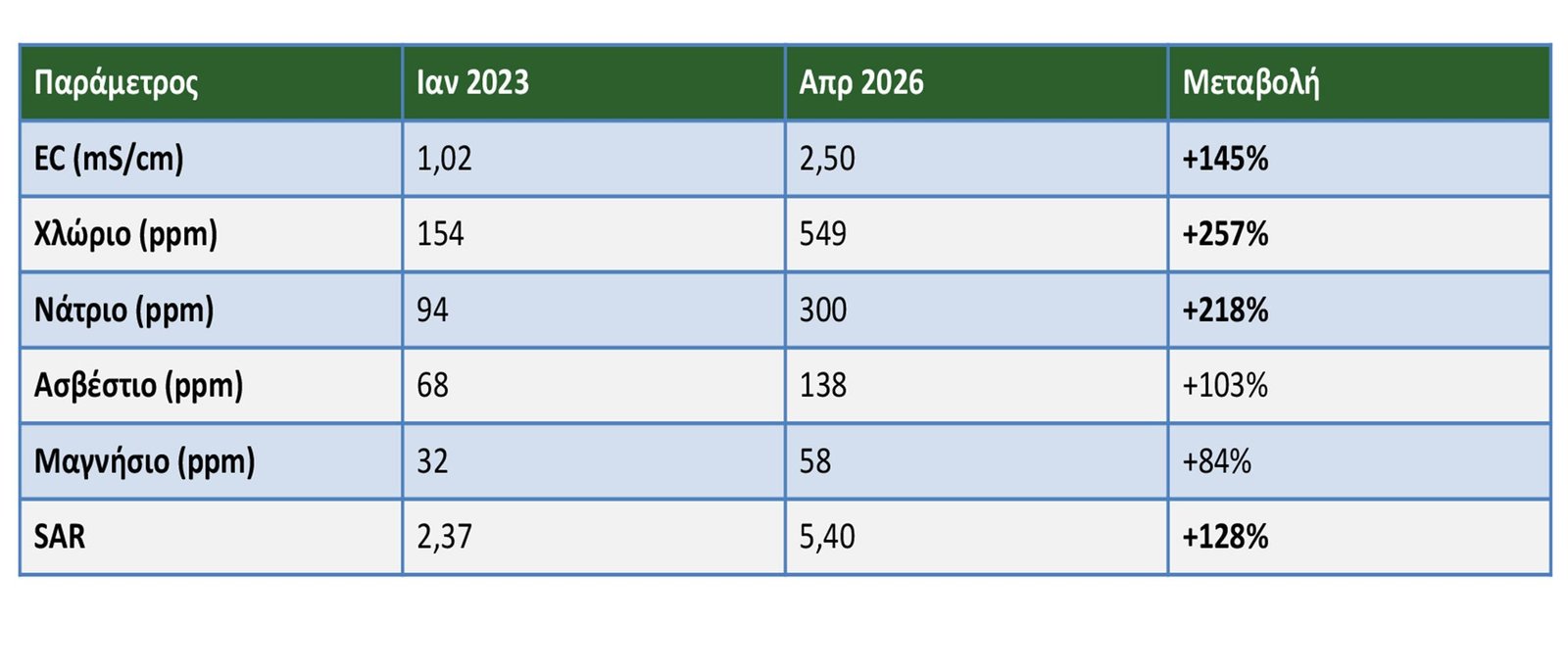
In 39 months, a water that was manageable passed into a class of incompetence. This is not an isolated phenomenon. The same pattern occurs in many Mediterranean irrigation sources, where drilling, water shortage and seawater penetration meet. It's just, thanks to the dense analysis, here we can see it with numerical accuracy.
The other shown in the series of analyses — and not only seen by the EC — is the change in recommendation. Not all ions increased to the same degree. Chlorine and sodium ejected (+257% and +218% respectively), while dicarbonates moved only +16%. The boron, although remaining within FAO limits, almost tripled (from 0.05 to 0.13 ppm) — something we must monitor because in the north the sensitivity thresholds of certain crops are low. So when we say «water weighs», we actually mean it changes character: it becomes more sodium-chloride, which is exactly the type of salt water that does the most damage to greenhouse crops.
How it hits you on plants
Saltiness does damage in two ways that run simultaneously. It's good to know them separately because they need different treatment.
First one's osmotic. — One «drought in water». When the soil around the root is full of salts, the plant has difficulty drawing water from it. It's like sucking from an increasingly narrow straw: the more salt, the bigger «force» It takes to draw water. The result is withered leaves a day even in fields that have just been watered — The so-called «normal drought». It's not the watering frequency, it's the water quality.
The impact is measurable and dramatic. In Schwarz & Kuchenbuch experiments in tomato, production fell 50% when the EC of the solution reached 6 dB/m — Just because the plant couldn't pull the water. In a corresponding study of Reina-Sánchez and its associates (2005), tomato plants irrigated with salt water consumed 40% less water than control plants. It wasn't a matter of quantity they gave them. — They couldn't hire it.
The second way is ionic — sodium «trick» root intake mechanisms. This is the most important part because it directly affects your lubrication.
Think of the root as a cashier accepting clients-ion. It has separate «boxes» which are supposed to pass potassium, calcium, magnesium. But the lockers don't check certificates — They recognize cargo and size. If in line there are 45 sodium-clients for every 1 bottle client, and sodium is quite like potassium, what will pass through the box? Main sodium — Even if the safe «He wants» potassium.
The numbers at the dam show just that image. In the 12 analyses of the last 12 months (May 2025 – April 2026), sodium dominates overwhelmingly in water. For each potassium ion reaching the root through irrigation water, there are approximately 45 sodium ions. This means practically that no matter how much potassium you put in the lubrication, much of it «Displaced» at the root of the sodium that carries your water.
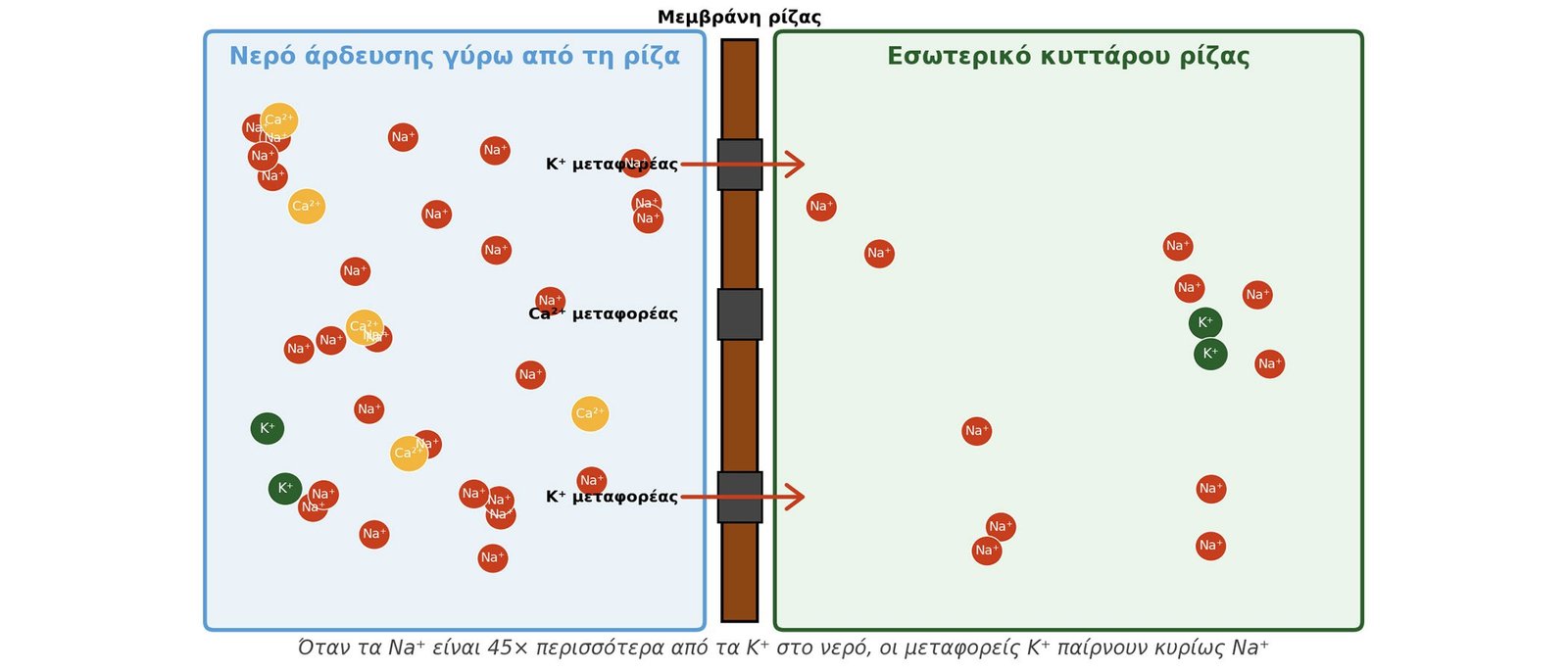
Graph 1. Schematic imaging of ion competition at root. When sodium outnumbers potassium and calcium in irrigation water, it passes through transporters intended for them — resulting in functional deficiencies in the plant, even when lubrication is sufficient.
The same applies to calcium. When sodium is at a very high concentration, it displaces calcium at the intake points. This explains why dry top rot occurs with bad water even when you add more calcium to lubrication. A recent study of Al Hosni and collaborators (2025) in Irrigation Science showed it experimentally: the higher the calcium in the solution (from 6 to 18 mM), the less sodium resulted in tomato tissues and pericarpal stability improved.
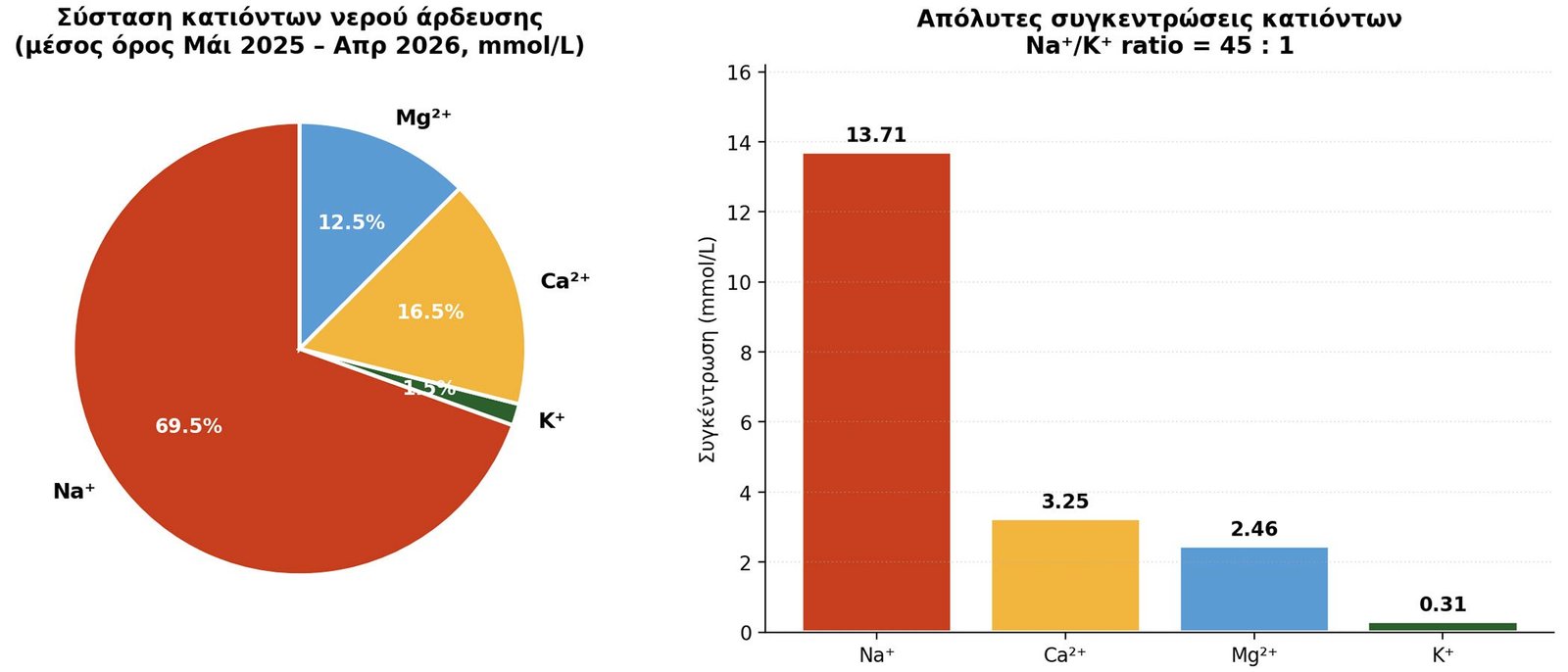
Graph 2. Recommendation of water caion for the last 12 months (May 2025 – April 2026). Sodium is consistently 65–70% of the total, while potassium is just 1–2%. For each potassium ion reaching the root through irrigation water, there are 45 sodium ions.
The conclusion is clear: The deficiencies you see are «functional», not realYou give the nutrients, but the plant doesn't take them. — Because sodium leads in line. In practice it translates into smaller fruits, falling flowers in peppers, soft cucumber fruits, uneven maturation in tomato, dry rot.
However, competition is not limited to sodium. Nutrients themselves compete with each other when their proportions escape. Calcium, magnesium and potassium share transporters at root — If you give too much magnesium, potassium and calcium are displaced· If you give too much potassium, magnesium is displaced. In the final application solution you aim to keep the ratio Ca:Mg: K in a balance of 2-3 : 1 : 2-4 (depending on stage and substrate). In harsh Mediterranean waters, which often carry excess magnesium, this proportion easily goes off — And then they show up «deficiencies» potassium or calcium even when given in sufficient quantities.
There is a third effect that is often overlooked: Bicarbonates water. At the dam move around 150 ppm — within the FAO light containment zone. When bicarbonates are high, they raise pH to the rhizosphere, and at high pH trace elements such as iron, manganese, zinc and boron become less available — «commit» chemical in forms that the root does not take. You see it as a chlorine between the nerves of the leaf, especially in hydroponic cultures, within a few weeks if you do not systematically add nitric acid for neutralization.
What you'll see in your crop
With an average EC water of the last 12 months 2.55 mS/cm, the expected losses per crop — based on the Maas-Hoffman tolerance threshold (1977), which is the reference worldwide — are:
Tomatoes (ECw 1,7). Expected loss of salinity: 8–10%. The tomato is relatively resistant to sodium, but more sensitive to chlorine. With bad water you will see increased dry summit rot, uneven maturation, smaller fruit size. Often producers attribute it to «heat», «poor crop» or viruses — while it's the water.
Cucumber (ECw threshold 1.7). Similar EC tolerance to tomato, but more sensitive to chlorine. Losses in quantity plus quality easily reach 15–20%: soft fruits, bitter taste, reduced maintenance duration after harvest.
Pepper (ECw 1,0). Here we are talking about 20–25% expected loss of production, with often quality problems: small fruits, flower fall, dry rot.
Eggplant (ECw shell) ~0.7). The big surprise. Although we traditionally consider it «durable», the real threshold is just 0.7 — Lower than pepper. With the current EC of the dam, losses are similar or even higher than those of the pepper.
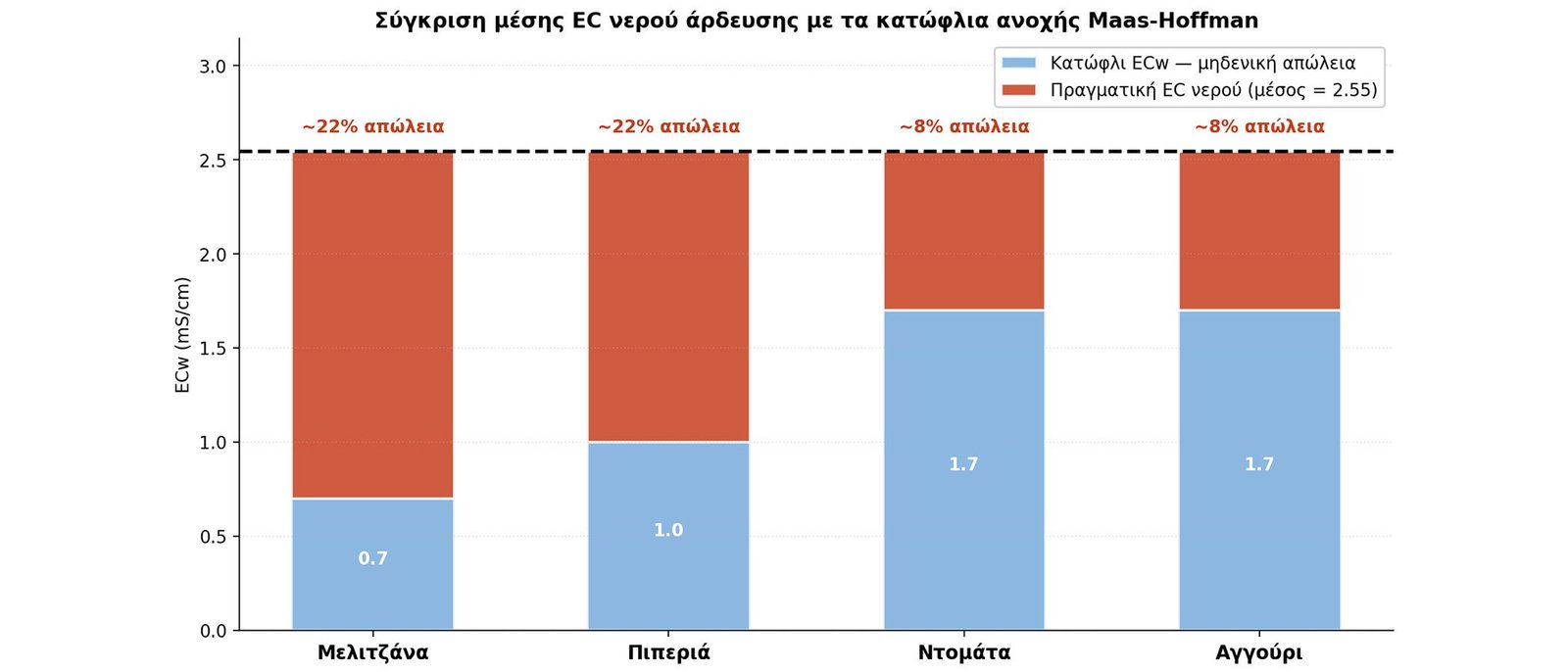
Graph 3. Comparison of the average EC water (≈2.55 mS/cm) with the Maas-Hoffman tolerance thresholds for the four main greenhouse crops. The black line (real EC) is above the zero loss limit for all four, and deep into the loss zone for pepper and eggplant.
An asterisk here: the Maas-Hoffman threshold was calculated for outdoor crops. In the greenhouse, and especially in crops on a substrate, tolerance is a little higher because you control the rhizosphere better. But the logic is the same: the longer the distance between the threshold and the real EC, the greater the loss.
More practical observation: if you work with such water without adjustments, you will see «inexplicable» drop in harvest, quality issues you attribute to «heat», «• reduction», «poor crop». It's often none of it. It's your water that's changed.
Another finding worth knowing: a small percentage of water sodium actually reaches the tissues of the plant — in tomato only 2–3% of the sodium we offer ends up in the tissues. Sounds a little bit. But when your water has 300–400 ppm sodium, and this 3% multiplys day by day in a season, it's enough to do all the damage you see on the wrists.
Is there a deal?
The situation is serious but manageable. Six moves work in practice — And they work better combined.
1. You adjust the lubrication. The recipe you gave with water EC 1.0–1.2 does not work with 2.5–3. Specifically:
- Potassium increase of 20–30% relative to standard recipes, to compensate for «theft» from sodium
- Calcium boost from the binding of the fruits, through calcium nitrate. This one movement can significantly reduce sodium resulting in the fruits
- Balance Ca:Mg:K in the final application solution (indicative of order 2-3 : 1 : 2-4), after mixing with water — Not just the amounts of fertilizer you put in the tanks.
- Neutralization of dicarbonates with nitric acid. Target pH solution 5,8–6,0. Otherwise, iron, manganese, zinc and boron are bound to the risosphere. — And you see paleness between the nerves
2. You wash more. The LF is the percentage of applied water that drains and rinses the salts under the root. With good water, 15–20% is enough. With water like the dam, You raise it to 30–40%.. Practically, for every 100 litres the plant needs, apply 143–167. Sounds like a waste in a water shortage — But it's the only alternative to gradual root salinization. Check always with EC drainage measurement: if this is 1.5–2 times the application EC, your LF is correct.
3. Vaccinate on a resistant subject. If there's an investment with tested yield in salt water, it's her. In tomato the resistant subjects drastically reduce the transfer of sodium to tissues and improve the intake of K, Ca, Mg in salty conditions. The cucumber works excellently. In pepper and eggplant, commercial choices are more limited. — but deserves a serious assessment in these circumstances.
4. Mix water sources wherever possible. If you have a second source of better quality (brown tank, lower SAR drilling), mixing can give real relief. Even a 70:30 ratio (bad: good) reduces the EC by about 0.5 unit — Enough to get a crop out of the heavy loss zone in a controlled stress zone.
5. You count systematically. None of this works without numbers. A decent EC meter costs 40–60 euros and gives you three values daily to know: EC irrigation water, EC application solution, EC drainage (hydroponics). With them you see the problems before they manifest themselves on the plant, not after.
Practically what that means: if you give EC 3.5 solution and the drainage counts 4.2, your LF is close to the right one. If the drainage is 6,0 or above, the salts accumulate at the root — should increase the application volume. If it's under 3.5, you wash and lose fertilizer. In difficult water this measurement is the best indicator you have.
In addition to the frequent measurement of the EC, a complete water analysis twice a year is minimal. The EC tells you if the quantity changes. Your analysis tells you if the recommendation changes — as changed at the dam within three years. If you had only EC, you would have seen the total number go up.· You wouldn't have seen that what really ejected is sodium and chlorine, while sulphurates and dicarbonates moved much less. And that distinction is the whole difference between a lubrication that works and one that is wasted.
Close
This is not a local phenomenon that will pass. In the Mediterranean, the coexistence of water shortages and permeability leads steadily to higher salinity waters. The Bramian Dam is a specific case where, due to dense analyses, it allows us to see with numerical precision what it means to change your water in a few months. — And what it costs if you don't adjust in time.
The point is that high conductivity is not just a larger number in an analysis. It is a system of problems that changes the way we think about nutrition and irrigation. It all begins in the root intake mechanisms, where sodium displaces potassium and calcium, and disrupts the proportions the plant expects. All this happens quietly, long before you see the first symptoms in leaves or wrists.
For the producer who will adapt his practice in time — choice of subjects, solution composition, leaching, pulse irrigation, systematic monitoring — casualties are manageable. For the one who will continue as before, the casualties will be hidden in «virus», «Bad crops», «inexplicable» area efficiency falls. The difference between the two is not a question of cost or technology — most adjustments are relatively cheap. It's a matter of understanding what the water really carries, and prepared to change the recipe it worked for ten years when the raw material changes.
In the circumstances of Ierapetra in November 2025, with EC 2.92 — What should have been done was to start adaptation as early as 2024, when the EC began to rise systematically. Whoever did this entered the winter season 2025/26 at reduced risk. Whoever didn't, now sees the casualties. — And more importantly, he's wasting learning time. Because water won't happen again.
Sources
- Rijk Zwaan Hellas. Water analysis values. Full file of irrigation water measurements from soil laboratory. Available in: https://www.rijkzwaan.gr/news/values-analysis-water-0
- Ayers RS, Westcot DW. Water Quality for Agriculture. FAO Irrigation and Drainage Paper No. 29 (rev. 1). Rome: FAO, 1985.
- Maas EV, Hoffman GJ. Crop salt tolerance — Current asset. Journal of the Irrigation and Drainage Division, ASCE 1977;103(IR2):115–134.
- United States Salinity Laboratory Staff. Diagnosis and Improvement of Saline and Alkali Soils. USDA Agriculture Handbook No. 60. Riverside, CA: USDA, 1954.
- Schwarz D, Kuchenbuch R. Water uptake by tomato plants grow in closed hydroponic systems dependent on the EC-level. Acta Horticulturae 1998;458:323–328.
- Al Hosni A, Joyce DC, Hunter M, Perkins ML, Al Yahyai R. Altered calcium and potassium distribution maps in tomatoches cultured under salinity: studies using X-ray fluorescence (XFM) microscopy. Irrigation Science 2025;43:613–636. doi:10.1007/s00271-025-01012-1
Written by George Psaroloakis, Agronos
https://www.linkedin.com/in/george-psarologis/

