
Today, the housing crisis is developing into one of the most thorny socio-economic problems which the new generation is called upon to face. With rents galloping and wages remaining pinned down, the acquisition of housing seems to most young adults in Greece as an impossible scenario, entraping them in a prolonged dependency on the family home.
The economic impasse leads to a prolonged puberty, preventing personal independence and aggravating the country's demographic problem
Image is familiar to hundreds of thousands of Greek households: a thirty-year-old worker, with a degree, possibly a master's degree, returning this afternoon from his job in the room where he grew up.
In the same walls hosting his teen posters, today are the documents of his tax declaration and his professional notes. Extending residence in the home is not a cultural whim or a choice of comfort, but a tough economic necessity.
The recent OECD report entitled «Investing in Youth: Greece’s Path to Financial Independence» It captures in the most relentless way the structural crisis that prevents the country's younger generation from passing the door towards complete independence.
The X-ray of a... prolonged puberty
The findings of the OECD report make up a landscape of deep social and economic asphyxiation. In Greece, nearly 74% of young people aged 20 to 29 live with their parents. This percentage places the country in the top positions of the relevant list among OECD member states, next to countries such as Korea, Italy, Spain and Slovakia, abstaining from Nordic and North European countries, where leaving the family home takes place early in the early years of adulthood.
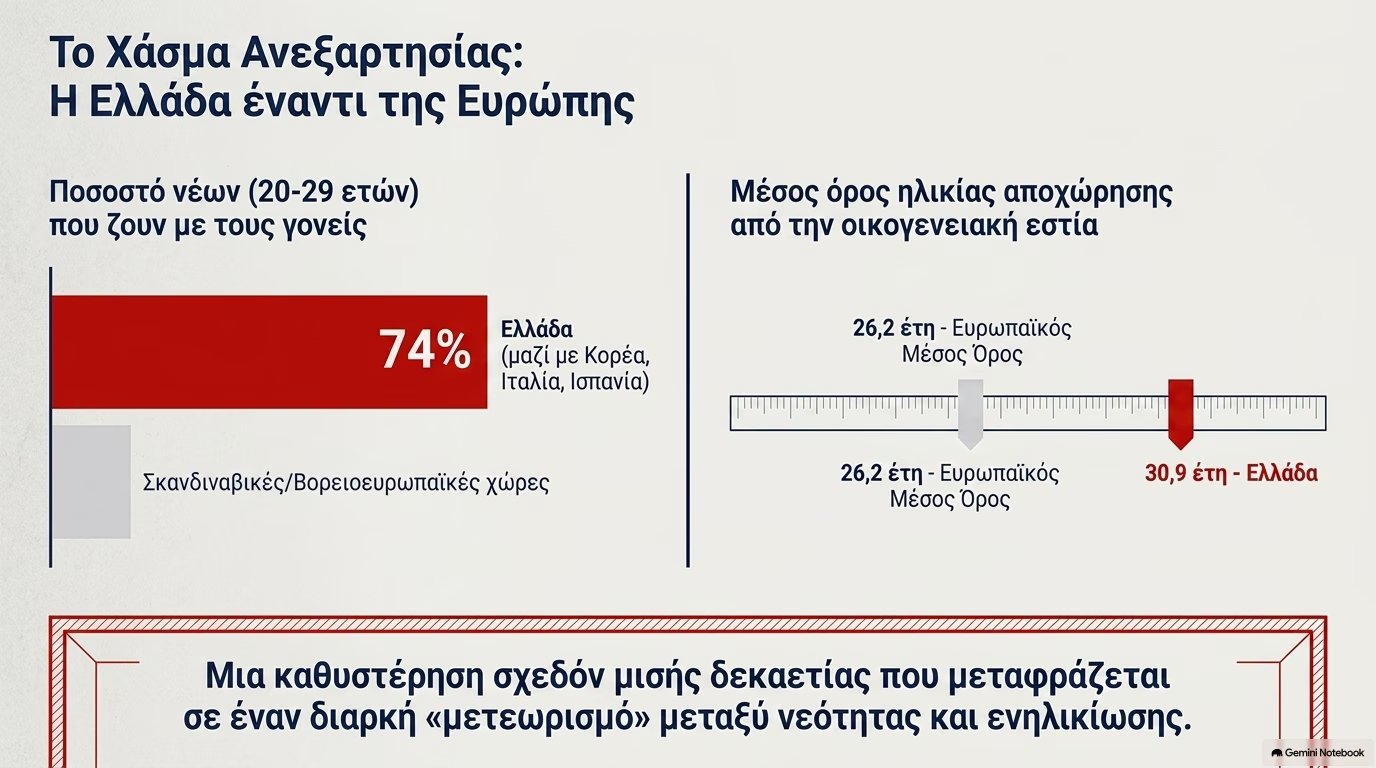
Even more indicative is the average age in which Greeks eventually manage to open their own home: 30.9 years. While the European and international average is 26.2 years, in Greece the transition to autonomous living is delayed by almost half a decade. Staying at home is not just a statistical size· translates into suspension of personal plans, delay in family creation and a lasting feeling «flatulence» between youth and adulthood.
Housing crisis: When rent swallows the salary
What, though, is due to this prolonged dwelling life? The answer lies in the profound disproportion between housing costs and disposable income.
For a young man aged 18 to 29 who dares to live alone in Greece, housing costs take on nightmare dimensions. The OECD report reveals that young people are invited to spend, on average, over 60% of their income only to cover rent and general interest accounts. This is more than twice the European average, which ranks housing costs in Greece as the most unbearable in Europe.
In the major urban centres, such as Athens and Thessaloniki, the situation is even more dramatic. Nearly 8 out of 10 young people devote over 40% of their income to the roof, far exceeding the internationally accepted 30% safety limit. The launch of real estate prices, the widespread spread of short-term leases of Airbnb type and the lack of available, quality and affordable housing have turned rental into an elusive dream.
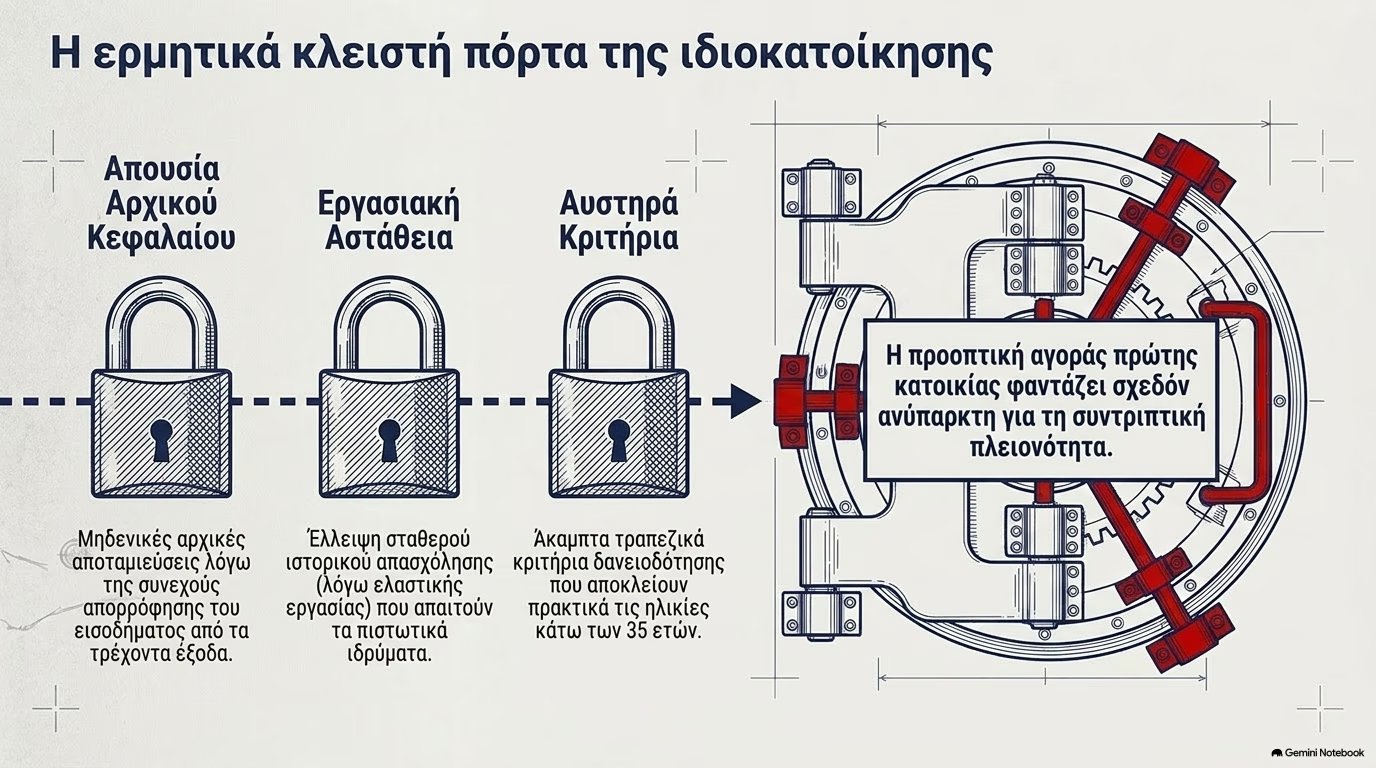
At the same time, the prospect of purchasing first residence seems almost nonexistent to the vast majority. The absence of initial savings, the strict banking lending criteria and the lack of stable historical employment keep the doors of bank lending tightly closed for ages under 35.

The labour market and psychological pressure
The housing problem doesn't work empty· directly linked to the structural weaknesses of the Greek labour market. Despite the decline in youth unemployment in relation to the dramatic levels of the previous decade, the quality of jobs remains low.
Young people in Greece often face:
- Low import wages: Pays remain pinned down, while inflation and living costs gallop.
- Flexible and temporary forms of employment: Seasonality (especially tourism and focus) and fixed-term contracts do not provide the stability required to make long-term financial commitments, such as a rent.
- Skills mismatch: Many young people with high formal qualifications are forced to work in positions below their potential, with corresponding low pay.
This economic hostage has a heavy psychological and social impact. According to the investigation «Risks That Matter» of the OECD, about 70% of young 18-24 years in Greece are strongly concerned about whether they will be able to find or maintain suitable and affordable housing in the future. This uncertainty cultivates a feeling of prolonged insecurity, cancels the creation of a family and feeds the demographic problem of the country, while maintaining alive the wave of flight of young scientists abroad (brain drin).
The politicians' bet: Are measures enough?
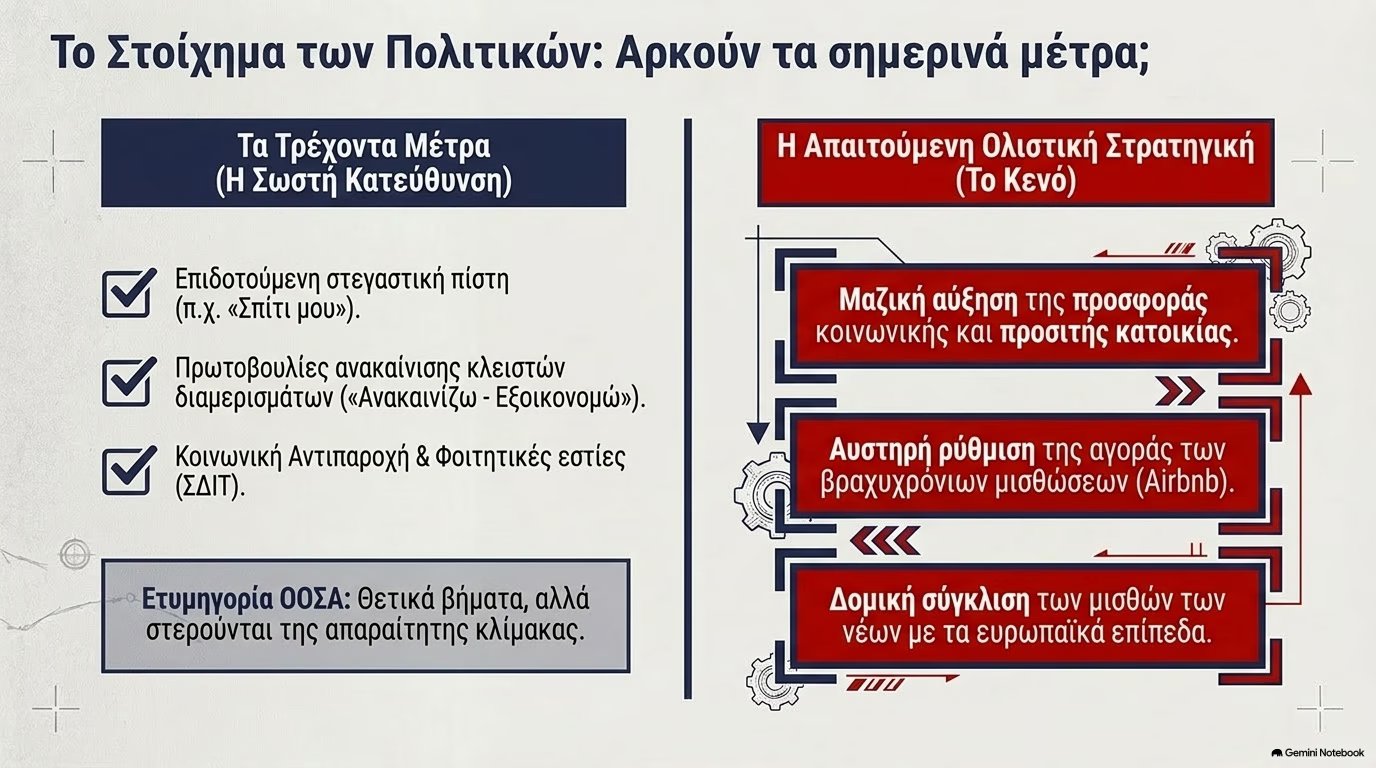
Against this structural crisis, the need for substantial interventions is imperative. The state has implemented certain measures under the Housing Policy and National Action Plan for Demographic, such as:
- Granted housing credit schemes (such as «Home»), facilitating the purchase of low-interest housing for young people.
- Renovation initiatives for closed apartments, aimed at channelling them to the market with affordable rents (e.g. «Renovate – Save for Young People»).
- The institution of the Social Contribution and the expansion of student outbreaks via PPP.
However, as OECD analysts point out, these measures, although they are moving in the right direction, need to take a larger scale and continuity. Addressing housing deadlock requires a holistic strategy that combines increasing the supply of social and affordable housing, regulation of the short-term lease market, but above all convergence of young people's wages with European levels.
Caught in the nursery
The «Home Sweet Home... with parents» But it reflects a deep social reality. The generation of 20s and 30s in Greece does not ask for luxuries· claims the basic right to autonomy and independence. As long as the children's room remains the only refuge against the economic storm, the country will continue to lack the dynamic, creativity and evolution that only an economically independent youth can offer.

