
The household debt map in Europe reveals an impressive reversal on the North-South line. Eurostat's recent data break down the traditional stereotype that wants the European South to live beyond its potential and the North to save. The reality is completely different, as the European Union's most over-indebted households are located in the euro area and not in the southern economies, which are usually treated as the most vulnerable on the continent.
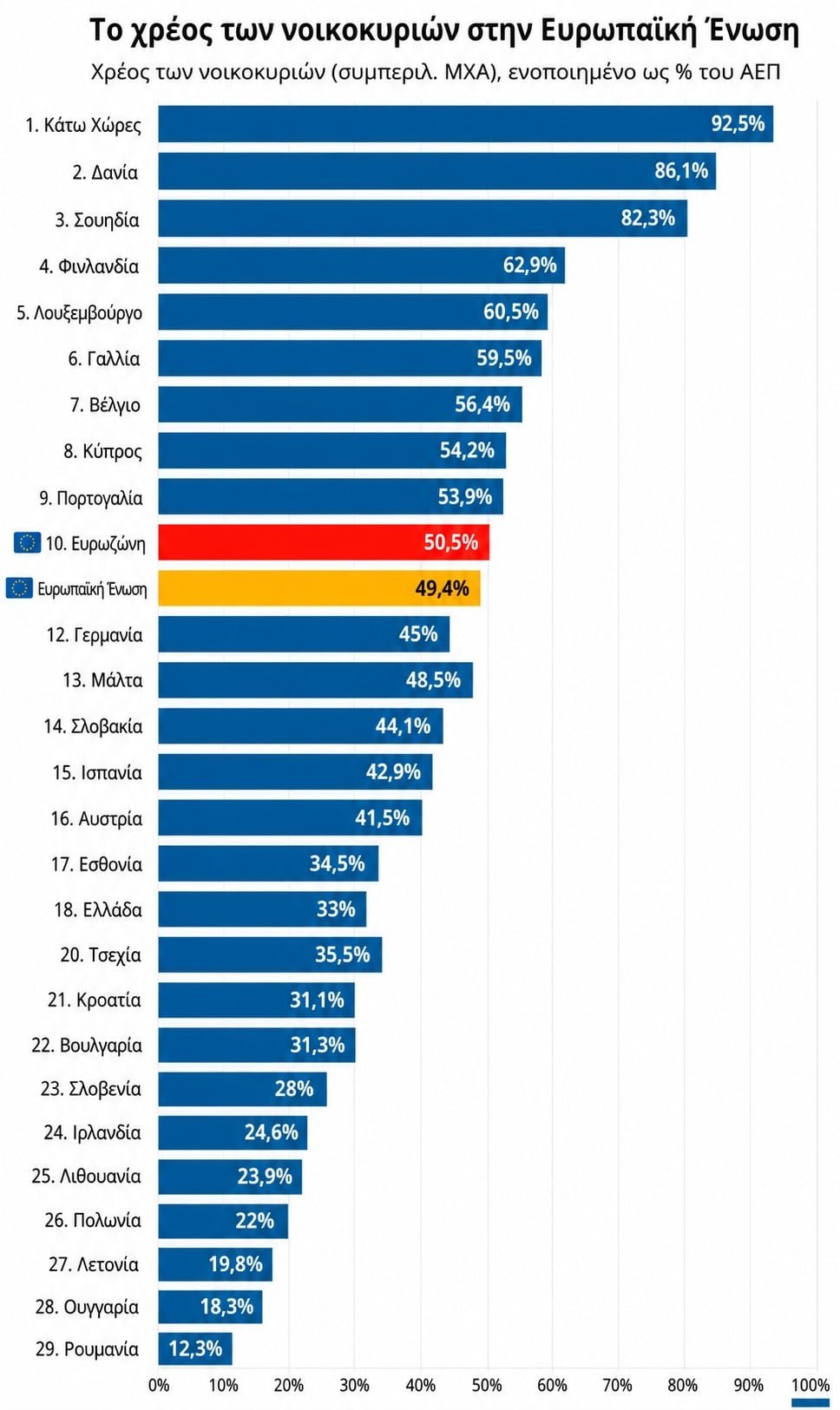
According to Eurostat's data, and citing Euronews, household debt was formed in 2025 to 49.4% of GDP for the EU and 50.7% for the eurozone.
Both indicators record a steady annual retreat since 2020, when they exceeded 60%. This indicator does not reflect the individual debt of each household, but provides the overall picture of the level of leverage of individuals over national income. The correlation of this loan with Gross Domestic Product (GDP) allows for a safe comparison between countries of different economic size, directly linking private debt to the overall productivity of each economy.
High private debt is not necessarily a problem. Countries with mature housing markets, high rates of lending or advanced financial systems show traditionally increased indicators. However, excessive leverage may deepen economic recessions.
The European Commission defines 55% of GDP as the threshold beyond which household lending is transformed into a macroeconomic risk. Historically, private and not public debt is what sparks credit crises, with a more typical example of the 2008 global financial crisis, which began from household balance sheets.
The European paradox focuses on the geographical reversal of indicators, as seven EU member states exceed the 55% of GDP security threshold, with all of them located in northern and western Europe. On the contrary, the European South, despite its historic burdened public debt, records a highly restrained private loan.
Italian households owe only 35.9% of GDP, compared with 38.0% in Greece and 42.9% in Spain, which significantly decline below the European average. While southern governments are among the continent's most over-indebted, individuals are clearly more conservative borrowers than northern Europeans.
The EU's 10 most burdened countries:
10. Germany (49.0%): Europe's strongest economy is approaching the European average because of the extremely low rate of ownership, which in 2022 was limited to 46.7%. The extensive rent market, controlled housing costs and the absence of tax exemptions for mortgage interest have historically limited the need for large bank loans.
9. Portugal (53.9%): Private debt reached 171 billion euros in late 2025, recording an annual 8.6% increase due to housing credit, during a period of rapid rise in real estate prices. Household exposure is considered high, as over 90% of housing loans are linked to floating or mixed interest rates based on Euribor, making borrowers vulnerable to ECB interest rate changes.
8. Cyprus (54.2%): According to the Central Bank of Cyprus, the relevant indicator has been declining about 62% since December 2016. However, 34% of the total debt relates to old non-performing loans located in the portfolios of credit-receiving companies that are under gradual repayment.
7. Belgium (56.4%): 43.1% of households have private housing with a housing loan —performance significantly higher than the European average of 24.3%— with the vast majority referring to fixed interest rates. The National Bank of Belgium recorded a strong rise in housing credit in 2025, with new lending ejected to 40.7 billion euros from 31.7 billion last year.
6. France (59.5%): Η εγχώρια αγορά κυριαρχείται από σταθερά επιτόκια, με τον δανεισμό κυμαινόμενου τύπου να αποτελεί εξαίρεση. Οι χορηγήσεις υπόκεινται σε αυστηρά κριτήρια, καθώς η μηνιαία δόση γενικά δεν επιτρέπεται να υπερβαίνει το ένα τρίτο του καθαρού εισοδήματος των δανειοληπτών, βάσει ανώτατου ορίου που επικαιροποιεί μηνιαίως η Τράπεζα της Γαλλίας.
5. Λουξεμβούργο (60,5%): Η επιβάρυνση εμφανίζει έντονη συγκέντρωση, καθώς τα στεγαστικά δάνεια αποτελούν το 90% του ιδιωτικού χρέους. Εντούτοις, σχεδόν τα μισά νοικοκυριά δεν βαρύνονται με οφειλές, ενώ ο μέσος καθαρός πλούτος άγγιζε τις 676.000 ευρώ.
4. Φινλανδία (62,9%): Το χρέος προέρχεται σχεδόν αποκλειστικά από τον στεγαστικό τομέα. Τα ατομικά στεγαστικά δάνεια αντιπροσωπεύουν το 63% των οφειλών. Ωστόσο, αν προστεθούν και τα κοινόχρηστα δάνεια για την κατασκευή ή τη συντήρηση των πολυκατοικιών —τα οποία επιβαρύνουν αυτόματα κάθε νέο αγοραστή διαμερίσματος— το συνολικό μερίδιο εκτινάσσεται στο 75%. Η Τράπεζα της Φινλανδίας αυστηροποιεί το ρυθμιστικό πλαίσιο για αυτού του είδους τον δανεισμό με στόχο τη συγκράτηση των ανοιγμάτων.
3. Σουηδία (82,3%): Αποτελεί μία από τις πλέον εξαρτημένες αγορές από τη στεγαστική πίστη στην Ευρώπη. Η κυριαρχία των κυμαινόμενων επιτοκίων αφήνει τους ιδιώτες πλήρως εκτεθειμένους στις μεταβολές του κόστους δανεισμού, ευπάθεια που αναδείχθηκε έντονα κατά τον πρόσφατο κύκλο σύσφιξης της νομισματικής πολιτικής της ΕΚΤ.
2. Δανία (84,1%): Η Εθνική Τράπεζα της Δανίας και η Ευρωπαϊκή Επιτροπή αντιμετωπίζουν το υψηλό ακαθάριστο χρέος ως σήμα κινδύνου, επισημαίνοντας πάντως ότι αυτό εξισορροπείται από ισχυρές συνταξιοδοτικές αποταμιεύσεις και πάγια περιουσιακά στοιχεία. Ωστόσο, οι οφειλές ως ποσοστό του διαθέσιμου εισοδήματος προσέγγισαν το 177%, καταγράφοντας μία από τις υψηλότερες επιδόσεις στην ΕΕ.
1. Ολλανδία (93,5%): Στην κορυφή της λίστας βρίσκονται τα πιο χρεωμένα νοικοκυριά της ηπείρου. Η De Nederlandsche Bank αποδίδει την πρωτιά στα ισχυρά κυβερνητικά κίνητρα για τη λήψη στεγαστικών δανείων, όπως οι φοροαπαλλαγές και τα χαλαρά κριτήρια που επιτρέπουν χρηματοδότηση έως και στο 100% της αξίας του ακινήτου. Το άνοιγμα αυτό εξισορροπείται από μεγάλα συνταξιοδοτικά κεφάλαια και υψηλά επίπεδα ιδιωτικού πλούτου.
preferred source on Google
To show more articles by Maritime in your searches easily and quickly, you must add the site to your preferred sources. You can do it by going Here..

