
Today's high school student is expected to retire around 2070. Until then, the labour market which will meet, it will have changed more times - and above all more radically - than it has changed overall throughout the 20th century. Some professions as we know them today, legally, will be overcome and eliminated.
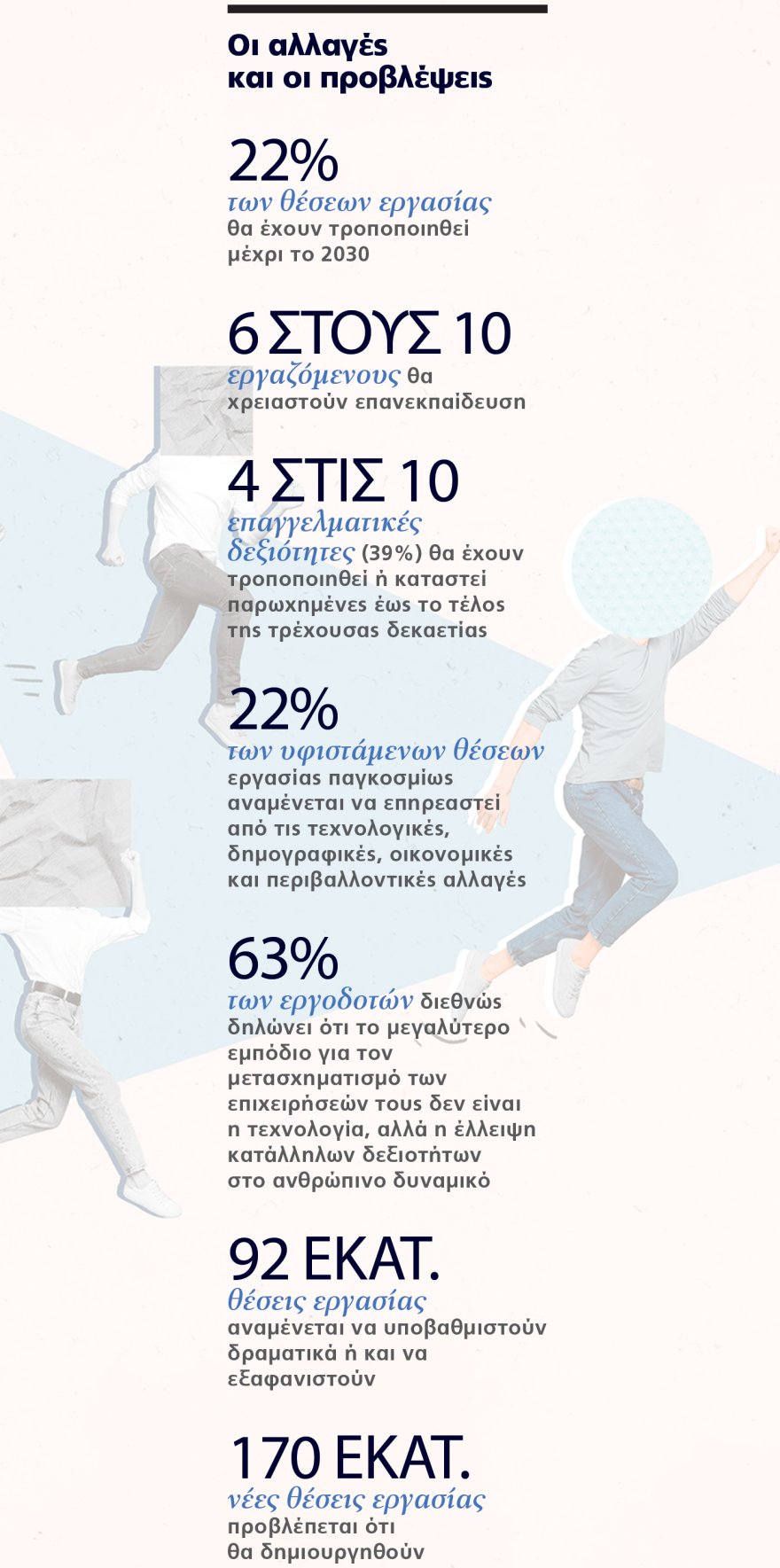
Some others will turn into something completely different. And, of course, some have not even been invented yet. By 2030, however, the 22% The jobs it is expected to have been modified and 6 out of 10 workers will need re-education, as international research concludes.
As far as Greece is concerned, the following paradox and contradictory applies: on the one hand, there is a lack of qualified staff in areas such as Information technology, the tourism, Logistics (supply/transport) and, of course, in Technical professionsOn the other hand, unemployment rates in young graduates remain proportionally high.

So there is mismatch, a gap between real demand and supply to the Greek labour market. This is a complex and multi-factorial issue, but also of crucial importance to the orbit of Greek society more broadly.
From the perspective of teenagers who are called upon to make critical decisions about their future, however extreme it may seem, the choices of a present 17-year-old affect not only developments, e.g. in the field of Artificial Intelligence, but also wars in Ukraine and the Middle East or energy transition.
In other words, there is a global uncertainty which is burdening and to some extent guiding the current candidates. Panhellenic. Children invited to choose studies that, ideally, lead to immediate or, at least, rapid professional rehabilitation, in coordination with the current needs of the Greek economy.
THE tourism, the Shipping, the technology (digital and non-digital), sustainable/green energy, The Health et al. are fields that gather the greatest interest. However, for survival and prevalence in the real professional track, the critical asset is not both the accumulation of specialized knowledge and the professional adaptability and resistance to psychological pressure.
Skill deficiency
According to his estimates Global Economic Forum (World Economic Forum – WEF), nearly 4 out of 10 professional skills (39%) required today will have been modified or become obsolete by the end of the current decade. In addition, 22% of existing jobs worldwide are expected to be affected by technological, demographic, economic and environmental changes.
Businesses regard skill deficit as a bigger problem than Artificial Intelligence, with 63% employers internationally declare that the biggest obstacle to transforming their businesses is not technology, but the lack of appropriate skills in human resources.
At the same time, one of the most impressive findings in the WEF survey is that around 92 million jobs are expected to be dramatically downgraded or even disappear. At the same time, however, 170 million new jobs are expected to be created – so the final balance is positive by around 78 million jobs. This perspective breaks down the stereotypical prognosis that «Artificial Intelligence will level the jobs.».
On the basis of the same WEF report, if the world labour market represented 100 employees, 59 would need a significant upgrade or change of skills, at the most by 2030.
The «Soft Skills»
The fastest growing international specialties, for example, are: Experts in Artificial Intelligence and Learning Engineering, Data Specialists, engineers Financial Technology (FinTech), experts Cybersecurity, developers or engineers Software, engineers Renewables Sources Energy, Environmental engineers and experts electrical and autonomous vehicles.
On the other hand, the most pressing occupations include: data registration officials, the cashiers, the secretarial support and administrators assistants, as well as those who conduct simple accounting tasks.
It is worth noting, however, that according to WEF, despite the explosion of Artificial Intelligence, skills with the greatest future value are not exclusively technological. At the top remain analytical thinking, creativity, resilience, flexibility, cooperation, leadership, lifelong learning. Overall, the cultivation of so-called «soft skills».
On the basis of the above, Demetrius Gregoriadis, Occupational Guidance Adviser, member of the Hellenic Advisory and Guidance Society (ELPSEP) and Christos Atlas, Certified Occupational Guidance Adviser and Head of the respective College office Anatolia, they print for the «First Question» The new working landscape that today's high school students will find before them.
Thus, the Top 10, according to Mr Gregoriadis and Mr Atlassis, as regards the ten professional sectors with the best prospects for the future, is as follows:
- Technology and Digital World
- Green Economy and Sustainability
- Tourism, Culture and Hospitality
- Health and Wellness
- Human Resources Education and Management
- Farming and New Food Technologies
- Shipping, Transport, Logistics and Supply Chain
- Finance and Business
- Construction, Infrastructure and Real Estate
- Creative Industries and Media, including Game Design, Digital Communication Strategy etc.
How the landscape changed
In the last 18 years or so, the World economy and, consequently, the labour market is in a state of permanent and uninterrupted change. The time when analysts described as «high stability period» is definitely in the past, having granted its place to a new reality, in its time «Multi-crisis».
From the collapse of Lehman Brothers in 2008 and the global financial crisis to the European debt crisis, the successive lockdowns of the COVID-19 pandemic and the recent geopolitical flares in Ukraine, the Middle East and Iran, the global economy has been constantly, fiercely shocked, sustaining a climate of universal uncertainty.
This is, in summary, the view expressed by Mr Gregoriadis and Mr Atlas, also stressing that «within this already flammable setting, the explosive emergence of Artificial Intelligence comes to act as the ultimate new catalyst. The changes that are occurring are deeply structural. It is expected to radically restructure productivity and cost, affecting the labour market, perhaps at a qualitative level rather than at a quantitative level.».
World trends are reflected in Greek reality through a revealing map, which recently published by Piraeus Chamber of Commerce and Industry (EVEP) on the professions of the next decade in Greece (2026-2036). This map illustrates the passage from traditional professions to new, more complex and sophisticated, «hybrid» Specialties.
As they point out in «SUBJECT» experts, «the golden rule for critical decisions to be made by the current high school student is undergraduate studies with as broad a content as possible to create strong bases. And then, a totally targeted master's degree, for specialization in cutting-edge areas».
New qualifications
Of course, technological and economic trends simply show the direction of things, without prejudicing or predicing the future. Who will eventually succeed in constantly changing and unpredictable conditions depends on a completely different mixture of qualifications.
Since the modern labour market has long ceased to seek exclusively the strict technical expertise (hard skills) – especially today that technological knowledge has a very short expiry date, since the progress of science and technology is dizzying.
However, the «mild skills», as critical thinking and ability to solve problems, adaptability and flexibility, appeal to communication, teamwork and willingness to cooperate, act as the necessary operating system, which allows the employee to remain active and within the game, thus evolving and calculated by the employer concerned.
As they point out in «SUBJECT» career advisers Gregoriadis and Atlas, for the candidates of the Panhellenic examinations and the students preparing for them, «The harmonious coupling of these two worlds is which gives birth to the two most valuable virtues of modern professional, professional adaptability and resilience.

These two qualifications make up, according to experts in professional orientation, the most powerful shield against inevitable shifts and challenges of a career.
Adaptability concerns the readiness and insight of the worker to predict and cope with any change in the professional environment in time, while resilience judges his ability to function effectively and react positively, even under the most stressful and adverse conditions.
The real question, therefore, is not so much the ex-ante choice of the "right", the ideal profession, but, above all, the acquisition of supplies, which will allow young people to adapt to a world that changes faster than ever.
This is because the future labour market will reward not necessarily those who know most, but those who can learn faster, evolve constantly and eventually turn uncertainty into opportunity».
Photos: EUROKINISSI, Shutterstock

