
The increasingly extreme heats that hit Europe not only threaten crops and livestock, but are now targeting one of its most iconic products and cheeses The ItalyThe parmesan.
In Emilia-Romania, the birthplace of the original Parmigiano Reggiano in Italy, high temperatures reduce milk production, launch energy costs and raise concern that the climate crisis can change the future of a cheese with a history of over 800 years.
According to a report by Reuters, fifty years ago, farmers opened the stable windows only on summer nights to cool cows. Today, with temperatures above 40 degrees Celsius, windows remain open 24/7, and fans and water spray systems have been added to protect animals and milk quality.
«Extreme heat affects both the quality and quantity of milk», Nikola Bertinelli, president of Parmigiano Reggiano Consortium and owner of a family farm operating since 1895, near Parma, told Reuters.
Up to 10% less milk
When the temperature exceeds 40°C, cows remain longer lying down, eat less and produce up to 10% less milk. This is a serious blow, as milk is, along with salt and rennet, one of only three ingredients of the authentic parmesan.
The production of Parmigiano Reggiano is allowed exclusively in five provinces in northern Italy, mainly in Emilia-Romania, while cows must feed exclusively on grass and hay produced in the same region.
«If it doesn't rain, it doesn't grow grass, it doesn't produce hay and there's no milk needed to produce cheese», Bertinelli explains.
 Parmesan / REUTERS / Matteo Minnella
Production costs fired
The need for constant cooling of stables has greatly increased electricity consumption, but the burden does not stop there.
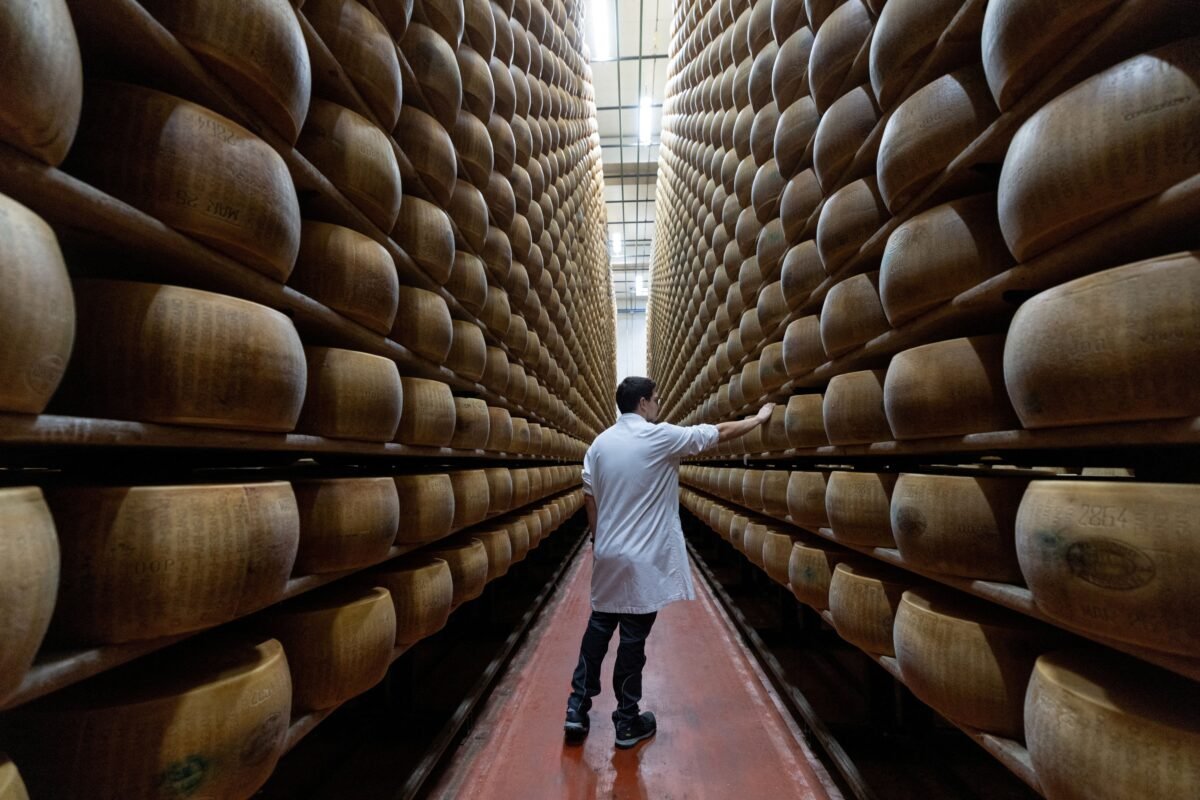
High temperatures also affect the huge warehouses where parmesan wheels mature for at least 12 months – and in many cases up to three years.
More than 500,000 Parmigiano Reggiano wheels, a total value of more than EUR 300 million, are kept in two warehouses of the company Magazzini Generali delle Tagliate (MGT), in the provinces of Reggio Emilia and Modena.
«During this year's extreme burns, daily energy consumption increased by about 30%», stated MGT director, Jancarlo Ravanetti.
As he said, the company is constantly investing in the upgrading of cooling systems, thermal insulation of installations and the production of renewable energy to reduce increasing energy costs.
The temperature controlled warehouses in the area are known as «Bank of Parmesan», as they accommodate hundreds of thousands of wheels of cheese of enormous economic value, which are even used as guarantees for bank lending.
Despite technology, human experience is still decisive. Each wheel is subjected to X-rays to detect internal imperfections, while experts check it every week by hitting it with small hammers, so that the sound can determine whether a defect has developed during maturation.
«The human factor remains the most important element throughout the process», points out Ravanetti.
A product of 800 years in danger
Parmigiano Reggiano's industry generates an annual turnover of around EUR 4.5 billion, employs thousands of workers and is a key pillar of the region's economy.
In 2025, more than 50% of total sales came from exports, with the United States becoming the largest foreign market.
However, industry people warn that climate change now threatens the very viability of production.
«If extreme weather phenomena become more intense and last longer, they will affect not only the quantity and quality of milk, but increase even more production costs», warns Paolo Ganzerly, director of international sales of the GranTerre Group.
«Parmigiano Reggiano has existed for more than 800 years. We don't want to be the last generation who can enjoy it»It ends up.

