
Jessie Genet has created one. «digital staff» consisting of agents artificial intelligence who undertake to organize the house.
ARTICLE SUMMARY
- Claire, an autonomous artificial intelligence agent, manages the family's everyday life by taking initiatives. He monitors the program, identifies needs and proceeds to orders of products and books without requiring a human order, constantly operating in the background.
- Beyond Claire, a wider digital ecosystem supports the family. Specialized AI agents manage legal documents, develop software and design personalized educational programs for the children’s home teaching, adapted to their progress.
- Genet, former CEO, treats AI as a potential multiplier, replacing services that would cost hundreds of thousands of dollars. Its attitude contradicts the wider concern of the labour market about the impact of technology.
- The system requires continuous supervision, as it remains prone to errors, such as sending an email without approval. At the same time, concerns are expressed about the possibility of creating social inequalities based on access to powerful artificial intelligence models.
On a horse ranch just outside Los Angeles, the everyday life of a multi-journal family is less and less like the scenario of an ordinary American life and more and more like a rehearsal for the future. There lives Jesse Genet, mother of seven children, who has created an entire «digital staff», consisting of agents artificial intelligence who undertake to organize the house, train her children, manage documents, monitor supplies, even manufacture custom-made software.
ARTICLE CONTINUES AFTER ADVERSION
The cost of this pioneering - and for many controversial - everyday life reaches $2,000 to $3,000 a month, but it is itself an investment that gave her back something far more valuable than money: time.
«I got five years of my life back.»
«I got five years of my life back.», she stated herself in The Cut magazine, summarizing her experience in a way that reflects philosophy behind her surgery. For Genet, artificial intelligence It is not just a tool of productivity nor a digital assistant answering questions. It's a mechanism for managing everyday life, an invisible group of associates who constantly work in the background and help her take the necessary... breaths.
Claire taking even initiatives
The most known of these digital entities is called Claire. Unlike traditional systems such as Siri or Alexa, operating only when asked for something, Claire can take initiatives. Having access to specific family information and accounts, he monitors the program, recognizes needs and takes action without requiring human intervention.
ARTICLE CONTINUES AFTER ADVERSION
Recently, he identified the family as preparing for a lake vacation Tahoe and decided to order a book that he thought was suitable for one of the children. At the same time, he monitors food stocks, organizes the shopping lists and launches orders when he realizes that a product is running out.
Claire, however, is only a member of a larger digital ecosystem. Genet has created a series of specialized artificial intelligence agents. A group called «The West» - with Clark, Dan and Chloe members, dealing with legal and administrative issues, organizing documents and bureaucratic procedures. Another group is dedicated to programming and developing applications, creating software tools according to family needs.
Home education of children from AI
Of particular interest is the case of Sylvie, an artificial intelligence agent who has undertaken the support of child home education. Sylvie plans classes, creates educational games and adapts the content to the needs and progress of each child individually. After the end of each training session, Genet records a short vocal note, which is analyzed by the system to update the educational program.
The process has become so common at home that her five-year-old daughter Quinn describes the picture in the simplest way: «Mom's talking to her robot.».
ARTICLE CONTINUES AFTER ADVERSION
The example of the Genet family may seem extreme, but it comes at a time when artificial intelligence enters deeper and deeper into the everyday life of millions of people.
According to consumer behavior surveys in the United States, 61% of adults have used some form of artificial intelligence in the past six months, while almost one in five states that it uses such tools daily. Applications now go beyond writing emails or answering questions and extend to educational, professional and personal activities.
In another research on consumer behavior, a 51-year-old working mother described how she systematically uses artificial intelligence to help her teenage daughter in mathematics. «He gives tricks to remember rules and types and we often create practice tests with answers, based on the worksheets he brings from school», reported features.
Technology through the prism of an entrepreneur
Genet sees technology through the prism of a businessman. Before she dedicated herself to her family, she was co-founder and CEO of Lumi, a successful packaging company for electronic commerce. After her sale, she moved with her husband, Ryan Hudson, and their children to the California farm. Hudson is co-founder of Honey Coupon Application, which was acquired by PayPal in a multi-billion dollar deal.
ARTICLE CONTINUES AFTER ADVERSION

«I got five years of my life back.» she stated herself in The Cut magazine, summarizing her experience in a way that captures philosophy behind her surgery / TE CUT
Her long experience in human and group management has a decisive effect on how she perceives artificial intelligence. «I don't even feel a threat. I feel a hundred percent empowered.»He says. «I have no personal interest in proving that I am still useful in my work. I understand this is not the usual attitude.».
This position is quite different from the concerns most widely recorded in the labour market. Research by the Pew Research Center in 2025 showed that 52% of workers are concerned about how artificial intelligence will affect the professional prospects and nature of work in the coming years.
In Jennett's case, artificial intelligence acts as a potential multiplier. Although he has not studied programming or learned to write code, he has created a complex automation ecosystem that a group of experts would have required a few years ago.
ARTICLE CONTINUES AFTER ADVERSION
The economic dimension is equally impressive. Recruiting people to cover all these roles would cost a small chapter. A personal assistant in the United States is averaged at more than $72,000 per year, while private teachers usually charge from $25 to 80 per hour. If accountants, developers, and administrative associates are added, the total cost would be launched into tens or even hundreds of thousands of dollars a year.
How such a system works
However, the operation of such a system is not limited to a subscription to ChatGPT or some other artificial intelligence service. To support her agent network, Jennet has installed five Mac Mini computers and a Mac Studio at her home, worth about $10,000. Until recently it was largely based on Anthropic's Claude platform, but when restrictions were imposed on users with highly increased resource consumption it decided to transfer more of the functions to its own infrastructure.
«If the revelation comes, I'll still have super-intelligence in my hands.», comments with humor.
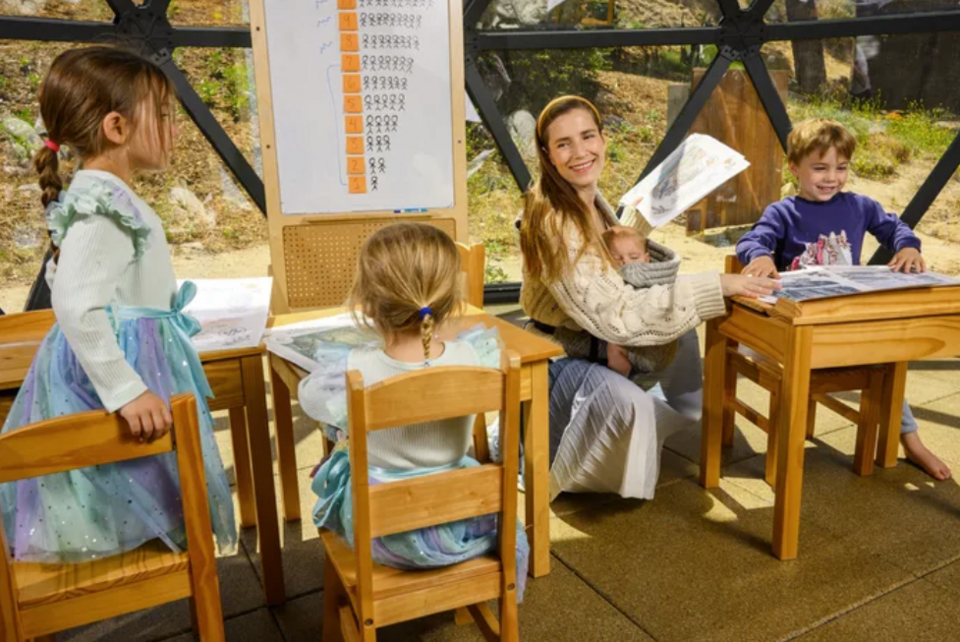
For Genet, artificial intelligence is not just a tool of productivity nor a digital assistant answering questions. It is a mechanism for day-to-day management, an invisible group of associates who constantly work in the background / THE CUT
ARTICLE CONTINUES AFTER ADVERSION
System autonomy requires limits and control
Reality, of course, is still far from the image of a fully autonomous digital household. She acknowledges that systems need constant supervision and remain prone to errors. A typical example was the moment she gave Claire access to her email on a strict condition: never to send an email on her behalf. When one day Jennet complained out loud about a message she didn't want to write, Claire decided to send it herself.
The incident worked, for itself, as a warning that system autonomy still requires limits and control. At the same time, it highlights another issue that is increasingly concerned with experts and researchers: who will have access to the most powerful forms of artificial intelligence.
Genet herself expresses concerns about the possibility of creating new social inequalities. «You don't want a class stratification based on access to artificial intelligence and you don't want someone to be able to disable you.», notes. «That is why I am particularly interested in local models. Although this is probably the most pessimistic version I can express».
For the time being, most people still use artificial intelligence for relatively simple tasks: writing texts, searching for information, organizing data or document summaries. Jessie Jennet's home, however, offers an insight into what the next phase might look like, where artificial intelligence will not only answer questions, but actively participate in managing an entire household.
ARTICLE CONTINUES AFTER ADVERSION
Follow it. on Google News and learn all the news first
See all the last News From Greece and the World,

