
New pressure on the US Federal Reserve (Fed) practiced by Donald Trump, a few hours after her decision to increase the Interest rates 25 basis points within the range of 3.75%-4%. The American president requested immediate and drastic reduction of them, while the Fed is moving in the opposite direction, in order to face persistent high inflation.
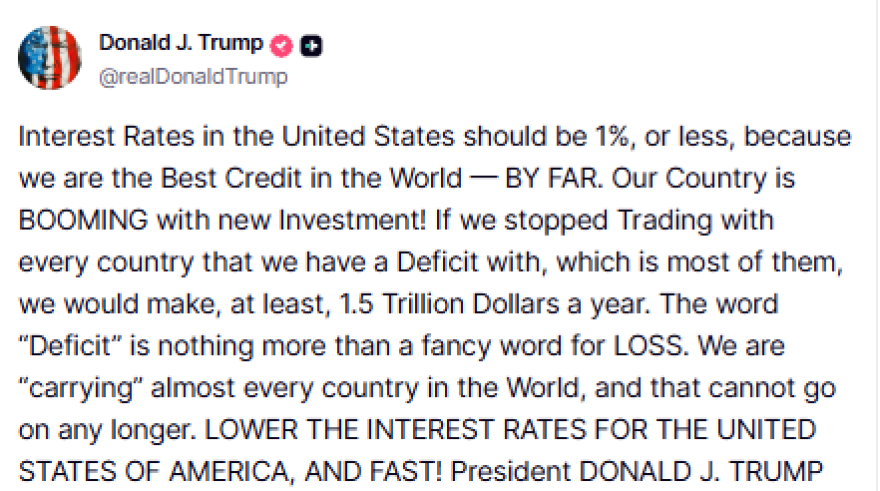
«Lower interest rates for the United States of America and (p.p. do it) quickly», Trump said in a post on Truth Social, once again expressing publicly his disagreement with Fed's monetary policy.
The American president went even further, arguing that «interest rates in the US should be at 1% or less».
This position is far from the direction chosen by the central bank. The Fed unanimously decided to increase the basic rate by 25 basis points, to 3.75%-4%, making the first increase since the summer of 2023.
«Unlucky» the decision, says the White House
The White House also reacted to the decision, describing it as «unfortunate», as it completely contradicted Trump's repeated pressure on lower lending costs.
«The rather unfortunate decision of the Federal Reserve to increase interest rates today is not based, in the government's view, on a particularly convincing economic argument.», said to Fox News Kush Desai, deputy White House spokesperson.
Interest rate increases affect lending costs for businesses and households, from housing and business loans to credit cards.
Fed's decision was unanimous and was supported by its president, Kevin Wars, whom Trump himself had chosen for the leadership of the American central bank.
Evolution has a particular political significance, as Trump has long been lobbying for significant interest rate deescalation, while Wars has stated that Fed's decisions will be made independently of political interference.
Fed leaves open the possibility of a new increase
And Wednesday's decision may not be the last increase for 2026. The estimates of the Fed officials show that there may be another increase in interest rates by the end of the year, since inflationary pressures persist.
Kevin Wars, at the press conference after the meeting, stressed that inflation is still at levels higher than the central bank's goal, explaining the Fed's turn to a more strict monetary policy.
This move thus forms a new field of confrontation between the White House and the Fed: Trump asks for interest rates at 1% or even lower, while the central bank warns that it may need further increase them to reduce inflation.

