
From France and Belgium to Sweden and Ireland, attacks in food business cooling systems reveal a new dimension of digital threats.
SEE STILL
Why are Europe's refrigerators vulnerable to cyber attacks?
05.11.26
Cyberattacks now go from the digital world to the real economy, proving that even systems that were previously considered simple technical installations can be the target of malicious actions, with serious economic and operational consequences. More than 300 exposed systems had been identified in Greece, according to the National Cybersecurity Authority, which restores its business protection recommendations.
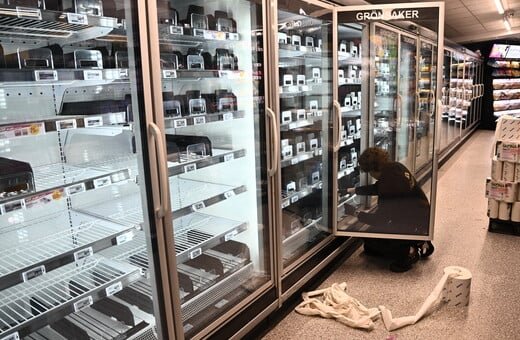
A typical example is France, where in October 2026 hundreds of major supermarket chains were faced with cyberattack on their cooling systems. The perpetrators allegedly gained remote access to the controllers of the cooling plant and modified the temperature and freezing settings, resulting in refrigerators and freezers rising temperature, causing large amounts of food to be corrupted and destroyed. In some cases, temperatures in the cooling chambers reached even 50 degrees Celsius.
The phenomenon was not limited to France. On 2 November, a new wave of attacks struck businesses in several European countries, including Belgium, Sweden, Ireland, Luxembourg and Estonia. Large retail chains confirmed problems in their cooling systems, while in several stores products had to be removed from refrigerators and freezers in order to ensure food safety.
At the same time, on November 5, the US authorities issued a warning of an ongoing threat against industrial cooling systems, pointing out that the exploitation of vulnerability to internet-connected temperature controllers can lead to serious damage, product losses and shutdown of critical installations. These developments show that cybersecurity does not only concern banks, public services or major technological infrastructure. It now concerns any business using related equipment, even when it serves a seemingly simple function, such as maintaining food at appropriate temperatures.
The National Cybersecurity Authority warning for Greece
On the occasion of successive complaints about cooling problems in food stores throughout the country, mainly in butcher shops, but also the inconvenience and reasonable concern of consumers, the National Cyber Safety Authority (CAC) intervenes, giving clarifications about the situation in Greece and repeating its recommendations to businesses. As he points out, according to the maintenance techniques responsible, the problems are attributed to cyberattack, as the damage detected concerns unauthorised changes in the operation of cooling systems. However, the Authority explains that to date there is no officially recorded incident in its services.
The R&D&IK stresses that it had identified security gaps and exposed systems in time. In particular, on 14 October, just two days after the attack on refrigerators of large food chains in France, he had issued a recommendation-warning for vulnerability to commercial cooling controllers of Danfoss, Copeland/Dixell and Carel. In fact, according to the Authority, more than 300 corresponding systems were located on the Internet in Greece. At the heart of this threat are refrigeration controllers, i.e. devices connected to the internet that allow remote control and regulation of cooling machines. Where such devices do not have sufficient protection, they may be made accessible by malicious users who are able to intervene in their operation.
The protection measures recommended by the Authority
The National Cybersecurity Authority reiterates the need for immediate shielding of systems, calling on businesses using old or uninformed cooling controllers to disconnect them from the public internet. In cases where this is not possible, remote access should be allowed only through a secure VPN connection. At the same time, it is recommended to change the default or weak passwords, to activate multifactoral authentication and to install all available security updates.
Particular emphasis is also placed on replacing old equipment, which is no longer supported by manufacturers and does not receive the necessary security updates. In addition, businesses are invited to know which external partners and technicians have access to their systems, to control remote access rights and to have properly trained personnel, capable of recognising unusual or suspicious behaviours.
«The question is not whether or when»
The central message of the National Cybersecurity Authority is that prevention must be an integral part of any digital interface. As he points out, any entity and undertaking using digitally connected systems must be prepared to face a possible cyberattack. The Authority points out that for a cyber incident the question is not «if» It will happen, but «when», stressing that the necessary measures must be taken in advance to prevent or limit the consequences of an attack.
Increasing use of Artificial Intelligence tools by malicious users makes the need to strengthen protection mechanisms even more imperative. Moreover, as noted, the cost of restoring damage caused by cyberattack is multiple in relation to the cost of implementing preventive measures. The conclusion is clear: cybersecurity is not only a question of technological equipment, but also a question of culture, information and readiness. At a time when even a refrigerator can be an entry gate for a cyberattack, prevention is no longer an option, but a prerequisite for the safe operation of any modern business.
With information from APR-APM
SEE STILL
France: Cyberattack on Cooling and Maintenance Units at Blood Bank · Global Voices
04.11.26
SEE STILL

Binance: False job interviews were used in the 6.3 billion dollar cyberattack
03.11.26
SEE STILL

Cyberattacks at supermarkets in Europe: Because the refrigerators are online.
03.11.26

