
Iran has shown that it is now the new leading player in the region and that US security guarantees Not only are they not enough but they may be operate destabilisingly, as the American presence introduces risks and instability to the regimes of the region
Geopolitical developments affect the global economy in real time ... and now the US does not have the power to deal with the consequences of crises that are themselves causingn.
We are already in a new era and War with Iran is probably the last thing America does as super-potential.Don't.
Although the stock market still has no «record» the major risks due to the euphoria of AI, facts are relentless: The Gulf States «fat» U.S. debt-buying wallets that were a critical source of funding for the financial system and US companies now find no reason to pay premiums to the US.
The US debt will no longer be recycled through «petrodollars», While the risk hyperinflation is no longer an extreme scenario, as the old everBuyers of surplus dollars will head to the yuan.
Wars historically form one of the more important factors for ejecting the United States public debt, and every state in war.
War and debt in the United States
To A1860s Civil Americanate was the first real debt explosion: federal debt increased from about $65 million in 1860 to about 2.7 billion after the end of the war – an increase of over 4,000%.
(This huge percentage increase was due to the fact that the debt was starting from an extremely low base, as President Andrew Jackson had completely eliminated it in 1835.
Instead, in later wars the growth rates appear smaller because the initial level of debt was already very high.)
THE World War I caused another huge leap, raising debt from about $2.9 billion in 1914 to about 25 billion in 1920 – an increase of about 760%.
O BWorld War was even more painful ,absolute numberAs a result, the debt will rise from approximately 5 %.$1 billion in 1940 to about 260 billion after the war – an increase of about 410%.
According to Vietnam War, US government debt grew from about $317 billion in 1965 to about 533 billion in 1975 – a jump of about 68%.
On the basis of the best available estimates, Afghanistan war added costabout 59% of the federal debt that existed when it started, while the war in Iraq in 2003 added a cost of about 47%.
We are now in Third month of the war with Iran.
The United States federal debt was found About $38.7 trillion when the war broke out and has already exceeded $39.2 trillion.
Where will he be when the war is over?
No one can know.
However, it is almost certain that it will be significantly higher.
Indeed,the equation is broken: War = Inflation
But there's one Interim stage in the process: debt.
War expenditure is financed mainly by borrowing, which is then largely bought by the central bank with money created «Out of nowhere».
A more accurate equation would therefore be: War = Debt = Inflation
So the war with Iran is accelerating U.S. government’s upward debt spiral and further strengthens the continuous devaluation of the dollar, which had already reached a critical point before the cumulative consequences of the war were taken into account.
But that's not all.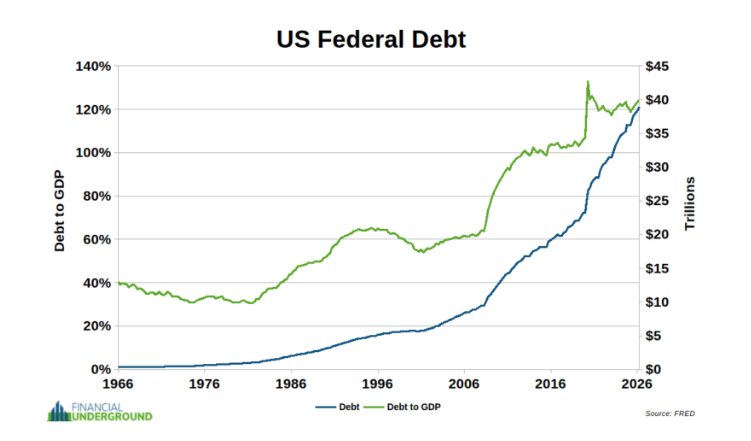
The alarm from the Persian Gulf
Another possible victim of the war is the petrolary system,which acts essentially as a protection mechanism for large oil producing countries in the Middle East in line with the United States, such as:
• Saudi Arabia,
• Kuwait,
• the United Arab Emirates,
• Bahrain,
• And Qatar. 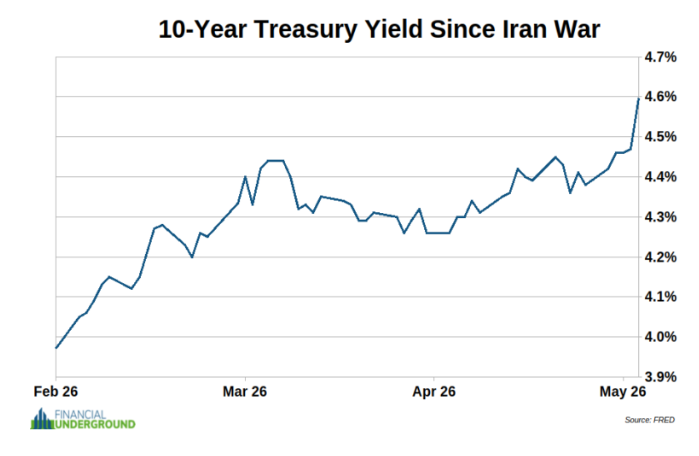
The petrodollar system has been a key support for the international validity of the dollar since 1971; When Nixon finally interrupted the last bond of the American coin to gold.
The logic of the system is simple: the American army «protects» These countries and those, in return, agree:
• lonprice oil in dollars,
• and reinvest their income in the US government bond market and in the US financial system.
This is how the dollar is based and the interest rates are kept lower than they would have been under other circumstances.
The oil-producing countries of the GulfThey become significant investors in the US State Bond Market (US Treasures), although their participation is smaller than the largest countries that maintain American debt such as Japan or China.
According to the latest data from the US Ministry of Economic Affairs and International Economic Resources, Saudi Arabia kept about $19.6 billion in American bonds in March 2026, while the United Arab Emirates about $14.1 billion.
The Kuwait He also recorded a significant increase in his placements, reaching about $66 billion in late 2025, level-record for the country.
Overall, its main monarchies Gulf —Saudi Arabia, United Arab Emirates, Kuwait and Qatar— estimated to directly hold about $350–500 billion in US government bonds; and(i) their total investments in the United States through overeign health funds (state investment funds), shares, private equity and real estate reach several trillion dollars.
The petrolary system
The importance of these funds is directly linked to the system of «petodolar».
From In the 1970s, Gulf countries invoice their oil mainly in dollars and reinvest much of their surpluses in American assets, particularly in government bonds.
This process contributes to the maintaining high demand for the dollar and allowing the United States to finance their public debt at lower lending costs.
However, in recent years trends have been observed inIn the case of small and medium-sized enterprises.
Recent reports say that Saudi Arabia and the United Arab Emirates reduced their placements in American bonds by nearly $17 billion within a month (March), amid geopolitical tensions and pressure on oil markets.
At the same time, discussions are increasingthe use of alternative currencies, notably Chinese guan, in certain energy transactions.
Despite these developments, the dollar still holds a dominant position in the global financial system.
Total foreign holdings in American bonds remain at historically high levels, with the U.S. Treasury calculating that theregular foreign placements in American titles exceeded $35 trillion in 2025.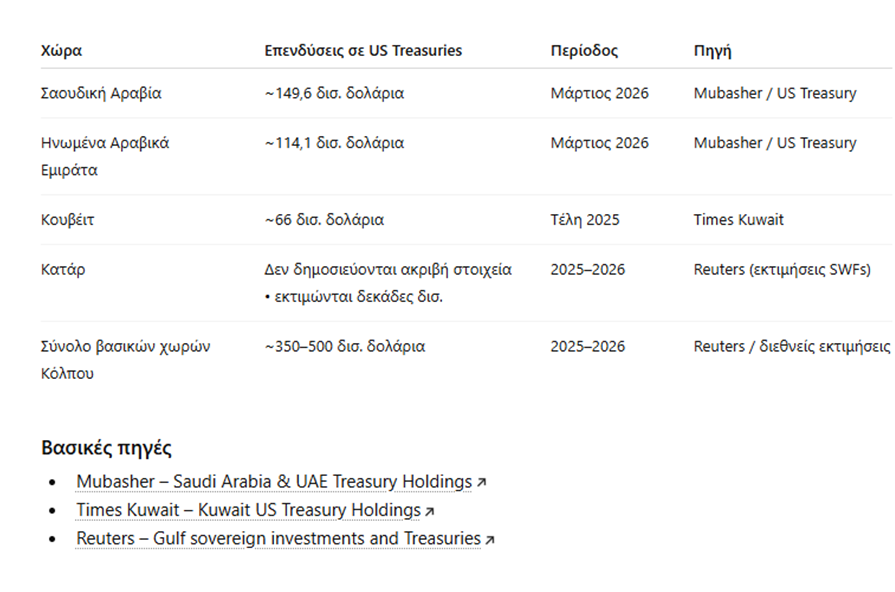
Source: BN explanation
However, this system now seems to be rapidly weakening.
The war with Iran reveals the boundaries of American military power and the United States' inability to provide the protection they believed guaranteed by the Gulf Arab states.
Iran has shown it is now the new decisive player in the region and that American security guarantees are not only insufficient but may operate destabilisingly, as the American presence introduces risks and instability to the regimes in the region.
With STens of Hormuz closed and important energy infrastructure destroyedThis is why the Committee on Agriculture, Fisheries and Rural Development has tabled a number of amendments.
This means that much less petrodollars are now returning to the American government bond market.
This is another negative factor in the US Treasury market.
There's not just mreduced demand for American bonds due to the shrinking recycling of petroln; there is also the risk esales unemployed – a sell off.
Currency swap lines
United Arab Emirates reportedly examined the possibility of selling part of the American bonds held — which make up much of $285 billion in foreign reserves — to compensate for the loss of oil revenue.
But instead of going into sales and causing market turmoil, negotiated – according to the reports – a currency swap line.
The Minister for Finance Scott Bessent described these lines as a means: «aupreventing an improper sale of American assets».
Clearly, there is strong concern about pressure on the American bond market.
At the same time, Iran openly stated that one of the conditions for the safe passage of oil tankers from the Straits of Hormuz is the fee payment to Chinese wan, about one dollar per barrel of oil.
According to reports, more than 20 countries have already accepted these new conditions.
Iran appears to collect these revenues in Chinese bank accounts and then use the yuan:
• for the purchase of natural gold,
• or Chinese goods and raw materials, some of which directly reinforce his war effort.
Japan is reportedly one of these countries.
Tokyo is heavily dependent on imported energy, as about 90% of its oil passes through the Straits of Hormuz.
This explains the reports that II don't know. — the currency of a strategic competitor — to keep its energy supplies uninterrupted.
It is possible that we will gradually see the petrodular system grant its place or co-exist with one System «petroyuan» –the old world is dead and the new man is not born...
www.bankingnews.gr

