
NASA gradually proceeds to its plan for permanent presence on the Moon. After Artemis II's successful launch on April 1, 2026, the American space service plans to allocate $20 billion for a lunar base. However, prolonged living there poses serious health problems: chronic exposure to cosmic radiation, reduced gravity, toxic dust and psychological pressure. Scientists propose solutions such as personalized exercise, armored accommodations with lunar soil, continuous normal monitoring and artificial gravity. The goal is sustainable operation on the Moon as preparation for future manned missions to Mars.
Analyticalally:
For the first time since Apollo missions, people are preparing not only to visit Moon as now NASA's Artemis II did, but live and work there for weeks, months and, eventually, years.
The project is gradually evolving. In 2022, the Artemis I mission successfully tested the Space Launch System (SLS) rocket and Orion capsule on an unmanned flight around the Moon. On 1 April 2026, NASA launched the Artemis II, a 10-day mission with four astronauts, which traveled behind the Moon and returned. As the first manned flight of Orion and SLS, this mission was particularly critical, as it had to prove that life support systems, navigation, thermal protection and overall operations in deep space can operate safely in the presence of people on board.
NASA's long-term ambition, however, far exceeds an individual landing. The American Space Service plans to allocate about $20 billion for a base on the lunar surface, capable of supporting repeated and increasingly longer stays. The goal is not only to explore the Moon, but also to acquire know-how for sustainable operation beyond Earth, with the ultimate horizon of future manned missions to Mars.
Health challenges
However, prolonged living on the Moon will test almost every human body system, reports The Conversation. The lunar environment exposes astronauts to a particular set of physical, chemical, biological and psychological pressures: reduced gravity, about one-sixth of earth, chronic exposure to cosmic radiation, extreme temperature changes, toxic lunar dust, isolation, disrupted sleep-awakening cycles and prolonged isolation.
Unlike astronauts in a low orbit, such as those at the International Space Station, crews on the Moon will move largely outside the Earth's magnetic field protection.
This increases exposure to space radiation, which can cause DNA damage, affect the immune system and have consequences for the brain and cardiovascular system. At the same time, reduced gravity radically changes the way blood, oxygen and fluids circulate in the body, with possible effects on neurological and vascular function.
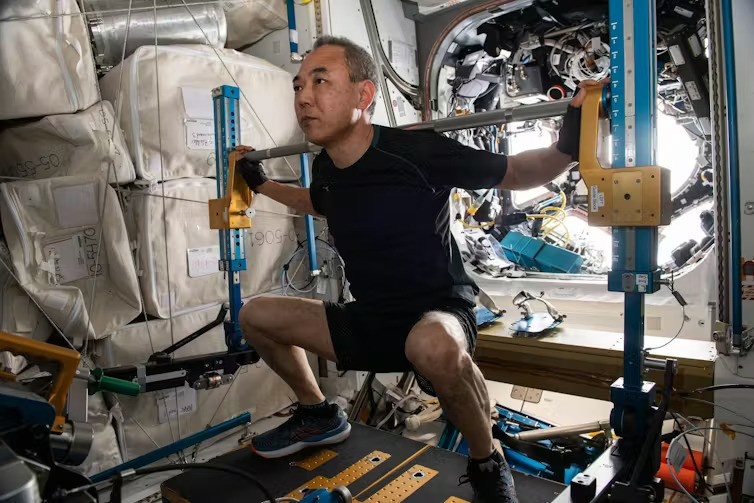
Regular exercise will be necessary to remain healthy on the Moon. Here, Japanese astronaut Satosi Furukawa is practicing at the International Space Station
NASA
Scientists estimate that these risks cannot be considered individually, per organ, but as part of an interconnected set, where brain, heart, vessels, muscles, bones, immune and metabolism affect each other. One of the biggest problems is that many of these physiological changes develop insidiously: astronauts may feel good, while complications develop quietly and become visible only months or years later. NASA therefore places particular emphasis on long-term physiology monitoring and risk mitigation strategy.
Reduction of risks
The encouraging thing is that man has great adaptability, as long as he is guided in a safe and sustainable way. Exercise remains a key means of protection. At the International Space Station astronauts work out about two hours a day to maintain muscle mass, bone density, and cardiovascular function. On the Moon, however, exercise systems should be redesigned for partial gravity conditions.

Growing vegetables in greenhouses on the Moon will be crucial for the proper diet of astronauts
NASA
Nutrition is also considered critical as it affects bone health, muscle retention, immune resistance and even the body's response to radiation. Therefore, individualised dietary strategies, adapted to the physiology of each astronaut, are expected to become increasingly important. At the same time, artificial gravity is also considered, through small-range centrifuges, which could soon offer periods of increased gravitational charge and help stabilise the cardiovascular and neurovascular system.
Radiation protection will require multiple levels of defence: armored accommodation, possibly using lunar soil, early warning systems for solar storms and operational practices to limit exposure to high risk periods. There should be continuous normal monitoring, with wearable sensors and advanced data analysis, so that early warning signs can be detected before they develop into problems that could jeopardise the mission.
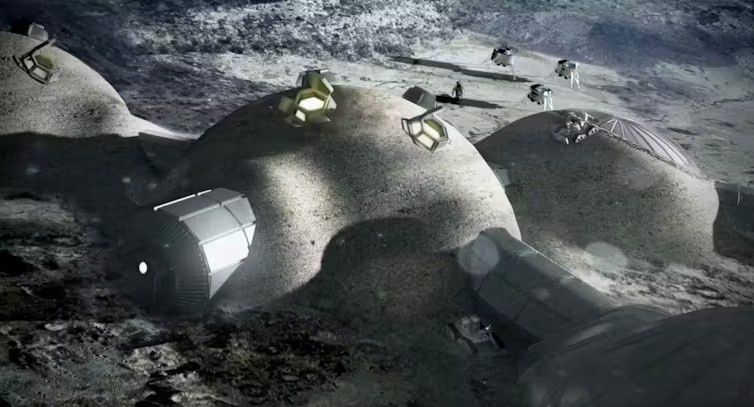
The shielding of the lodges on the Moon, possibly using lunar soil (regolite) could offer radiation protection
Foster + Partners
The stay for long periods on the Moon is expected to be both exciting and relentless. It will not only be a new destination for exploration, but also a cruel test for human biology. If humanity succeeds in keeping people healthy, durable and productive on the lunar surface, then it will have taken a decisive step toward a truly space age, in which exploration will no longer be based on short heroics, but on sustainability and adaptability.

