
Almost all major European cities experience rent increases and as a result some form housing crisis.
The increase in rents more affects low-income workers and those who do not have stable employment, as they must spend a significant percentage of their housing income if they have the economic potential.
Generally, higher wages can mitigate the blow to the housing crisis, but the real solution can be state intervention, which remains rare.
The common belief among economic experts is that you should not spend more than 30% of your income on rent. This traditional empirical rule is becoming increasingly outdated, at least for those who want or need to live in the great cities of Europe.
People with low, even medium income, are increasingly excluded from the major cities of Europe.
The persons with the lowest income, Like part-time workers, freelancers and regular distance workers, they barely have enough income to afford rent.
Middle income citizens, those in the middle of income distribution in any city, are expected to pay more than 30% of their income if they want to rent their own apartment in most places.
The Euronews Business examines more closely gross minimum wages and average rent costs in all EU countries and their capitals. In many capitals, even the gross minimum wage is not enough to cover the rent.
The Greece, Unfortunately, it lies among the countries of Europe, where minimum wage workers suffer the most. To afford to maintain a home they will have to pay a salary and a half.
Housing and general interest accounts are the largest category of expenditure for European households. According to Eurostat's most recent data, 23.6% of household spending in the EU goes to housing, water, electricity, gas and other fuels in the EU. Rents represent a particularly large share in large cities.
Rents exceed gross minimum wage
The most important thing is that rent is a significant burden for workers with the minimum wage, as it exceeds their monthly earnings in many European capitals.
In what capitals, then, rent goes beyond gross minimum wage levels? And what part of the minimum wage goes to rent in European capitals?
According to an analysis by the European Trade Union Confederation (ETUC) based on EU data, the average cost of renting a two bedroom apartment in the capitals of most EU countries exceeds the gross minimum wage.
Only in five EU countries with a minimum wage is the monthly rent below the minimum wage. However, as data from both Eurostat and ETUC are based on gross minimum wages, the actual burden for workers is probably even higher when net wages are taken into account.
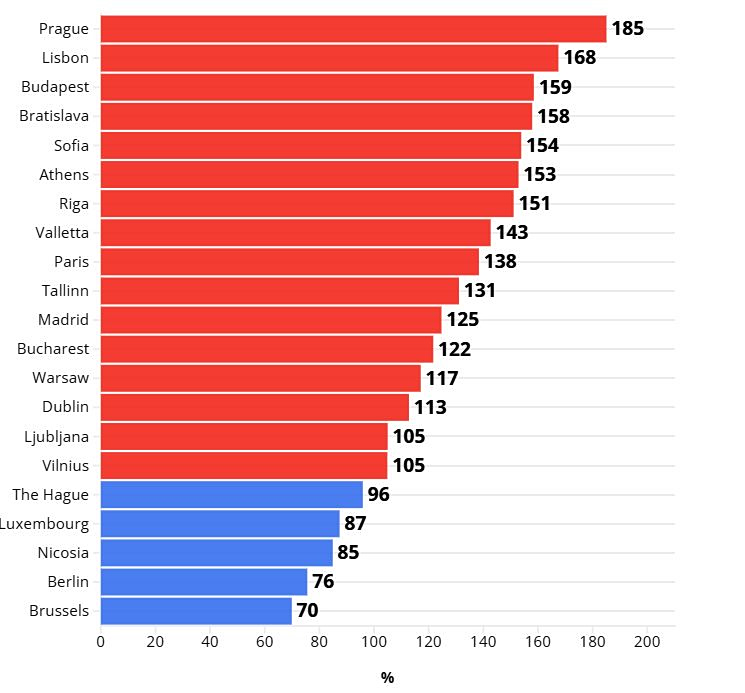
Minimum wage workers in the Czech capital suffer the most. In Prague, the average rent is 1,710 euros, while the minimum wage in the country is 924 euros. This means that an amount equal to 185% of the minimum wage is required to purchase a two bedroom apartment.
In Athens, those who pay the minimum wage will have to spend their entire salary on rent and will need more than half the salary to cover it.
Lisbon ranks second with 168%. In Portugal, the monthly gross minimum wage equivalent (paid over 14 months per year) is EUR 1,073, while the average rent in the capital is EUR 1.710.
The share of gross minimum wage required for rent also exceeds 150% in Budapest (159%), Bratislava (158%), Sofia (154%), Athens (153%) and Riga (151%).
This percentage also exceeds 100%, meaning that even the gross minimum wage is not sufficient to cover the rent, in Valletta (143%), Paris (138%), Tallinn (131%), Madrid (125%), Bucharest (122%), Warsaw (117%), Dublin (113%), Ljubljana (105%) and Vilnius (105%).
For example, in Paris, the average rent for a two bedroom apartment is 2,523 euros, while the minimum wage in France is 1,823 euros. In Madrid, it is EUR 1,721 versus EUR 1,381.
Brussels and Berlin the best capitals for minimum wage workers
On the contrary, Brussels is emerging as the EU's best capital for workers with a minimum wage in terms of financial rental. Gross minimum wages cover 70% of the rental cost there. In Brussels, the average rent for a two-bedroom apartment is 1,476 euros, while the minimum wage is 2,112 euros.
Berlin is the second best with 76%. The share of gross minimum wage required for rent is 85% in Nicosia, 87% in Luxembourg and 96% in The Hague.
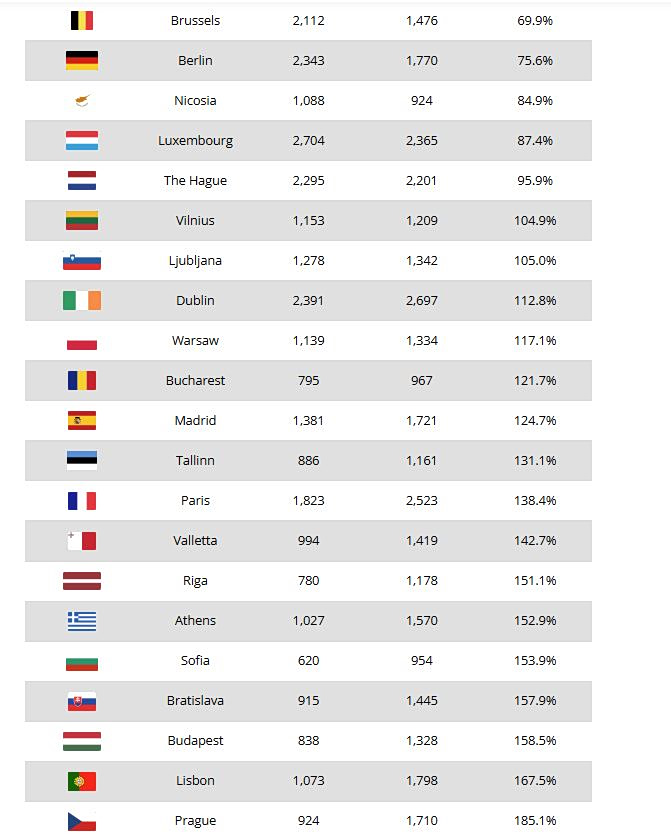
In Brussels, the average rent for a two-bedroom apartment is 1,476 euros, while the minimum wage is 2,112 euros. In Athens, the average rent for a two bedroom apartment is 1,027 euros, while the minimum gross salary is 1,570 euros
«High housing costs and low wages lead people to poverty and economy in recession», said ETUC secretary general, Esther Leeds.
«Disconnection between rent and pay is completely unsustainable. When we add to this increasing cost of energy and food, workers are forced to borrow for the necessary and virtually without disposable income – making savings to replace basic household appliances or a visit to the dentist impossible», add.
Rent is more affordable at country level than in capitals
Compared with capitals, the averages of countries give a better picture. In many countries, gross minimum wage is sufficient to cover rent. However, rent continues to hold a significantly greater share than 23.6% of EU households' average spending on housing and utilities .
Among a subset of 16 EU countries analysed in this comparison of ETUC, the share of gross minimum wage required to cover rent ranges from 33% in Poland to 61% in Malta.
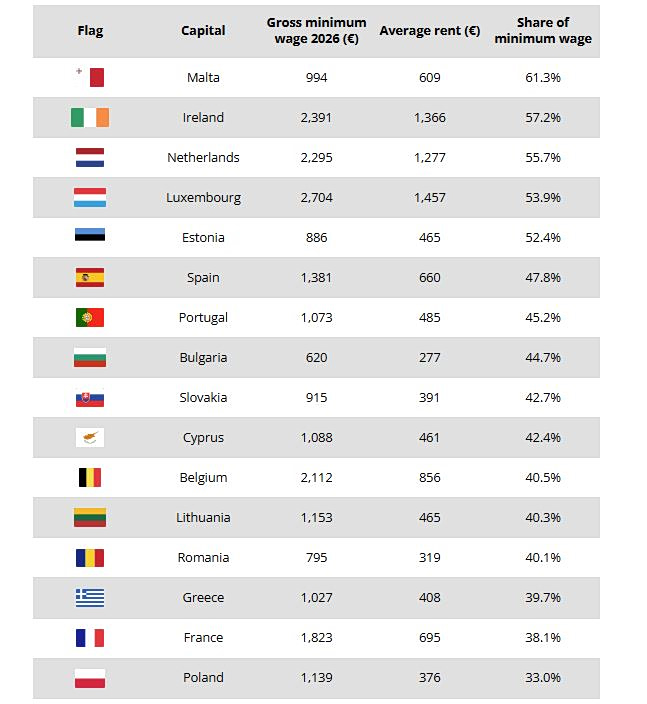
In Greece, the minimum wage is 1,381 euros, while the average rent is 660 euros. So at country level, the tenant should spend half his rent.
In Poland, the gross minimum wage is 1,139 euros, while the average rent is 376 euros. France is also doing better at EUR 1,823 compared to EUR 695. Greece can also be a good choice for employees with a minimum salary outside Athens, at 1,027 euros versus 408 euros.
In Spain, the minimum wage is 1,381 euros, while the average rent is 660 euros.
Recommendations of ETUC
The European Trade Union Confederation (ETUC) calls for various policies, including...
- All EU Member States should fully implement the Minimum wage Directive, including strong action plans to substantially promote collective bargaining, which will ensure that more workers receive fair wages.
- Governments must take into account housing costs when determining the adequacy of minimum wages.
- Increased public investment in social housing, including through EU investment instruments and revision of State aid rules.
Minimum wages in 2026 vary significantly across Europe, both in nominal terms and in purchasing power. About 13 million workers in 21 EU countries earn the minimum wage or less, according to Eurostat. The rate is significantly higher in several countries.

