
Total wealth 2025 amounted to 600 trillion dollars, with 95% owned by households.
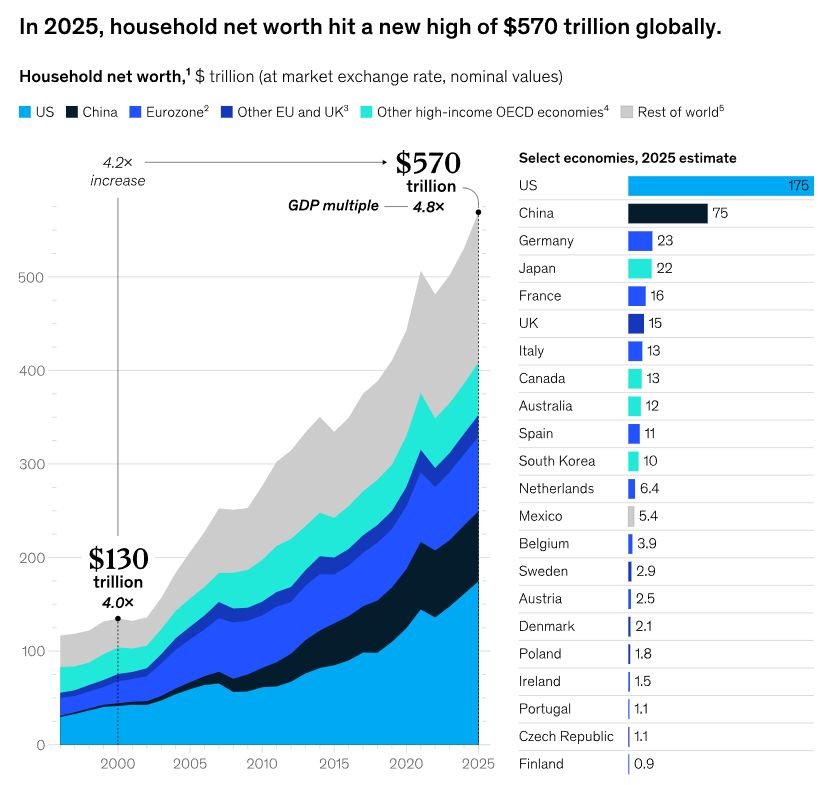
As can be seen from McKinsey's relevant study, about half of households' wealth consists of real assets, mostly real estate. The other half is financial assets such as government bonds, shares, pension schemes.
ARTICLE CONTINUES AFTER ADVERSION
In particular, the global wealth of households rose to the 570 trillion dollar record, thus being increased by $40 trillion from 2024. This was more than four times its value in 2000, at nominal values and market exchange rates. What is the «thorn»This wealth grew faster than GDP, asking questions about its health and stability.
How is this wealth distributed? The United States still holds the largest share, at 30%. The Eurozone and China held the next largest shares, 14% and 13% respectively. At country level, Poland, Ireland, Spain and Sweden presented the highest rates of increase in household wealth (in dollars), reaching a two-digit percentage each.
The Eurozone countries, including Austria, France, Germany, Italy and Portugal, saw their wealth grow slightly in dollars, but decrease in fixed terms of exchange, as the dollar retreated against the euro from 2024 to 2025. As the study notes, many Eurozone countries showed a decrease in per capita wealth in terms of purchasing power parity and this was largely due to the fall in real estate prices.
ARTICLE CONTINUES AFTER ADVERSION
The distribution of wealth
The problem is that this wealth is not distributed accordingly, it is not diffused into society. In general, the rich become richer, while the poor remain poor, with «scissors» of inequalities to open. This is also reflected in the latest UBS report, according to which «While the average wealth increased significantly, median wealth actually declined in most markets, which highlights the growing gap between the richest and the wider population».
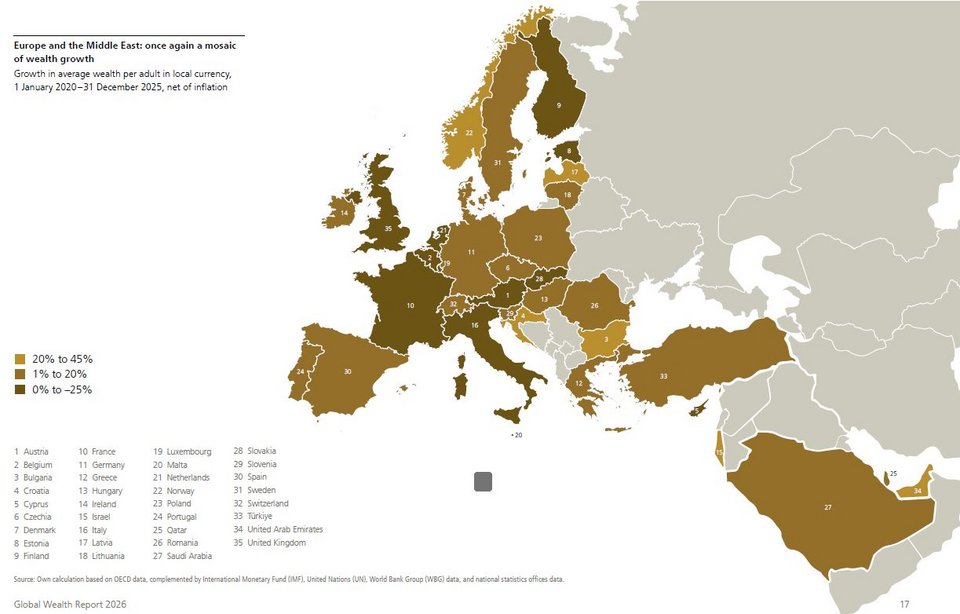
From this picture Greece is not excluded. Average property per adult increased by about 9% over the last five years, but median wealth declined by about 18%. It is indicative that in one year millionaires increased by 3.5%, i.e. by 2,762 people, reaching 82,000.
How will wealth be taxed?
And that's how the debate came up all over Europe about whether, how much and how the rich should be taxed, at a time when the crisis in the Middle East is coming to throw salt into the wounds that the pandemic and war in Ukraine opened, «rocking» income, especially of the weakest households.
ARTICLE CONTINUES AFTER ADVERSION
For example, 64% of Germans would support a property tax, 61% increase in inheritance taxes and 81% agree that wealth is being unfairly distributed at the moment.
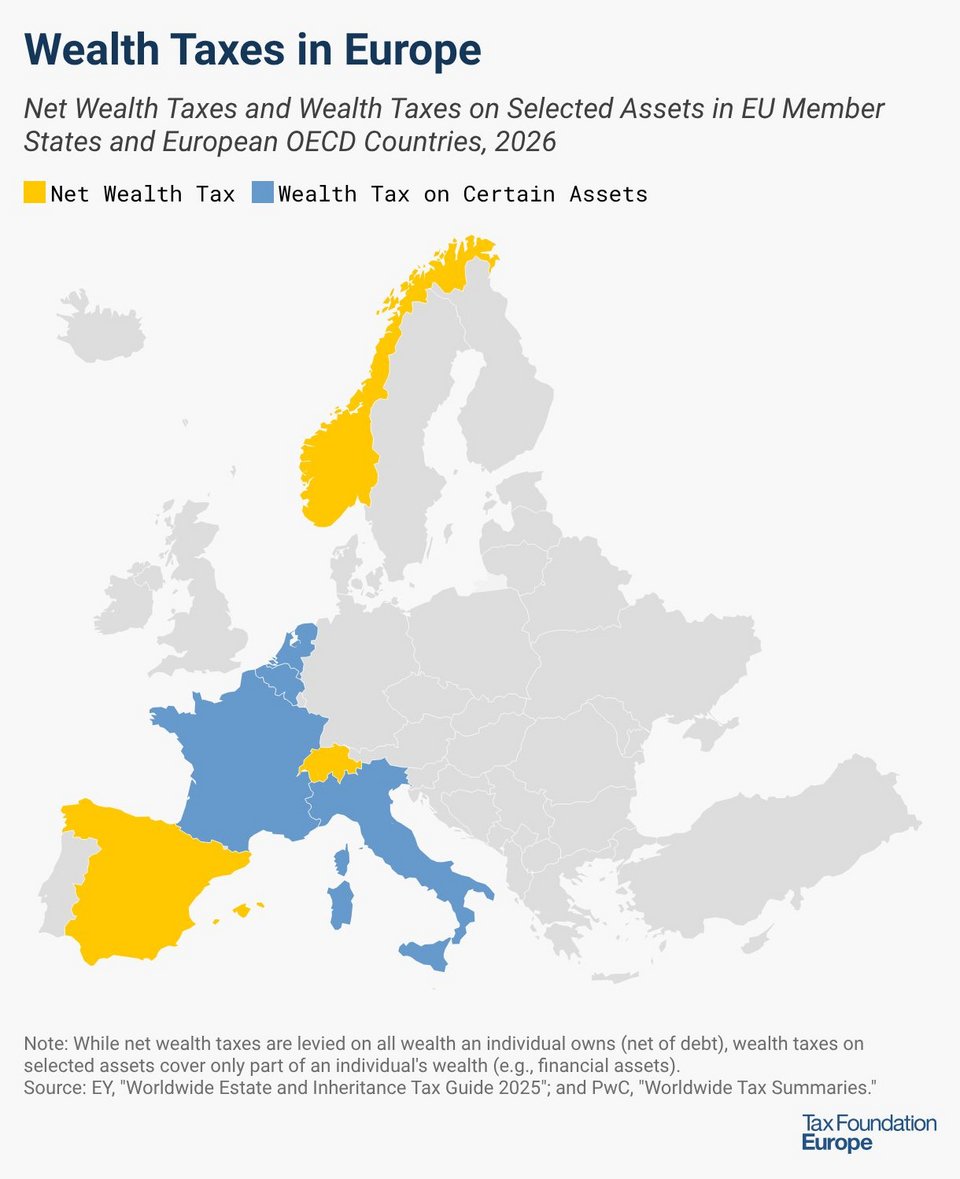
The debate, at present, remains on a... literary level. However, there are countries in Europe, which already impose a tax on wealth, thus giving a «busula» for corresponding interventions. As the Tax Foundation notes in a comparative study, the concept of net wealth tax is similar to that of property tax. However, instead of taxing property only, it covers the total wealth held by a natural person. Today, only three of the European countries are imposing a net wealth tax: Norway, Spain and Switzerland. At the same time, however, France, Italy, Belgium and the Netherlands impose wealth taxes on selected assets, but not on the net wealth of a natural person.
The Spanish model
Spain's net wealth tax is a progressive tax ranging from 0.16% (in Navarre) to 3.5% of the net wealth exceeding EUR 700,000, with rates significantly varying between the autonomous regions of Spain. Andalusia, Cantabria, La Rioja, Madrid and Murcia grant 100% discharge to natural persons with net wealth of less than 3 million euros.
ARTICLE CONTINUES AFTER ADVERSION
Estramadura provides 100% discharge. Residents of Spain are subject to tax on a global basis, while non-residents pay the tax only for assets located in Spain.
In addition, the Spanish central government introduced in 2022 a «Solidarity property tax» ranging from 1.7% to 3.5% for natural persons with a net property of more than EUR 3 million. Under this tax regime, the central government shall collect any additional revenue from the solidarity tax after deduction of revenue from the regional property tax. In December 2023, the Spanish central government extended the application of the solidarity tax indefinitely.
Follow it. on Google News and learn all the news first
See all the last News From Greece and the World,

