
Young Europeans tend to They live with their parents. for a longer time in the countries of the southern and eastern EU, with Greeks being second on the list.
According to Eurostat's most recent figures, in fact, young people in Italy, Spain and Greece do not leave the family home until 30 or later.
The difference between the north and south of Europe reaches almost the decade, with countries such as Finland, where the average is only 21, Denmark, 22, Estonia and Sweden, 23 years. The EU average, however, is 26.
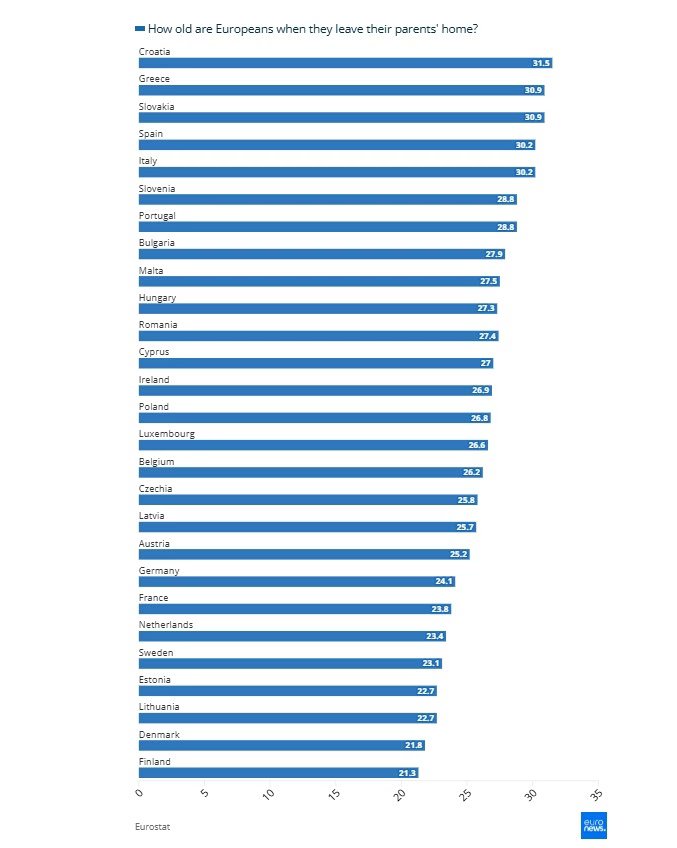
Interestingly, this figure has remained virtually stable over the last twenty years, without much fluctuations.
What role does youth employment play?
Is the fact that young people live longer with their parents linked to low employment rates?
As often happens, statistics cannot be explained without taking account of the economic aspect.
In countries where young people leave home later, such as Greece, Croatia, Spain and Italy, the employment rate of young people is also lower than the EU average.
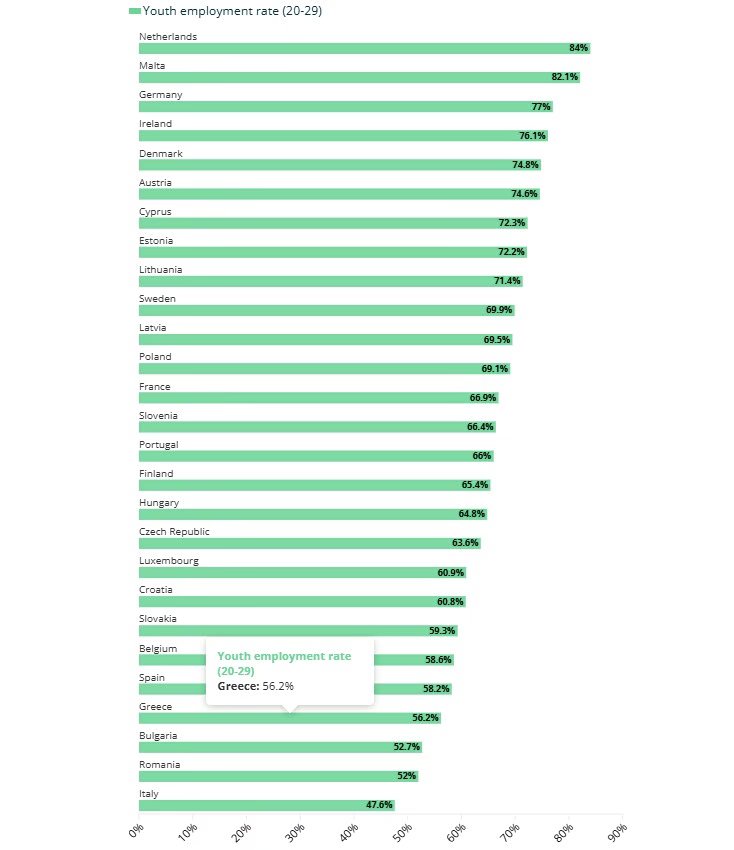
The lowest employment rate of young people throughout the European Union is seen in Italy with 47.6%, followed by Romania with 52% and Bulgaria with 52.7%. Spain and Greece are also close to the bottom, while the EU average is 65.5%.
Southern Europe: «Avoid renting at all costs?»
The situation is more complicated in terms of ownership. Yes, South Europeans need more time to «fly» from paternal «nest», but when they do, the goal is the quick transition to direct ownership rather than rental (and possible exposure to unpleasant situations).
Indeed, if we cross Eurostat's data with RE/MAX's annual report on trends in Europe's housing market, it becomes clear that the age at which young people leave the family environment in countries such as Italy, Spain and Greece often coincides, or approaches a lot, with the age at which they acquire their first residence: 31 in Spain, 33 in Italy, 35 in Greece.
In other words, people there tend to stay as short as possible in rented housing, which is reflected in the impressive gap between the majority who are owners of the residence in which they live, and the minority they rent, compared to the opposite situation in countries such as Austria, Germany and Switzerland.
How much do parents help their children buy a house?
However, it would be short -sighted not to consider the parent factor.
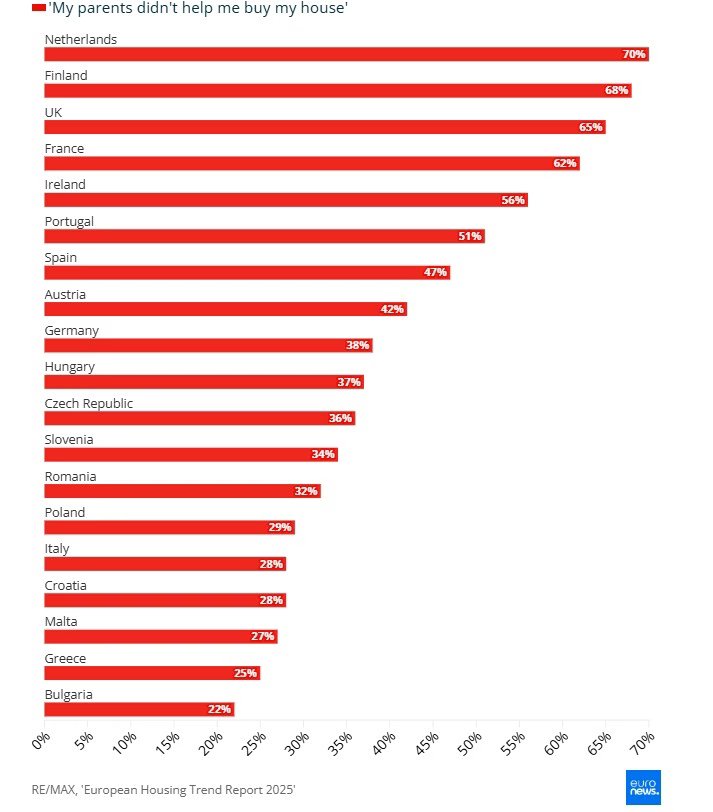
Most people in Spain, Croatia, Greece and Italy are indeed homeowners, but the majority received help from their family in one way or another: 75% in Greece, 72% in Italy and Croatia, while Bulgaria has the highest percentage with 78%.
What generation received the greatest help in the EU?
The most common form of help is cash, but also the inheritance or property previously purchased and to which children later move.
This is a huge gap compared to countries such as the United Kingdom, France or the Netherlands, where about two thirds of parents or more do not in any way support the purchase of housing by their children, according to the European Housing Trends Report.
Then, there is the generation factor, which shows that parental aid has increased over the decades, with the Z generation – people about 18 to 27 years old – now becoming the generation that has received the greatest help in history (74%), followed by the Y generation (Milenians – 68%) and the X generation (59%).
The only two generations whose majority did not receive support were «Boomers» (born between 1946 and 1964 – 49%) and «Silent Generation» (born between 1928 and 1945 – 37%).

