
Europe is faced with a difficult dilemma: to limit Russian imports even more, taking on the risk of more expensive fertilisers and food, or to accept that in some critical areas economic decoupling from Russia has a much higher cost than originally estimated.
Despite multiannual sanctions and political pressure to limit economic relations with Moscow; European countries continue to buy Russian fertilizers, andIn the absence of a complete substitution, they are proving extremely difficult.
This in conjunction with the crisis in the agricultural sector of Europe creates the conditions for a an explosive crisis.
Demand for Russian products remains high, while analysts warn that a sharp break in supplies from Russia could cause a large increase in international prices of fertilizers and severe turbulence in the global food market.
The industry of mineral fertilisers is one of the areas in which the Russia still has a particularly strong position on the international market.
And that's not just because of the huge volume of production.
Russia has direct access to basic raw materials, significant gas reserves and comparatively lower energy costs, which allow its producers to maintain competitive prices.
Even Russia's opponents recognize the problem
Russian Export Center's head, Veronika Nikishina, has argued that Russian fertilizers play a crucial role in global food securityth.
On the Russian side, This is one of the main reasons why the strictest possible restrictions on this particular trade have not been imposed.
The European Union chose to impose duties instead of a full ban on imports.
However, even after the imposition of additional charges, markets continue. Only in June, according to the reports, imports of Russian fertilisers into the EU countries amounted to hundreds of thousands of tonnes, totaling tens of millions of euros.
The importance of Russian fertilizers is not limited to Europe.
The United States had since 2022 included fertilisers in a category of basic goods, which highlighted the practical limits of Russia's full economic isolation policy.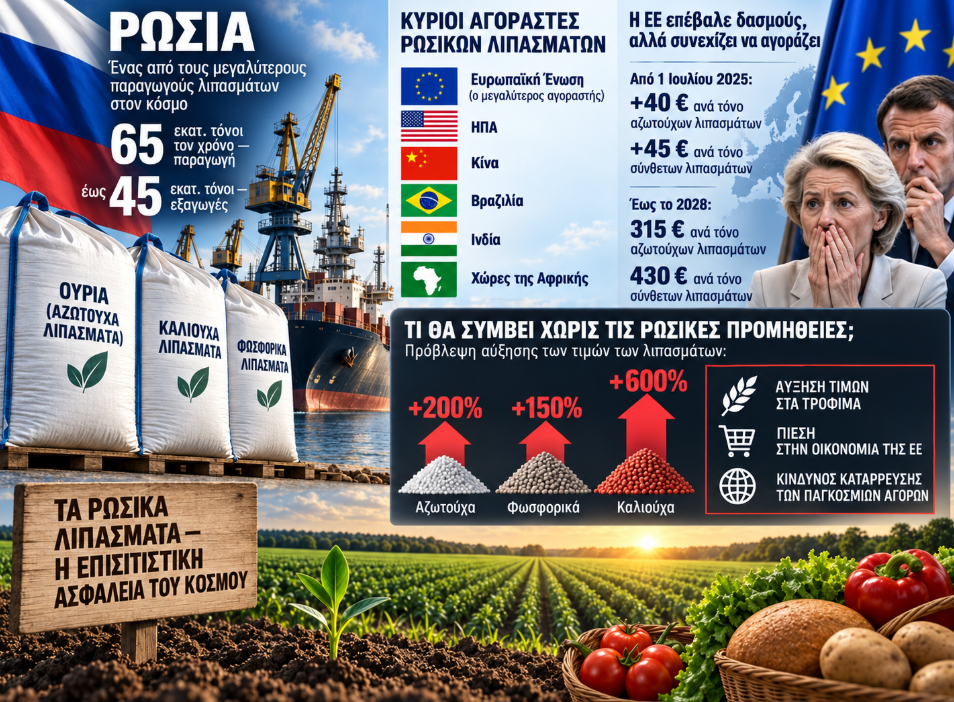
Why Russian fertilizers remain so competitive
Russia is among the largest mineral fertilizer producers worldwide.
The Its annual production is estimated at around 65 million tonnes, a significant part of which is directed towards exports.
One of the most important advantages is natural gas.
Gas is a critical component for the production of nitrogen fertilizers and, according to analysts, it can even represent 70% to 80% of the total production costs.
His teacher Synergy University Sergey Zainullin argues that certain categories of Russian fertilizers can be two to three times cheaper than similar products from other suppliers.
For a European farmer, this difference can prove decisive.
Geography works for Russia
Another important advantage is Russia's geographical proximity to the European market.
Smaller distances contain transport costs, resulting in imports being able to remain economically advantageous even after the imposition of additional duties.
At the same time, Russia exports a very wide range of fertilisers: nitrogen, calcare, phosphate and composite products.
Enough of this.(i) high concentration and meet the requirements required by European markets.
RepresentativesEuropean industry has previously recognised the EU's significant dependence on Russian urea supplies.
Despite repeated announcements to diversify suppliers, the problem has not disappeared.
What happens if Russian supplies are lost?
This is where the greatest risk lies.
Economicists warn that a the full replacement of Russian quantities on the international market would be extremely difficult, as there is no sufficient spare capacity while global demand remains strong.
Sergey Zainullin estimates that a full disappearance of Russian supplies could lead to unprecedented price increases.
According to his assessment, nitrogen fertilizer prices could increase around 200%, phosphates by 150%, while in calcareous fertilisers the rise could, in its extreme scenario, even reach 600%.
These forecasts are estimates and not sure developments, but show the magnitude of the fear that exists around a possible abrupt interruption of the Russian offer.
From fertilizers to food prices
Such an increase in costs would not be limited to fertilisers.
It would almost inevitably pass on to agricultural production and then to food prices.
European farmers would face higher farming costs, while the effects could be transferred to consumers through more expensive cereals, feed, meat and other basic products.
And the problem would not only be European.
In one globalised food market, a significant rise in fertilizer prices could particularly affect countries with lower incomes and greater dependence on imported food.
The limits of sanctions
The fertilizer market thus highlights one of the basicsMr President, I would like to thank the President-in-Office of the Council for his work.
In areas where the Russia owns a large share of world production and has significant comparative advantages, its full removal from the market can cause costs not only in Moscow but also to importers themselves.
That is why, despite the political conflict, Russian fertilizer still reaches Europe.
This case shows that Russia continues to have significant influence on critical sectors of the global economy, particularly where energy, agriculture and food security are directly linked.
And as long as a competitive supplier does not appearor which can simultaneously replace Russian quantities, prices and geographical proximity, Europe is faced with a difficult dilemma: lonto limit Russian imports even further, taking on the risk of more expensive fertilisers and food, or to accept that in some critical areas economic decoupling from Russia has a much higher cost than originally calculated.

