
Even if Straits of Hormuz re-opening, energy market officials and analysts estimate that the industry will no longer be able to rely on them as in the past. For the Straits, there is no return to normality. Countries across the region are considering the construction, expansion or restoration of infrastructure that will bypass the passage.
At the same time, states importing fuel from the region hurry to secure oil and gas from other sources, implement saving measures and turn to alternatives such as coal. These strategies are expected to vary over time. Today's carbon shift can, for example, give its place to greater investment in solar and nuclear energy.
Whatever happens next, Iran will not forget how easy it is to «choking» navigation in the Straits, which means that energy companies and consumers should prepare for a very different future.
Alternatives
«Once rockets began to drop and hit drones, it was absolutely clear that there was no return.», said Badr Jafar, businessman and special envoy for operations in the UAE.
To limit the energy crisis, Saudi Arabia and the United Arab Emirates have redirected a significant part of their oil production to ports outside the Straits, via pipelines built years ago in the face of a possible crisis. Iraq also recently began to channel small quantities of oil to Turkey, through a pipeline that has been repeatedly put out of service due to political tensions and armed conflicts.
More than 7 million barrels of oil are traded daily outside the Persian Gulf through these routes, while before the war the corresponding figure was less than four million.

However, it is only a small part of about 20 million barrels carried daily from the Straits before the war. In addition, pipelines do not offer a solution for countries such as Kuwait and Qatar, while they cannot be used to transport products such as aluminium, fertilisers and others goods.
For all these reasons, and beyond geopolitical goals, opening the Straits remains vital. Their critical position on the global energy market explains why international oil prices declined by 9% on Friday, at the lowest levels since the second week of the war, after the Iranian Foreign Minister said that The Straits will be «fully open».
But Tehran made a turn the next day, after Donald Trump made it clear that American forces would continue to block ships heading towards and from Iranian ports. Later, The U.S. took over a cargo ship under an Iranian flag, which, according to Trump, attempted to bypass the American blockade.
The difficulty of cross-border projects
This back and forth strengthened the notion that free passage from the Straits of Hormuz can be interrupted by any world power is determined to do so. «The Straits of Hormuz will be less important in 2030 or 2035 than it was in January.», said Elliot Abrams, who had been a special envoy for Iran and Venezuela during Trump's first term. «Alternatives will be found».
Some simpler options includeextending existing pipelines, storage facilities and ports to Saudi Arabia and the United Arab Emirates. However, this would only solve part of the problem. Most Gulf countries do not have the luxury of accessing another coastline outside the Straits.
Iraq, among these countries, has proposed the construction of a new pipeline to the Mediterranean through Syria. In the past, political conflicts have often stopped such cross-border projects. A pipeline from Iraq via Saudi Arabia to the Red Sea was built in the 1980s. However, Saudi Arabia closed him in 1990, after Saddam Hussein invaded Kuwait.
Today, with limited alternatives, Iraq was forced last month to stop producing about three million barrels of oil daily.
«Suffocation site»
«You can draw beautiful lines on the map», said Robin Mills, CEO of Dubai-based Qamar Energy Advisory Company. «Trying to realize it is something completely different.».

Badr Jafar expressed his optimism that the war could function as a catalyst for cooperation in the region — Something that so far remained difficult. «There is nothing like the sense of urgency and the need to rehabilitate from this point of suffocation to see such initiatives implemented»He said. «It's not impossible – not at all».
Such infrastructure will probably cost even tens of billions of dollars – crises such as the one people are experiencing today have huge costs.
«One or two months of disorder like this, and the work is extinguished», said Mills, referring to smaller-scale interventions, such as expanding existing infrastructure.
Of course, no alternative is completely safe, as Iran has shown by attacks on energy infrastructure across the region. However, the existence of more options makes it harder for any country to «choking» energy supply.
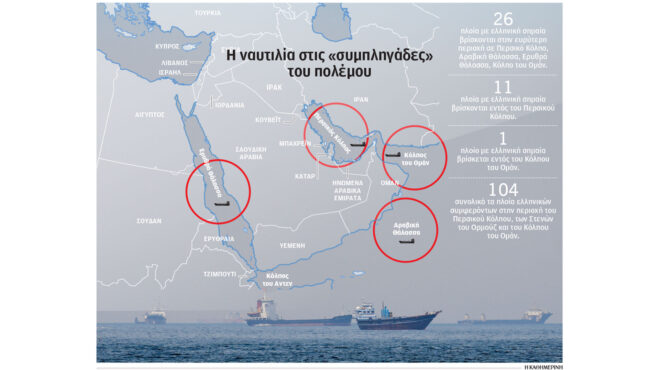
Energy importing countries are also moving rapidly to reduce their dependence on the Persian Gulf: either buying more fuel from the US, or planning to restart nuclear power stations. These trends, according to experts, are likely to be consolidated.
They may give an advantage to oil and natural gas producers who are not dependent on maritime straits and accelerate the transition from fossil fuels.
However, restructuring energy routes, with a view to resilience and not efficiency, will be costly. These investments will take time and will likely lead to higher prices for consumers, Spencer Dale, a former BP chief economist, said.
«The world is now more uncertain, more vulnerable than before», Dale, visiting professor at London School of Economics and Political Science, reported. The logical reaction, he said, is to strengthen the resilience of the energy system against geopolitical turbulence. «But that's expensive.».
Source: NYT

