
The average nationwide price of unleaded 95 had reached Sunday, September 13 at EUR 2,149 per litre, while the drive diesel at 2,108 euros. At the same time, today Brent is moving again near 107 bucks a barrel, as new attacks on Saudi energy infrastructure and transport difficulties increase the concerns about the supply.
But oil is only one side of the equation. The other is taxation. In the case of Greece, this is one of the most heavy taxes in Europe.
Where did the big increase start?
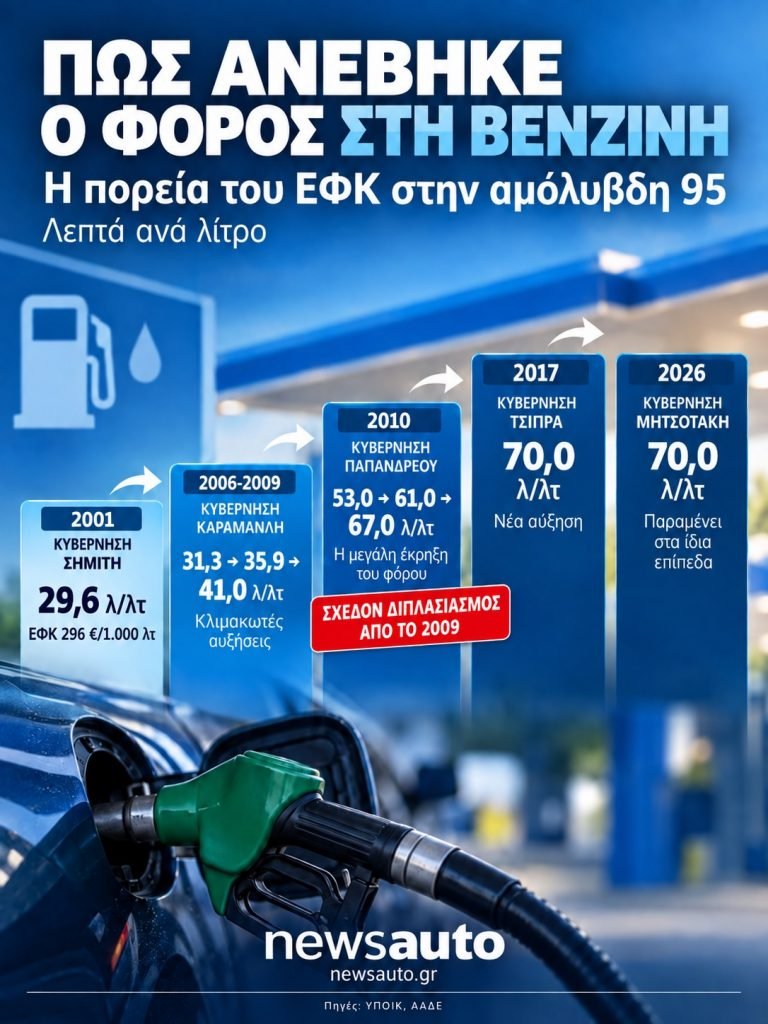
In 2001, under the government Costas Simitis, the Special Consumption Tax in unleaded was in EUR 296 per 1,000 litresThat's 29.6 minutes per litre.
The systematic upward course began essentially in government Kostas Karamanlis. Law No 3483/2006 established a step-by-step increase in the EIC: EUR 313 in 2006, EUR 331 in 2007, EUR 350 in 2008 and 359 euros per 1,000 litres as of 2009The EUR 359 was then the minimum level provided for in European legislation.
But he didn't stop there. In June 2009, again under the Karamanlis government, the unleaded EEK increased by 14.2%, out of 359 to EUR 410 per 1,000 litres. The Bank of Greece itself had recorded this increase between the tax measures taken at the time to strengthen state revenue.
The real tax explosion, however, came the 2010, by George Papandreou government.
On 9 February the EPC rose from 410 to EUR 530In March he went to EUR 610 and early May in EUR 670 per 1,000 litres. Three major increases in less than three months. At the same time VAT increased, initially from 19% to 21% and then from 1 July 2010 to 23%.
Here we need an important clarification on the phrase that is often heard that «gas tax doubled overnight».
It does not emerge from the official evidence that the retail price of petrol or the EPK literally doubled overnight. What happened was almost as impressive, but in successive waves: the EPC from EUR 359 in January 2009 reached EUR 670 in May 2010, increase almost 87%.
If the VAT applicable is calculated on the EPK itself, the image becomes even more characteristic. The EIC charge plus the VAT corresponding to it was approximately 42.7 minutes per litre in early 2009With EIC 670 euros and VAT 23%, it reached 82.4 minutes per litre in summer 2010. So it's increased about 93% within about a year and a half.
This is essentially the real basis behind the designation «Doubled»The biggest and fastest burden was indeed borne by Papandreou's government, but the upward course had previously begun by Karamanlis government.
The period of memorandums followed and in 2016, by government Alexis Tsipras, normal VAT rose from 23% to 24%As of 1 January 2017 the EEK of the unleaded, from 670 to today, increased again. EUR 700 per 1,000 litres, while the drive diesel was formed at EUR 410.
These factors remain essentially to date. The current government did not increase the nominal gas EEK, but also did not reduce it: the official tax driver of the finance ministry still predicts 700 EUR/1.000 litres in unleaded and 410 euros in diesel, where the minimum European levels are respectively EUR 359 and EUR 330.
Thus, only the 70-minute EIC, when charged with VAT 24%, corresponds to 86.8 minutes per litreThis is before VAT is calculated on the value of fuel itself and other charges.
In the last completely comparable figures of the European Commission, for the week of 7 September, unleaded in Greece cost an average EUR 2,093/litre. Of which about EUR 0,973 was the tax-free price and about EUR 1,120 per litre accounted for total taxes and charges. That's more than half the amount the driver paid for the pump.
What would we pay for Malta's taxation?
And here comes the comparison with Malta, which currently has the cheapest petrol in the European Union: EUR 1,340 per litre, compared with EUR 2,093 in Greece in the comparable figures of September 7.
The difference in taxation policy is huge. In Greece the EPK of unleaded is EUR 700 per 1,000 litres and VAT 24%.
In Malta the legislation in force provides for an EIC EUR 359 per 1,000 litres in unleaded and EUR 330 in diesel, that is essentially European minimum levels. Normal VAT in Malta is 18%.
What does that mean in practice? If we take the Same exact before tax Greek price of 7 September, i.e. around EUR 0.973/litre, and instead of the Greek EIC of EUR 0.70 and VAT 24% we apply Malta’s tax regime – EUR 0.359 and 18% VAT – the theoretical price of unleaded in Greece falls to around: 1.57 euros a liter!
From EUR 2,093 to approximately EUR 1,572. The difference is over 52 minutes per litre or about 26 euros in a 50 litre filling.
And this is perhaps the most impressive element: with the comparable figures of the same week, Greece with Malta's fuel taxation would be almost at the top of the cheapest EU countries, practically next to Bulgaria of EUR 1,571/litre and behind only Malta of EUR 1,340.
So it takes attention to one wording: It is only with Malta's taxes that we cannot say that Greece would have the cheapest petrol in Europe. But it would be one of the most expensive markets, among the two-three cheapest.
There is also a second secret behind Malta's EUR 1.34. The country's government is not based solely on lower taxation. It has maintained fuel prices essentially «frozen» via State subsidies and hedging system, to limit exposure to sudden changes in international prices. The Maltese Government itself cites these two factors as key reasons why petrol remains at EUR 1.34 and diesel at EUR 1.21. The European Commission estimates that the total budgetary cost of Malta's energy subsidies can reach around 1.4% of GDP in 2026.
And that is probably the essence of the debate today. When Brent goes up, all European countries are under pressure. But how much this international increase will eventually reach the driver is not determined only by the oil market. It is also defined by the choices of each state in taxation.
In Greece, nearly two decades of successive increases have created a permanent «tax multiplier» In the pump. And when the slow rises again over $100, this mechanism becomes even more felt in the driver's pocket.
Follow it. newsauto. gr Google News and learn all the news first
Share it

