
The compulsory withdrawal Old IX is no longer a theoretical debate: the timetable has been set, the objectives are clear and Greece, with the oldest fleet of vehicles throughout the EU, is right at the heart of change.
How did we get here?
The push behind this move didn't come suddenly. The ACEA, i.e. the European Automobile Manufacturers Association, has long been proposing a gradual withdrawal plan by emission category, which the European Union is moving to adopt. At the same time, Parliament adopted by a large majority a new regulation on the full life cycle of vehicles. — from their design to mandatory recycling at the end of their lives. The message is clear: the time of «saravalu» It's getting out of hand.
Important clarification, however, for those immediately concerned: ACEA's timetable is a proposed framework of guidelines and not yet active, universal law at EU level. This does not mean that one must remain inactive — means that the direction is definitive, even if the exact dates allow revisions.
The timetable by category
The gradual withdrawal begins this year, in 2026, with the specification vehicles Euro 1 — cars manufactured 1992 to 1996, without modern filters, with emissions of pollutants currently considered unacceptable. Ford Escort, Opel Astra of '95, Fiat Punto of '93 — This is the generation that gets first into the target. In 2030 they followed Euro 2 (1996-2000), vehicles with improved catalysts but outdated technology — Clio II, Golf Mk3, Corolla of '98. In 2034 comes their turn Euro 3 (2000-2005), featuring typical models such as Ford Focus first generation, Peugeot 206 and BMW E46 — cars that many today consider «reasonable age». In 2039 the withdrawal of Euro 4 (2005-2010) — Golf Mk5, Toyota Prius second generation, Audi A4 — a category corresponding to the largest volume of the Greek fleet today. In 2043 the Euro 5 (2010-2015), with mandatory DPF particle filters, and finally 2050 even Euro 6 (2015 to date) — the cleanest thermal vehicles currently circulating.
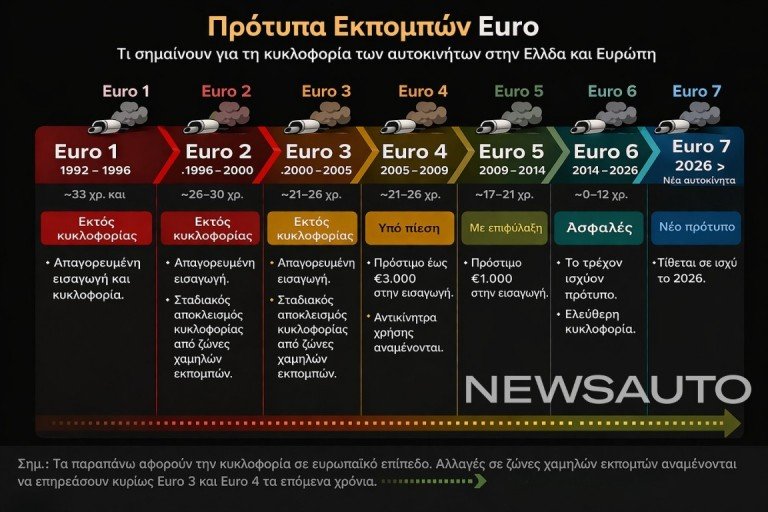
When does a car retire regardless of its category
In addition to the timeframe per Euro, there are criteria that can lead a vehicle to mandatory recycling regardless of its age: if it remains immobilised for a long time and is now considered waste, if it has not passed KTEOs for over two years, if it fails repeatedly in technical controls without being repaired, or if its repair costs exceed its commercial value. Vehicles falling within these categories are officially declared «non-repairable» and no further movement is allowed.
In addition, the new framework provides for a digital platform at EU level to prevent the re-export of such vehicles from other countries — By closing the «back door» used by some to restore retired IX.
Greece on the front line
Our country has the oldest fleet of passenger cars throughout the European Union. The average age of IX on the Greek roads touches 17.3 years, while the corresponding European average varies between 12 to 13 yearsThe 5-year-old scissors capture with numbers a structural problem: decades of underfinancing, economic crisis that prevented fleet renewal and a culture «while it lasts» which has been deeply established in Greek society.
In 2022 more than 5.4 million vehicles had been registered in the country, of which 4.5 million had an average age of over 10. This means that hundreds of thousands of IX are already or will soon join the categories that the new framework is targeting. Each year, according to the Director General of EIA, some 60,000 cars are being recycled in Greece. — a number expected to increase significantly in the coming years.
What if you want to keep your car?
The EU does not close the door to those with an old but functional and sustained vehicle. If the owner can prove that the car is in functional and safe condition — passes KTEO, has no serious structural problems and does not remain abandoned — then withdrawal is not automatically imposed. The framework aims mainly at «ghosts» of the road: undeclared, uninsured, chronic immobilized and technically incompetent IXs who continue to circulate in the shadow of legality.
A change with social impact
The proposal has not been accepted without opposition. Low income layer owners who depend on an old IX as a unique means of transport express reasonable concerns, as not everyone has the ability to buy a new or newer model. Professional engineers and crews express fears of losing jobs. Industry experts point out that the transition cannot be done without brave financial incentives — corresponding scale to those given for electric cars. In addition, manufacturers will bear the cost of collecting and processing old vehicles, while used spare parts from end-of-life vehicles will be declassified by «wastes» and will be considered legal products under strict conditions — a regulation which directly affects the Greek spare parts market.
The message Europe is sending is clear, even if legal implementation tools have not yet been fully finalised: the road to the modernisation of the motor fleet is a one-way street. For the country with the oldest fleet in the EU, this is not just a European cheque. — is a mirror of a reality that has been missing for many years.
Follow it. newsauto. gr Google News and learn all the news first
Share it

