
Many and significant variations in the labour market identifies a new study of recent developments in its core sizes.
In 2025 employment continued to rise while unemployment further declined. This positive development had a bearing on strengthening participation in the workforce and improving most of its key indicators.
The Greek labour market is transforming. The time when the economy was based on a large and stable foreign labour tank retreats
However, as the report states KEPE and John Holezas, behind the overall favourable picture are significant challenges. The course of employment varied between population groups and sectors of economic activity, while education continued to be a key factor in employment prospects.
At the same time, the reduction in foreign labour force and indications of staff shortages in some sectors highlighted issues related to the availability of labour and the effective functioning of the labour market.
The «empty» foreign workers in the labour market
For about twenty years, and specifically until the outbreak of the major economic crisis, the presence and contribution of foreigners to the domestic economy was decisive. In 2008, on the eve of the economic recession, foreigners accounted for 6% of the country's total population, while representing 8.2% of the workforce and employees.
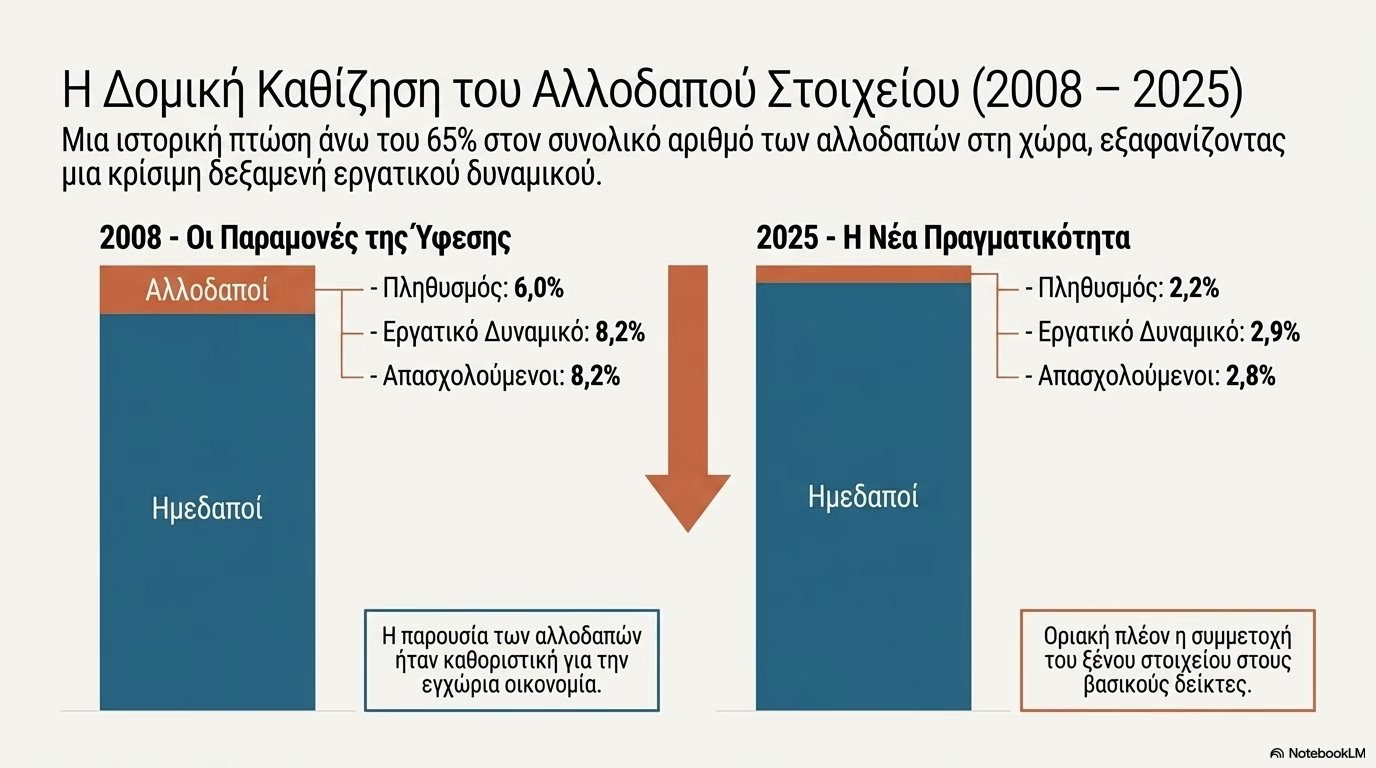
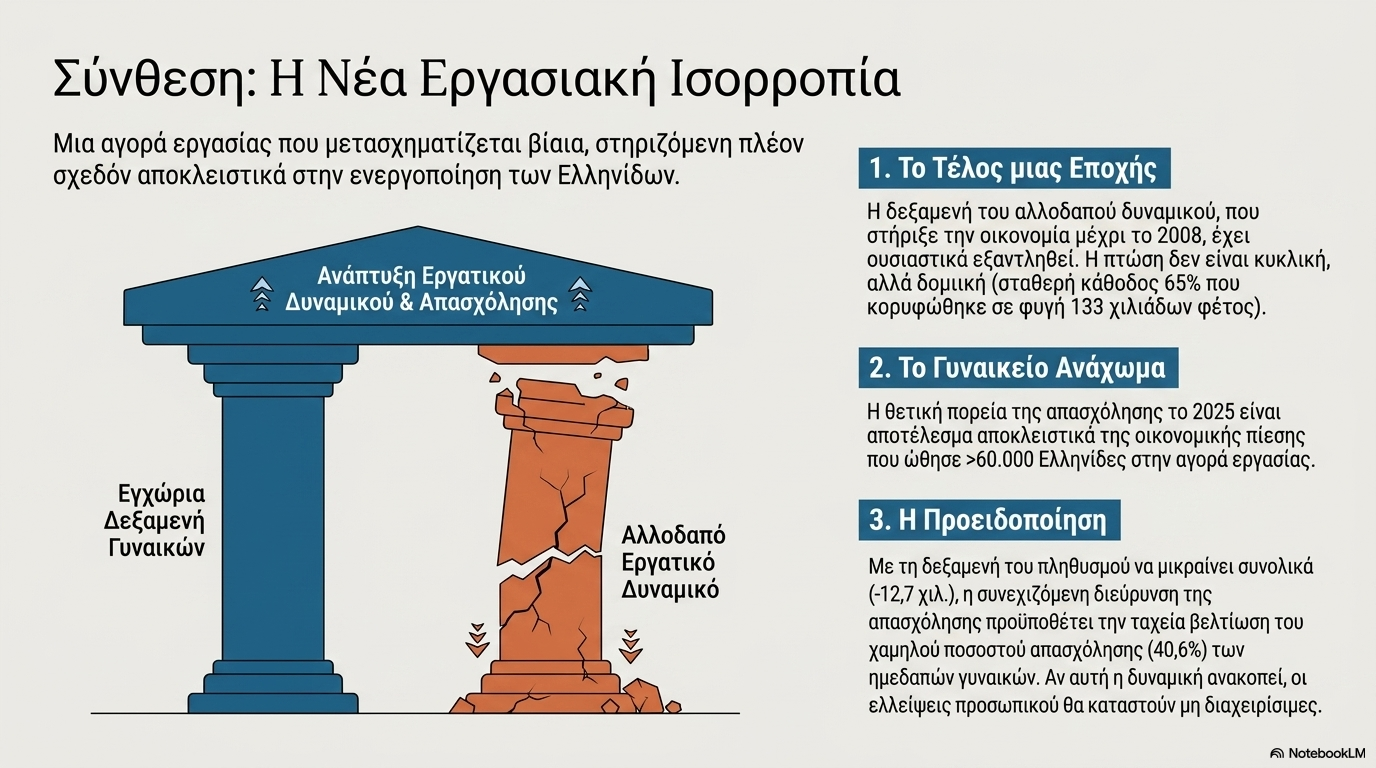
However, this image is now in the past. By 2025, these shares were dramatically reduced to 2.2% for the population, 2.9% for the workforce and 2.8% for the employees, with the total number of foreigners in the country recording a precipitation of more than 65%. This trend took explosive proportions in the last year, in which half of the remaining foreigners seem to have left the country, with the decline reaching 133 thousand people.
The mass flight of foreigners over the past year has not been uniform, but has shown strong gender differences. Population decline was silverier in women, as their number decreased by about 55%. Accordingly, foreign men also experienced a significant but comparatively smaller decrease, which was made to 46.5%.
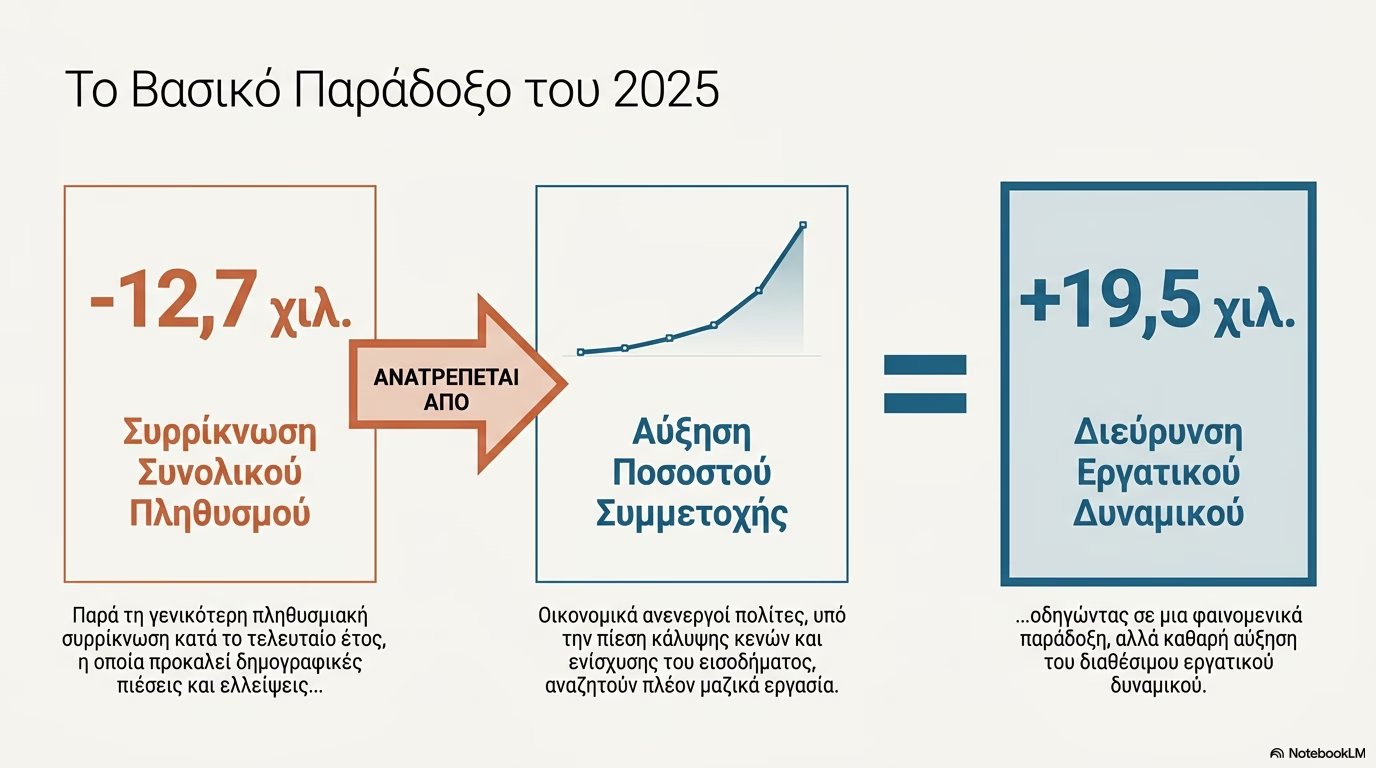
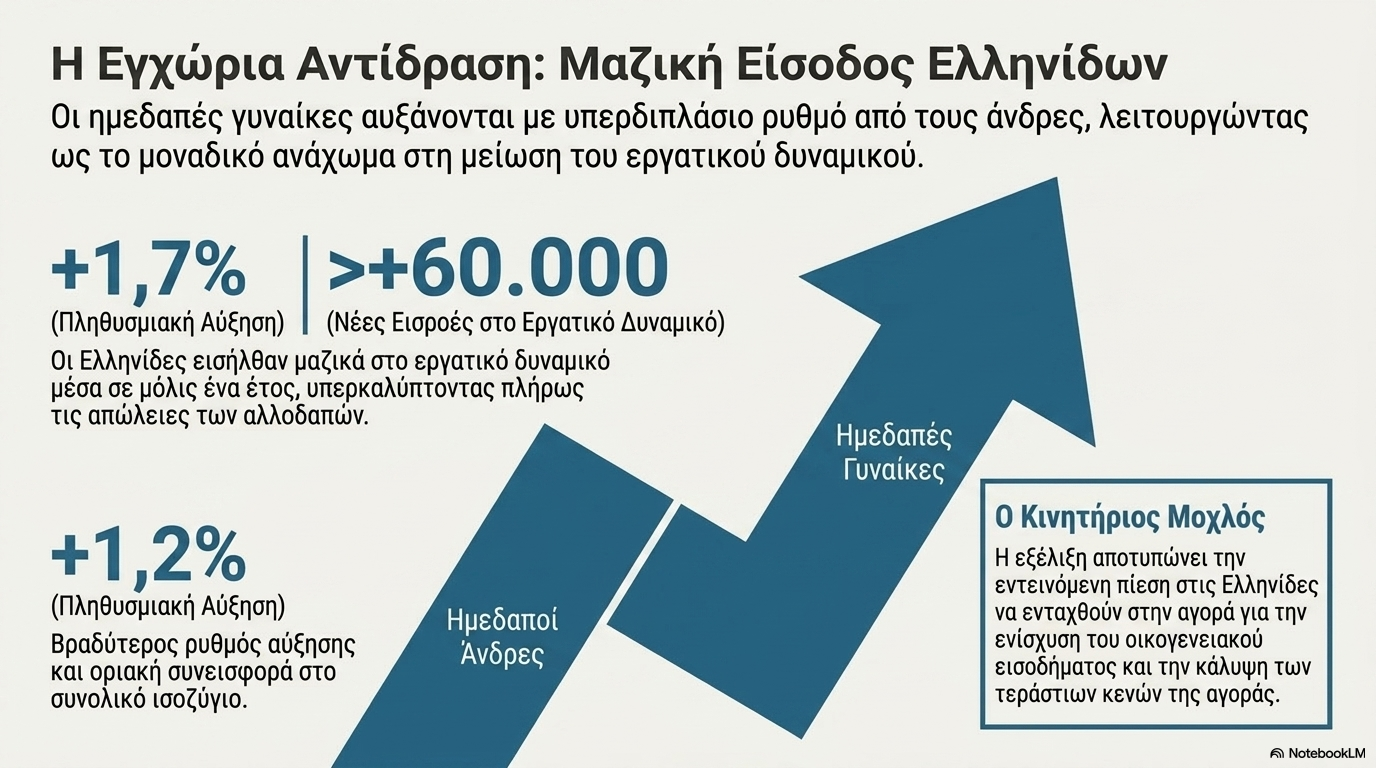
In contrast to this trend, the domestic population moved increasingly. Greek men experienced an increase of 1.2%, although at a slower rate than domestic women, which increased by 1.7%. Nevertheless, the benefits of strengthening the population of domestics proved insufficient to balance the heavy losses of the foreign element. As a result, the country's total population recorded a net decline of 12.7 thousand people in the last year.
The paradox with the workforce
Despite the general population contraction, which causes intense concern due to the recorded labour market shortages and wider demographic pressures, the country's workforce experienced a seemingly paradoxical increase of 19.5 thousand people. Given that the total population tank is declining, the expansion of the workforce can be interpreted solely by increasing the rate of participation of persons in the labour market — that is, more people who previously were financially inactive, are now seeking or finding work.
And in this field, the differences between national and foreign nationals are structural:
- The foreign workforce retreated to 97.5 thousand people, with men making up 58% of this group.
- Unlike general population changes, the decline in foreign labour was equal between men and women, with the difference being only 10 thousand people in favour of men.
- On the contrary, domestic women entered the labour force massively, increasing at more than twice the rate of domestic men and recording a rise of over 60 thousand people in one year.
Participation and employment indicators
This development reflects the increasing pressure on Greek women to actively join the labour market to strengthen family income and cover market gaps. Here, the increase in domestics managed to overcome the decline of foreigners, leading to a positive final sign for the workforce.
Participation in the labour force reflects the willingness to work, but does not necessarily identify with employment. Traditionally, foreigners move to the country for the primary purpose of work, which justifies their steadily higher participation rates. Data for the last quarter of 2025 fully confirms this reality for both sexes:
- Men: Foreign men over the age of 15 participated in the workforce at a rate exceeding 88%, at a time when the corresponding proportion of domestic men approached 60%.
- Women: Foreign women recorded a membership rate similar to that of domestic men (near 60%), while domestic women were in the latter position, with their percentage not exceeding 46%.
Distances are even wider when we look at the employment rate itself, i.e. the share of the working population. During the fourth quarter of 2025 (2025d), domestic men showed an employment rate of 56%, at the time foreign men touched the impressive 84%. This huge scissor, approaching 30 percentage points, reflects deep structural and cultural differences, as well as the pressing living conditions facing both groups. In women, foreign employment rose to 53%, while Greek women were limited to 40.6%.
Changes
Focusing solely on job changes over the past year, it is clear that the recorded total rise was based solely on the domestic tank. Domestic employees increased by 126,6 thousand persons, marking a marginal proportional increase of 3%. On the contrary, foreign employees recorded a vertical drop of 53 thousand persons, a percentage drop that exceeded 37%.
The internal redistribution of these sizes reveals the following:
- Most of the increase in domestic workers came from women's sex, with women earning about 10,000 more jobs than men's growth.
- On the foreign side, the shrinkage was mainly driven by men, as the reduction in employed men was twice as much as that of foreign women.
The first figures for 2026 are encouraging with forecasts for further increase in employment and participation in the workforce. However, the parallel increase in unemployment compared with the previous year's period indicates that developments over the remainder of the year should be monitored with caution.

