
Randstad's new research into staffing trends (HR) and wages in Greece in 2026 reflects a labour market Multi-speed.
First of all, the depth is confirmed. pay gap between small and larger enterprises. From the latest published Detailed Periodic Statements of e-EFKA (June 2025), it appears that the average salary in micro-enterprises, less than 10 persons, is only EUR 854, for full employment. On the other hand, the average full-time salary for enterprises with 10 employees and more, the average full-time salary is EUR 1,440.
In Randstad's research, mainly medium and large enterprises are involved, one of which has a multinational presence. 63% employ from 50 people and over, while 42% have from 100 to over 1,000 people. Organizations employing more than 500 people make up 10% of the sample.
Source: Randstad Greece survey, HR trends and salaries 2026
The range of wages
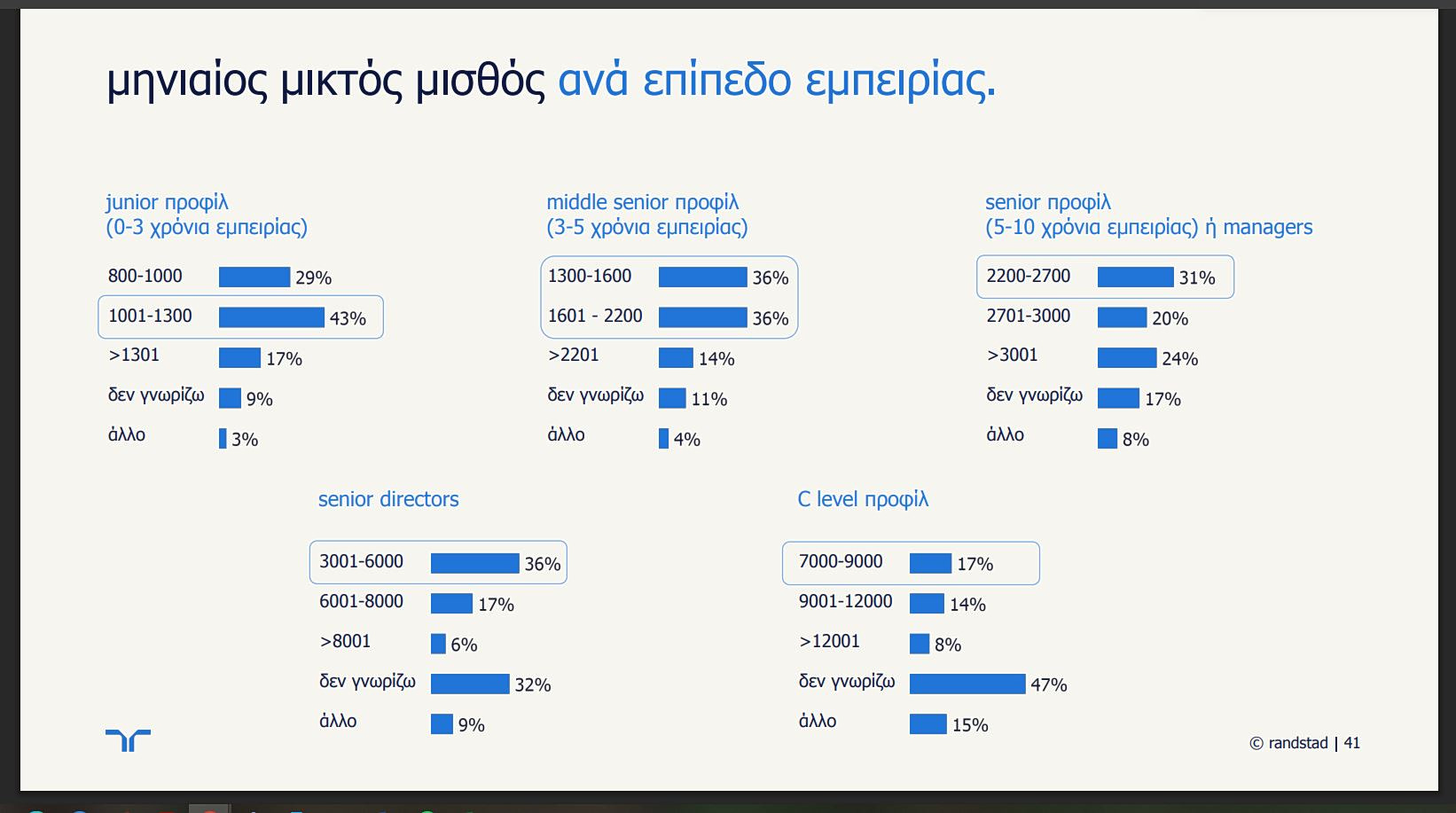
Given the composition of research participants, it is not surprising that the monthly gross salary for a worker with 3-5 years of experience starts from 1,300 euros and above. 36% of those with three to five years of experience are paid from 1,600 to 2,200 euros.
Similarly, for those with 5 to 10 years of experience, the salary starts from 2,200 euros, while one in four is paid over 3,000 euros.
These are wages that are not even seen by small business workers, from 1 to 10 persons, which account for almost 90% of the total. However, as the productive structure of the Greek economy changes, medium and large enterprises have an increasing share in total employment. Now 50% of private sector employees, employed in businesses from 50 people on and on.
Which branches are represented in the investigation
The investigation into HR and wages was conducted through interviews with 861 leading executives from different industries. Of these 19% is active in industry and production, 15 in IT/technology, 15% in wholesale and retail trade and 9% in hospitality and catering services. Economic-insurance sector, construction, pharmaceutical industry and energy-environment make up almost 20% of the sample.
This is an X-ray of its entrepreneurship. «first speed» and not all businesses. The results of research deserve attention, as they show a working and wage picture, significantly better than the national average. The question is whether small and medium-sized enterprises can reach similar levels or whether they are doomed to wither or be absorbed by competition.
The main challenges for businesses of 2026
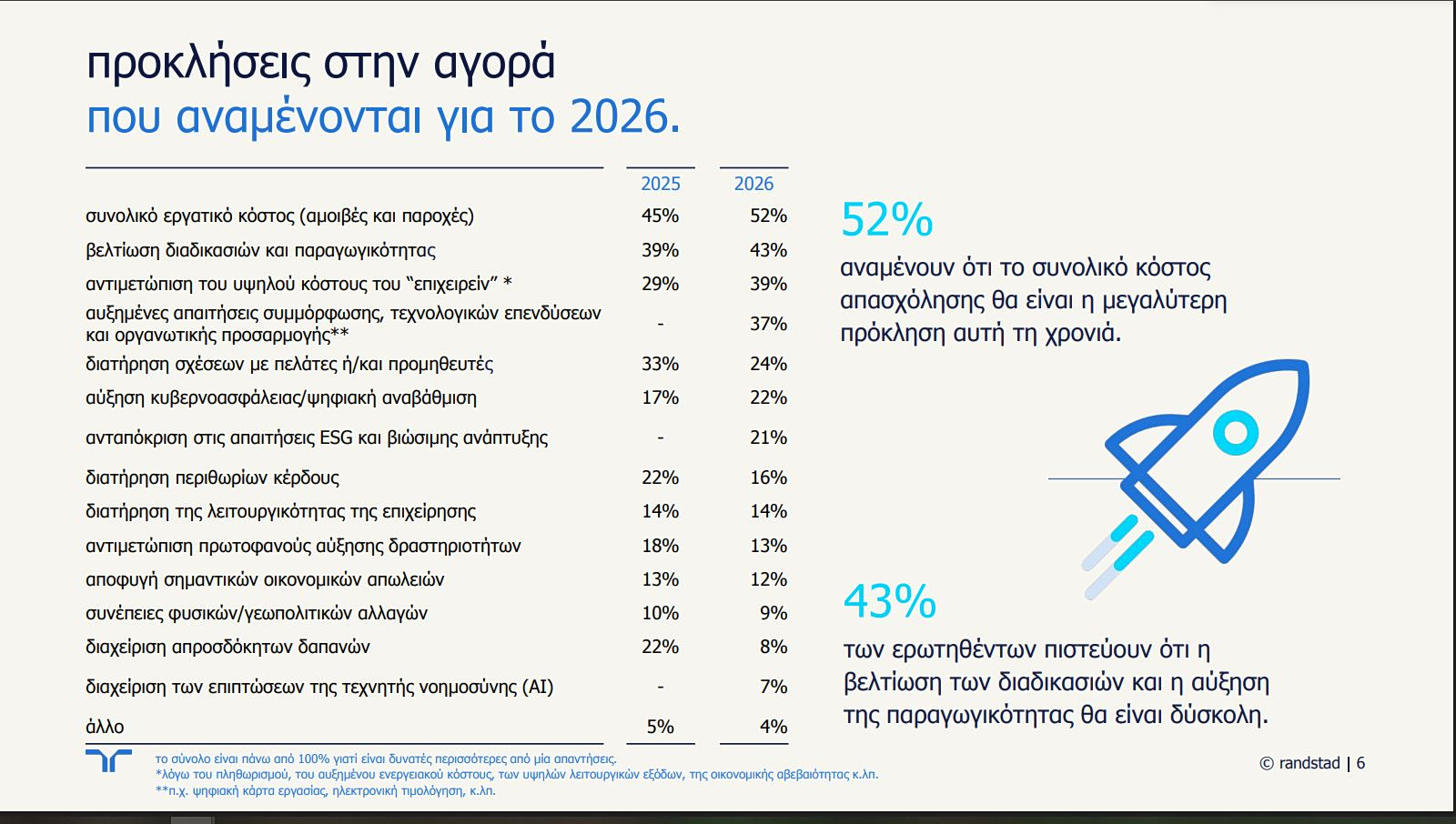
Consistent optimism is expressed by the majority of middle and large business executives for 2026, with 64% expecting a sales volume increase. However, positive expectations are clearly more limited than in 2025, in terms of growth rate.
For one in two enterprises (52%), total employment costs are the most important challenge to face this year.
For 43%, the main objective is to ensure the productivity and effectiveness of internal procedures.
According to researchers, these figures reflect the need for businesses to balance between growth and profitability, seeking new ways of enhancing productivity without, however, a disproportionate increase in their operating costs.
The most sought-after jobs
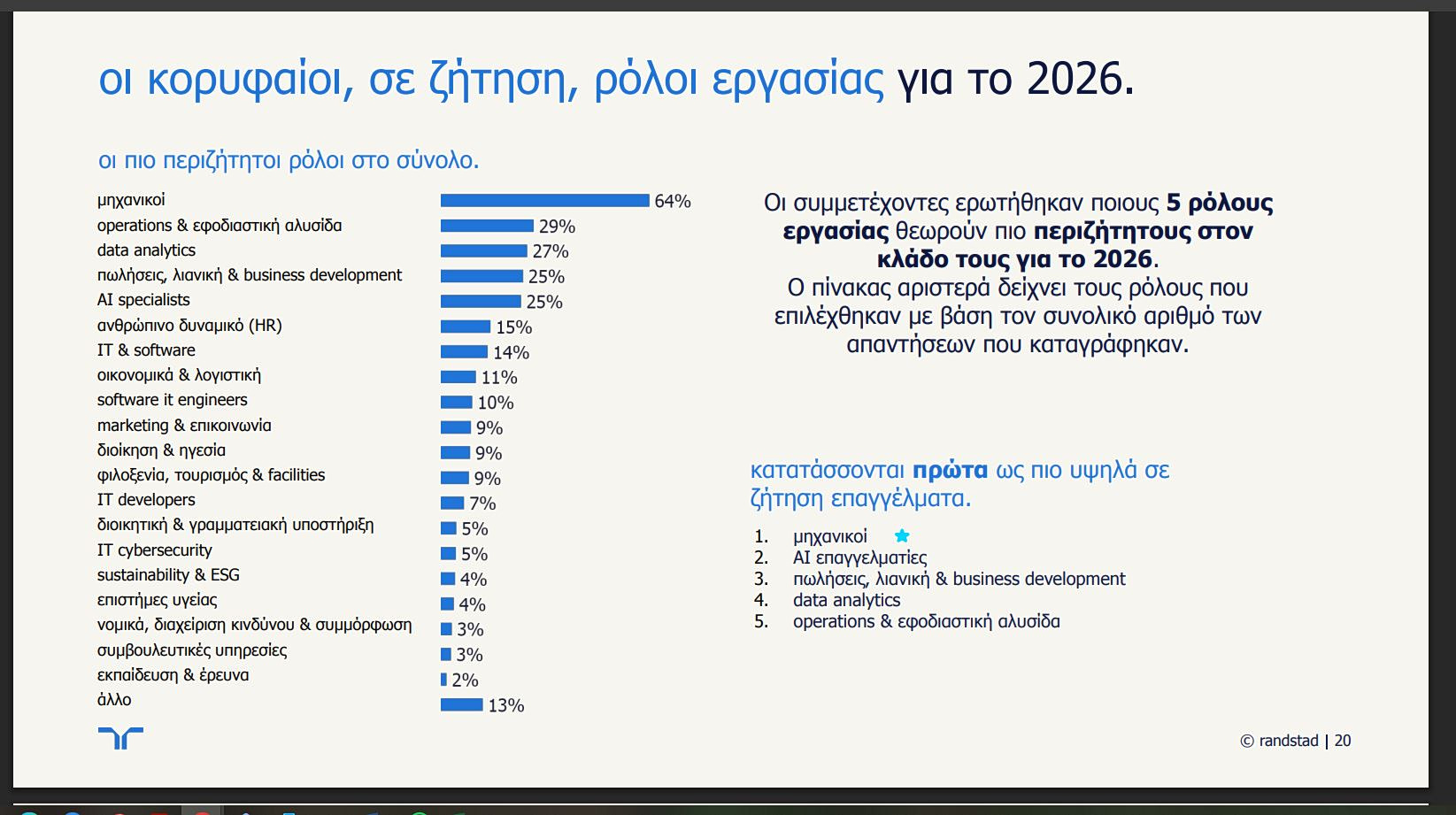
Participants were asked what 5 working roles they consider most sought after in their industry for 2026.
The most sought-after job role is engineers, bringing together 64% of the responses. The following are production management (operations) – supply chain with 29% of responses. Data analysts and AI professionals guarantee their position in the first five, with 27% and 25% of respondents placing them at the top. Sales also collect 25% of the responses.
Labour roles with the lowest demand are research and education with just 2%, advisory services and legal-management of risk and compliance with 3%.
Source: Randstad Greece – HR Trends + Misths 2026
Where will new recruitment be made?
Over one in two companies (54%) plans to increase its number of employees in 2026. 39% will retain the same number, while only 3% plans to make cuts.
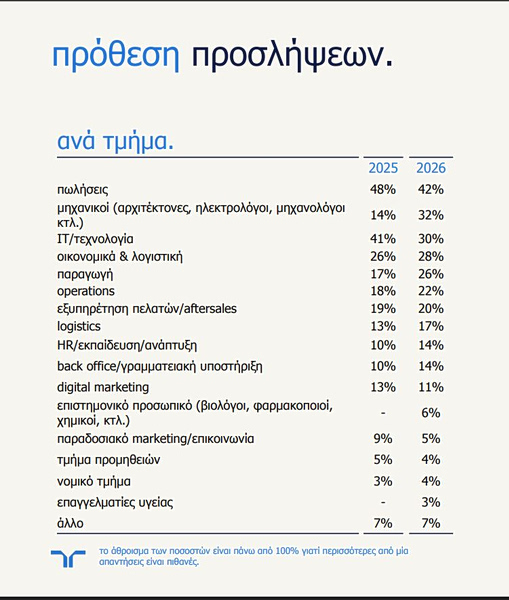
Of those intending to hire within 2026, 42% seek sellers, reduced compared to 2025 (48%). Almost one in three (32%) seeks engineers (architects, electricians and engineers). This is the highest-rise occupation, since only 2025 14% replied that it intended to hire engineers.
30% plans to hire IT-technology professionals, compared to 41% last year.
A strong rise is noted in the production sector, with 26% recruitment intention versus 17% last year.
Difficulties in finding staff
The most demanding occupations (engineers, IT/technology, production) also have the greatest difficulties in finding staff.
Almost 7 out of 10 enterprises (68%) consider it the biggest obstacle in the process of staffing «unrealistic wage expectations»As against 65% in 2025. One in two considers it an important obstacle to the lack of work experience, compared with 40% in 2025. 47% say as a top obstacle that they do not find workers with specific knowledge-training and skills, compared to 43% in 2025.
Another phenomenon that has increased is that candidates accept the job offer, but eventually leave (36% of the replies against 22% last year).

Mobility of workers
The search for better wages and working conditions continues to be the main reason for leaving workers, as 58% leaves after another employer's most attractive proposal. At the same time, 37% chooses to leave looking for better prospects for professional development. Despite sustained mobility, the levels of withdrawals remain in controlled contexts, with 75% of businesses reporting that 2025 were maintained below 16%.
Higher and lower wages
Special interest in job-seekers has been shown in the tables with the lowest and highest wages, by industry and employment. We present some branches indicatively.
In secretarial support the position with the lowest wages is that of the assistant secretariat – back office assistant, starting at 1,250 and reaching 1,500 euros.
The highest starting salary has the position of executive / personal assist, with 2,500 euros, while reaching 3,800 euros.
To customer service the lowest wage starts at 900 euros (data entry agent – digitalization agent). For the same position the maximum of the earnings is 1,300 and 1,200 euros respectively.
The head of customer service has the highest starting salary, with 3,500 euros and reaches 4,500 euros.
In the production industry and engineers, the earnings are comparatively higher. The lowest paid position is that of the line operator – production line manager, with 1,300-1,600 euros. The technical manager gets no less than 5,000 euros and reaches 7,000 euros.
In the energy sector wages start at 1,800 – 2,500 euros (environment engineer) and climb 4,000 to 5,000 euros (technical manager).
Economics and accounting lower wages start from 1,200 to 1,600 euros (assistant accountant, finance clerk) and take off at 6,000 and 10,000 for high-ranking positions.
In hotels-focusing, the lowest wage starts at 1,100 euros for a waiter or receptionist in cities, with islands paying for the same seats as 500 euros above.
The executive chef starts from 4,000-5,000 euros in cities, while on the islands it takes 6,000 to 9,500 euros. These are salaries that seem unrealistic, compared to the collective contract of work signed in the focus and reaching 1,100 euros for the chief cook.
The full investigation, with the profit tables by position-branch HERE

