
In Philadelphia, hundreds of residences participated in a program with white roofs, which dropped the temperature and saved an average of 560 kWh per year for air conditioning.
More than 20 years ago, in Philadelphia USA began an experiment with a simple idea, what would happen if the roofs of the houses Were they painted white?
The programme involved some 340 dwellings, in which they lived mainly low-income elderly peopleIts application took place from 2001 to 2003 and the results showed that the change in the colour of the roof could be limit the heat reaching inside the houses and reduce the use of air conditioning.
The temperature fell below the roof.
The measurements showed that the maximum temperature on the inner side of the roofs decreased by 4 to 5 degrees Fahrenheit, i.e. about 2.2 to 2.8 degrees Celsius. At the same time, in the upper floors without air conditioning, the maximum temperature was reduced by about 2 degrees Fahrenheit, or about 1.1 degrees Celsius. The result was also seen in electricity consumption. The residences involved in the project reduced average consumption for air conditioning approximately 560 kWh per year
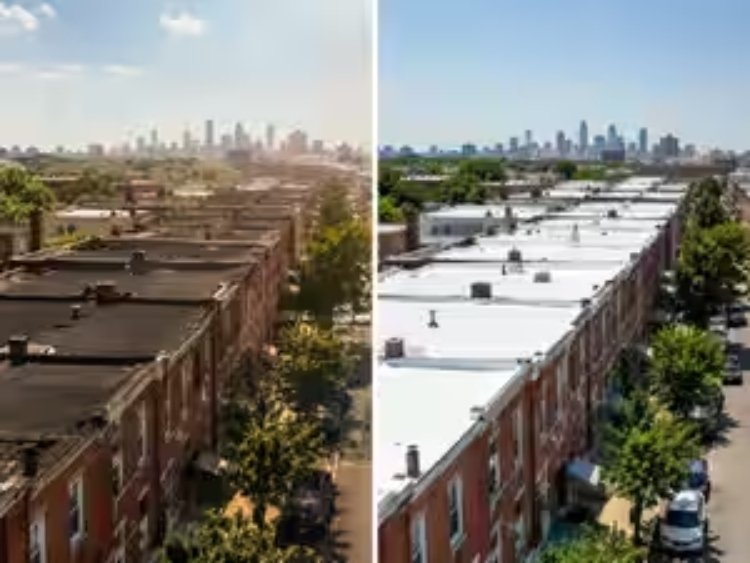 .
For low-income households, This reduction could mean less electricity costs in the warmer months. The explanation lies in the way the different surfaces react to solar radiation. Dark roofs absorb much of the radiation and are heated more, while white surfaces reflect more of the sunlight. So, the roof accumulates less heat and carries a smaller amount to the interior of the building.
The case of Philadelphia She wasn't the only one. In 1995, the Florida Solar Energy Center covered with white reflective coating the roof of a school in Cocoa Beach, Florida. According to the evidence, a reduction in annual electricity consumption was recorded by approximately 13,000 kWhSimilar tests were carried out in California buildings, where lower temperatures were recorded on the roofs and less use of air conditioning systems.
What are the «cold roofs»
The so-called «cold roofs» (cool roofs) are made of or covered with materials reflecting more than a solar radiation; limiting the heat that absorbs the building. Not all need to be completely white, as there are other materials or coatings with high reflectivity that can offer a similar result. Their use may have an effect not only on buildings but also on cities themselves. Dark roofs, along with asphalt and other urban surfaces, contribute to the increase in temperature in the urban environmentThe reduction of heat absorbed by these surfaces may, under the appropriate conditions, also contribute to reducing electricity demand in days with high temperatures.
The effectiveness of reflective roofs are not the same in each area And every building. The dust and deterioration over time they can reduce the reflectivity of materials, while an important role play the local climate and characteristics of each construction. Nevertheless, the 340 white roof experiment in Philadelphia showed that a relatively simple interference on the surface of a building can limit heat which reaches inside and reduces the energy needed to cool it.

