
Rents in Europe have long ceased to move alongside wages. In many cities, housing costs have become the main pressure factor for households, especially for those at the lowest end of the labour market.
Housing and general interest accounts now absorb most of the monthly expenditure in the EU, reaching 23.6% according to Eurostat. But behind this average are much more extreme situations in the major capitals.
Rent is a significant burden for workers with minimum wages, exceeding their monthly earnings in many European capitals.
What capitals are those where rent exceeds the level of gross minimum wage? And what percentage of the minimum wage is absorbed by rent in European capitals?
According to an analysis by the European Trade Union Confederation (ETUC), based on EU data, the average cost of renting a two-bedroom apartment in the capitals of the majority of EU countries exceeds the gross minimum wage.
Only in five EU countries with a minimum wage is the monthly rent lower than the minimum wage. However, as both Eurostat and ETUC data are based on gross wages, the actual burden on workers is likely to be even higher, taking into account net earnings.
The most burdened cities
Minimum wage workers in the Czech capital are most affected. In Prague, the average rent is EUR 1,710, while the minimum wage in the country is EUR 924. This means that an amount corresponding to 185% of the minimum wage is required to cover a two-bedroom apartment.
The minimum wage is not enough in Athens
In Athens, according to the table, the minimum wage is €1.027 while the average rent for an apartment reaches €1.570. This means that rent corresponds to 152.9% of the minimum wage, i.e. it is more expensive than a monthly salary.
In simple terms, a minimum wage worker cannot cover the rent alone, as he would need about a wage and a half to pay it. This shows that the wage and rent relationship in Athens is one of the most pressing in Europe compared to other capitals.
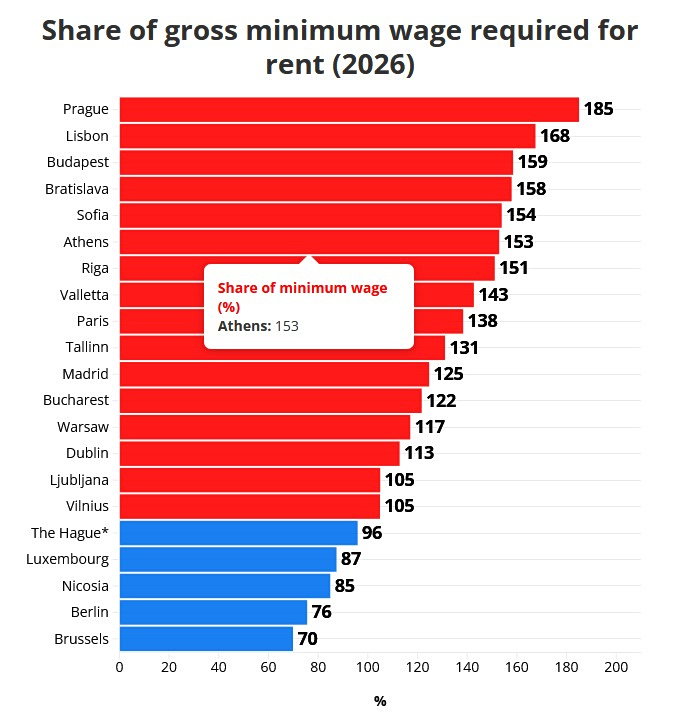
Lisbon ranks second with 168%. In Portugal, the monthly gross minimum wage equivalent (paid in 14 instalments per year) is EUR 1,073, while the average rent in the capital is EUR 1.710.
The percentage of gross minimum wage required to cover the rent also exceeds 150% in Budapest (159%), Bratislava (158%), Sofia (154%) and Riga (151%). This means that minimum wage workers would have to spend their entire salary on rent and need more than half a salary to cover it.
This percentage also exceeds 100%, i.e. even the gross minimum wage is not sufficient to cover rent, in cities such as Valletta (143%), Paris (138%), Tallinn (131%), Madrid (125%), Bucharest (122%), Warsaw (117%), Dublin (113%), Ljubljana (105%) and Vilnius (105%).
For example, in Paris, the average rent for a two-bedroom apartment is 2,523 euros, while the minimum wage in France is 1,823 euros. In Madrid, the corresponding amounts are EUR 1,721 compared to EUR 1,381.
The best capitals for minimum wage workers
On the contrary, Brussels is emerging as the best EU capital for minimum wage workers in terms of the accessibility of rents. Gross minimum wages cover 70% of rent costs there. In Brussels, the average rent for a two-bedroom apartment is 1,476 euros, while the minimum wage is 2,112 euros.
Berlin is in the second best position with 76%. The percentage of gross minimum wage required to cover the rent is 85% in Nicosia, 87% in Luxembourg.
More affordable rents
Compared to capitals, averages at country level show a better picture. In many countries, the gross minimum wage is sufficient to cover the rent.
However, rent continues to absorb significantly more than the average 23.6% of EU households' spending on housing and general interest.
Between a subset of 16 EU countries analysed in this comparison of ETUC, the share of gross minimum wage required to cover the rent ranges from 33% in Poland to 61% in Malta.
In Poland, the gross minimum wage is 1,139 euros, while the average rent is 376 euros. France also presents a better picture, with EUR 1,823 compared to EUR 695.
In Spain, the minimum wage is 1,381 euros, while the average rent is 660 euros.
«Greece can also be a good choice for minimum wage workers except Athens, at 1,027€ against 408€» write the article. However, it should be borne in mind that rents are significantly higher than other countries, while the general cost of living remains at a sufficiently demanding level, which limits the actual disposable income.

