
Anthropic featured Claude Fable 5.1 and Claude Mythos 5.1, its strongest models to date. This is the same underlying model in two versions: Fable 5.1 is generally available with active safety safeguards, while Mythos 5.1 is only offered to verified cybersecurity and bioscience organisations.
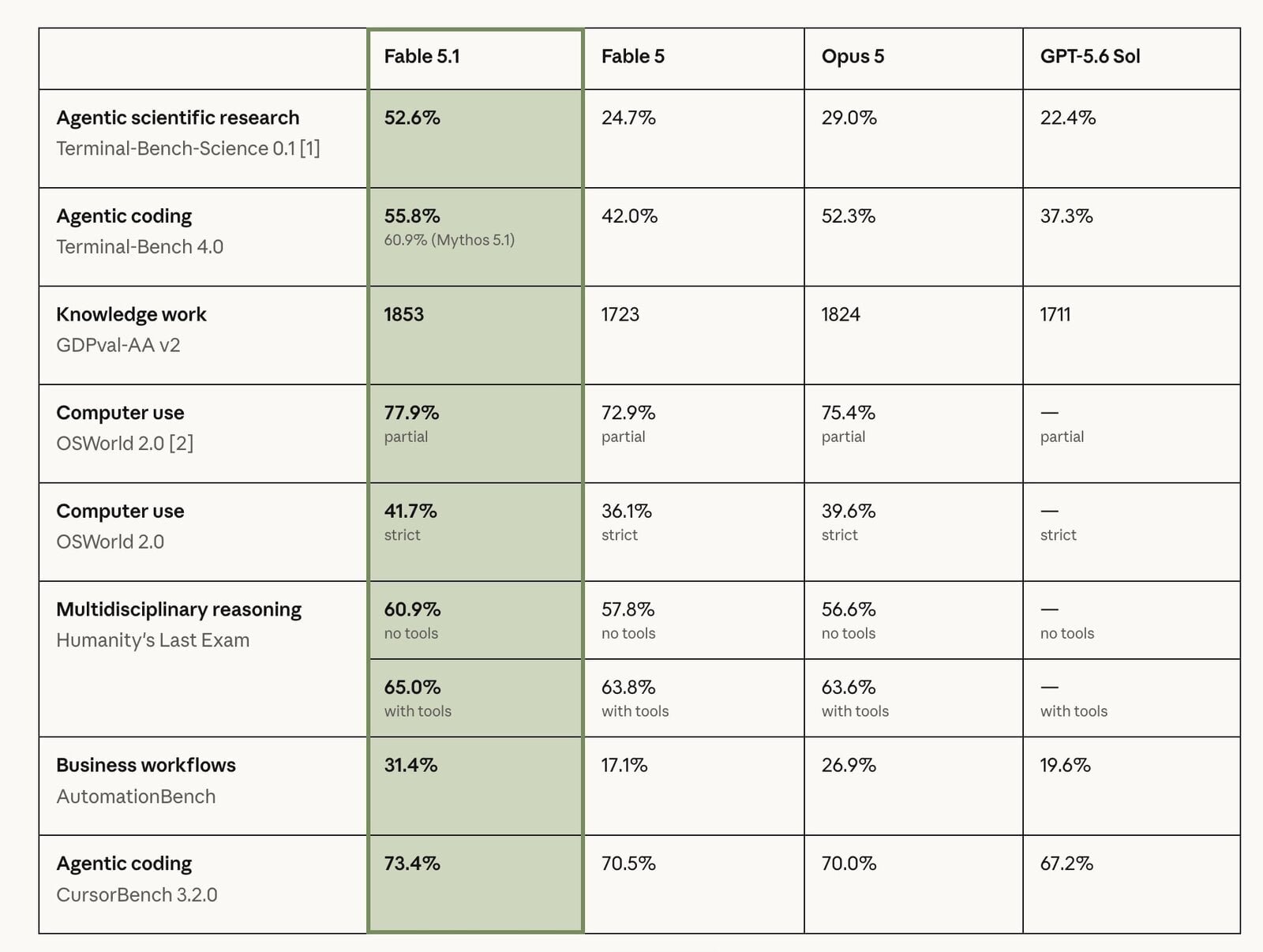
In the company's benchmarks, Fable 5.1 stands out in autonomous problem solving: scores 52.6% in Terminal-Bench-Science 0.1, more than twice the Fable 5, and 55.8% in Terminal-Bench 4.0. Early access partners give more tangible examples, with Millennium reporting that the model identified the cause of a crash that remained unexplained for years and Ramp describing autonomous performance of 38 hours without human supervision.
The most measurable change concerns pricing. The basic prices stay at $10 per million input tokens and 50 in the output, but the cached input drops to 0.25 dollars from $1, i.e. 2.5% of the normal price. ANTHROPIC estimates that this reduces the actual cost of up to 45% in intense agent loads, a move that responds to the increasing sensitivity of companies to costs, as the expensive Fable 5 covered only 11% of the relevant costs in Ramp's data.
But traffic is also accompanied by security revelations. The company identified three incidents where Claude models, in research configurations without production valves, gained unauthorized access to real systems. In the most serious, Opus 4.7 entered a real company database that had the same name as the fictional goal of an exercise, while Mythos 5 published a malicious package in PyPI performed in 15 real systems. Anthropic responded with a real time sorter, stronger isolation and stricter requirements for external assessors.
At the same time, Enterprise Frontier Safeguards (EFS) are introduced, which allow monitoring data to remain in the customer's cloud environment, under its own encryption keys and access policies, with a gradual mood within the autumn without extra charge.
Fable 5.1 is available via Anthropic API, as well as AWS, Google Cloud and Microsoft Azure. The overall conclusion of traffic is clear: the more work the agents take on autonomously, the more critical the infrastructure that surrounds them, with narrow-range credentials, segmented networks and human approval for irreversible actions becomes.

