
Loading Text-to-Speech...
Hot August go into Ministry of National Economy and Special Coordination Service The Recovery Fund, to close the last milestones and to be able to submit the 9th and last request for grants and 8th for Loans The Recovery Fund. According to the ministry, this will total 6.7 billion euros.
After five years, the Recovery Fund finally arrives at the end of this year and Greece is saying goodbye to a key source of funding Investment and reforms, totalling EUR 35.95 billion, of which EUR 18.22 billion grants and EUR 17.73 billion loans.
Of these, 24.63 billion euros (12.93 billion grants and 11.70 billion loans) have so far been collected and 11.32 billion euros (EUR 5.3 billion grants and 6 billion loans) remain to be recovered.
The penultimate, 8th grant request, along with the 7th loan request, submitted in May, is expected to be approved in early September, after getting the green light from the Council of Ministers the last revision of the programme (including many other countries) within August. But the revision has already been approved by the Commission The amount of the 7th loan tranche was even increased, compared to the May request, to EUR 3,68 billion (from EUR 765 million). In particular, because four milestones of the 8th loan request had been fulfilled, they were transferred to the 7th request and the amount of the loan tranche increased accordingly. Thus, the funds expected to be formally approved in early September and to reach the state's funds by the end of September will amount to around EUR 4.6 billion, of which EUR 865 million will be grants and EUR 3.68 billion loans.
There will be 6.4 billion euros left for the full absorption of the Greek allocation of the Recovery Fund. The government will submit in the 9th and final request for these 6.7 billion euros (4.4 billion euros of grants and 2.3 billion euros of loans) by the end of September and the disbursement, if all goes well, will normally take place by the end of December.
The last tranche of loans and grants from the Recovery Fund is EUR 6.7 billion, according to the Treasury.
That is why the last request is now working frantically in the Ministry of National Economy, as it is linked, not more or less, to the satisfaction of 123 osmonics, according to data from the competent agency, of which 117 milestones are linked to the grants and six must be fulfilled for the loan side. «The suspense always exists, but we will collect all the funds we owe», ensure appropriate sources of TAA. The most difficult of these, the same sources say, are construction projects, such as the restoration of infrastructure destroyed by the «Daniel», o Northern Crete Road, the building infrastructure for research centres and OAKA.
The same sources highlight the importance of certification of the Pillar Assessment in Greek Development Bank, in mid-July, allowing the bank to absorb EUR 2 billion of loans which will then be channelled to finance small and medium-sized enterprises. In this way the full absorption of the recovery fund's loan strand allocated to Greece was ensured and time was given for its transfer to businesses.
In fact, it is reported that the granting of loans could begin immediately, once the 8th tranche has been disbursed, i.e. since the end of September. Something that will certainly strengthen the government's electoral arsenal.
Moreover, the positive outcome of the Pillar Assessment enables the Greek Development Bank to then manage funds such as those of the new Funds of the European Union, as well as the Structural Funds.
High requirements are considered construction projects such as the restoration of infrastructure destroyed by the «Daniel» And BOAK.
In any case, by closing the Fund, many questions will need to be answered about the effectiveness of the use of its resources. The PASOK, with Paul Gerulano, has criticized the successive revisions, which demonstrated the weaknesses of state and government to complete what it had planned at the beginning and which were based on the famous Pissaride designMr. Geroulanos is talking about «sloppyness in the original plan and inability to implement it».
Economists point out that the key question is whether the programme implemented has had some contribution to changing the production standard and increasing productivity, something that they doubt.
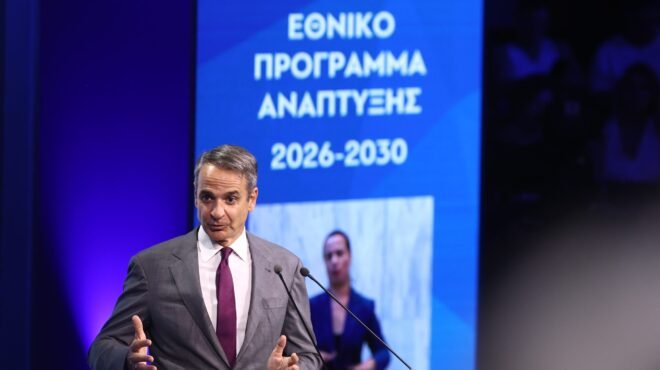
For the country, the big question is how to fill the gap that the Fund will leave in investment activity and its contribution to growth. According to the last Multiannual Financial Programming of the Ministry of National Economy, from 16.7 billion euros in 2026, the 2027 PPS falls to 10.6 billion euros, 2028 to 11.9 billion, 2029 to 13 billion euros and 2030 to 14.2 billion euros.

